Once again, an Audio Space amplifier has found its way onto my workbench. I had already had the opportunity to repair other amplifiers from this brand, particularly some models equipped with EL34 tubes. This time it is an Audio Space Reference 3.1, a rather imposing integrated tube amplifier, both in size and weight, using four 300B tubes in push-pull configuration.
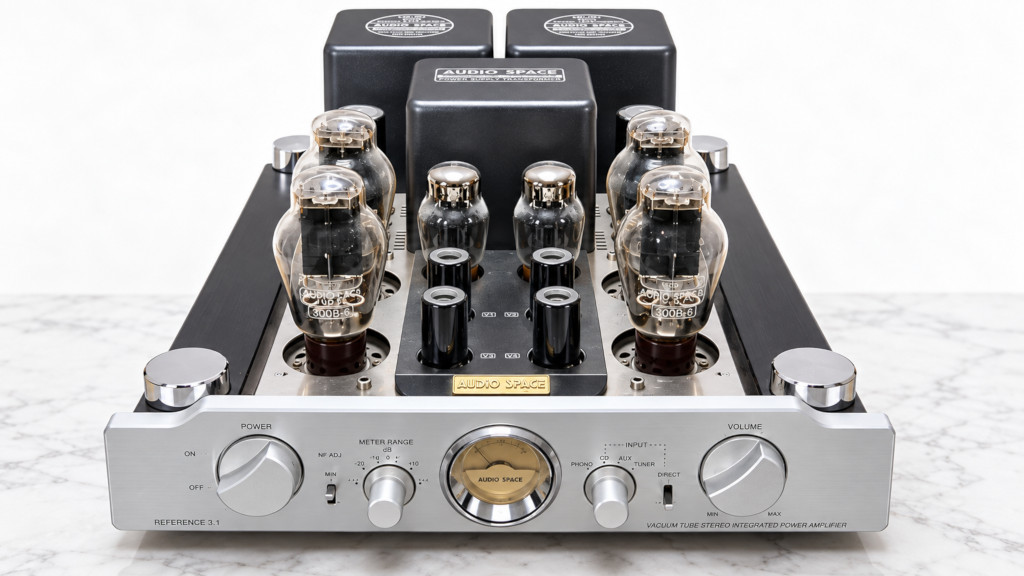
The Reference 3.1 was rated by the manufacturer at 21 watts per channel in Class A (although in reality it operates in Class AB). Its tube complement consists of four 300B output tubes, two 6SN7 (or 6N8P) driver tubes and four 12AX7/ECC83 tubes, two of which are used in the MM phono stage. It also features a Direct input, which bypasses the input selector and volume control (which is actually a passive attenuator), as well as the possibility of selecting between two different levels of negative feedback.
On paper, then, it is certainly an interesting and fairly ambitious amplifier. Unfortunately, as we will see, during the repair I came across a number of design choices that were considerably less refined than its external appearance might suggest.
The amplifier’s problems
The amplifier was brought to me mainly because of two faults. The first concerned the bias adjustment of the four 300B tubes. On one tube in particular, the current was unstable and difficult to adjust, while more generally it was difficult to reach the 50 mA specified by the manufacturer. The second problem was even more annoying during listening: the two channels had different output levels. One channel consistently played slightly quieter than the other, enough to cause a clearly audible shift in the stereo image.
The first thing I did was test all the tubes that had been supplied with the amplifier, measuring them and selecting the best specimens. This allowed me to rule out from the beginning the possibility that the channel imbalance was simply caused by poorly matched tubes. At that point I began looking for the actual problems inside the amplifier.
Unstable bias
The most obvious fault was the unstable current reading on one of the 300B tubes. The Reference 3.1 has a meter on the front panel which, through a selector switch, allows the current of each of the four output tubes to be checked and the individual bias to be adjusted. In this case the problem was not particularly mysterious: there were poor contacts caused by oxidation and dirt both in the tube sockets and in the selector switch used to choose which 300B was displayed on the meter.
I therefore thoroughly cleaned all the tube sockets and switches in the amplifier. After this operation, the readings became stable again and the specific problem of the current apparently changing continuously disappeared. There was, however, another issue still to be addressed.
Why can’t some 300B tubes reach 50 mA?
According to the manufacturer’s instructions, the bias should be adjusted to approximately 50 mA for each 300B tube. During testing, however, I found that with several perfectly healthy tubes it was impossible to reach this value: the adjustment trimmer simply reached the end of its travel before the required current could be obtained. The problem becomes even more evident when the mains voltage is slightly below the nominal 230 volts.
After checking the circuit, it became clear that this was not a problem with the tubes but, in my opinion, the result of a less-than-ideal design of the circuit that generates and adjusts the negative grid bias voltage for the output tubes. The available adjustment range is simply too limited. I did not consider it sensible to modify the amplifier merely to force it to reach the 50 mA specified by the manufacturer. In a situation like this, I would much rather set all four tubes to a slightly lower current, for example 40 mA, provided that their currents are properly balanced.
It should also be considered that the operating point in this amplifier is quite sensitive to variations in mains voltage. Expecting the bias to remain fixed at exactly 50 mA regardless of whether the wall socket is supplying 220, 225, 230 or 235 volts does not make much sense.
The most interesting problem: channel imbalance
Once the bias problem had been solved, there was still the issue of one channel continuing to play slightly louder than the other. Finding the cause of this fault took considerably longer. I checked the resistors along the signal path and their values were substantially correct. I swapped and selected the tubes, but the fault did not follow them. I also checked the signal level at various points in the circuit, gradually reaching the conclusion that the problem was not in the amplification stages.
In the end, the cause of the imbalance turned out to be something much more difficult to correct: the two output transformers do not have exactly the same turns ratio. The difference is small, but sufficient to produce slightly different voltages at the loudspeaker outputs when the same signal is applied to both output stages. In simple terms, it is as if one of the two transformers had a few more or a few fewer turns on its secondary winding than the other. In an amplifier of this level, one would expect the two output transformers to be matched more accurately.
Correcting the imbalance through negative feedback
At this point there were essentially two possibilities: live with the problem or find a way to compensate for it without unnecessarily altering the amplifier. Fortunately, the Reference 3.1 uses global negative feedback, and the NFB network itself provided a simple and minimally invasive way to solve the problem.
I slightly modified the negative feedback network by adding the possibility of fine adjustment through trimmers. This makes it possible to precisely adjust the gain of the two channels on the test bench and compensate for the small difference introduced by the output transformers.
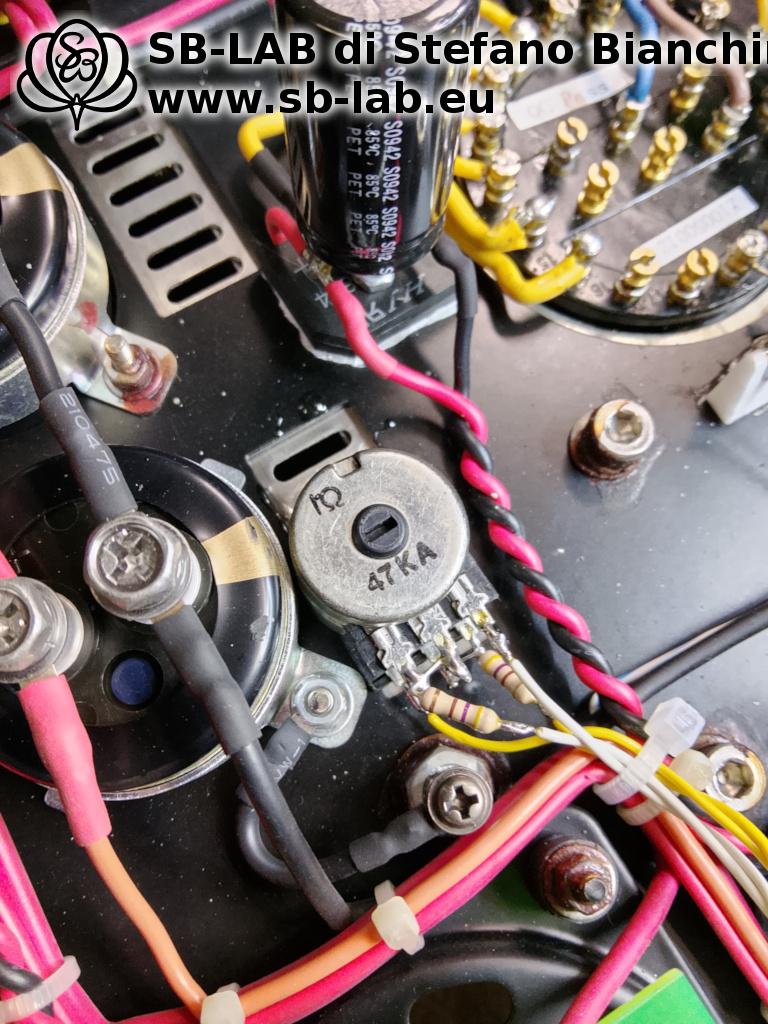
The adjustment is carried out by applying the same signal to both channels and simultaneously measuring their outputs into resistive loads. Once calibrated, the two channels finally produce the same output level. This modification was not made to change the sonic character of the amplifier or increase its performance: it simply compensates for a manufacturing tolerance which, in my opinion, should originally have been addressed by better matching the pair of output transformers.
Bench measurements
Once the repair was completed, I carried out my usual bench measurements. The maximum power I measured was approximately 20 watts per channel, therefore very close to the 21 watts specified by the manufacturer. However, a distinction must be made between the maximum power that can be reached and the power that can actually be used while keeping the signal reasonably clean. The amplifier reaches approximately 16 watts RMS before distortion begins to increase noticeably. Pushing it further, around 20 watts can be reached, but by then the amplifier is progressively entering saturation.
The damping factor I measured was approximately 2.0. Total harmonic distortion at 1 watt was 0.7%. The measurement that left me most puzzled, however, was the frequency response. On the unit I had on my workbench, the upper -1 dB point was already around 10/11 kHz.
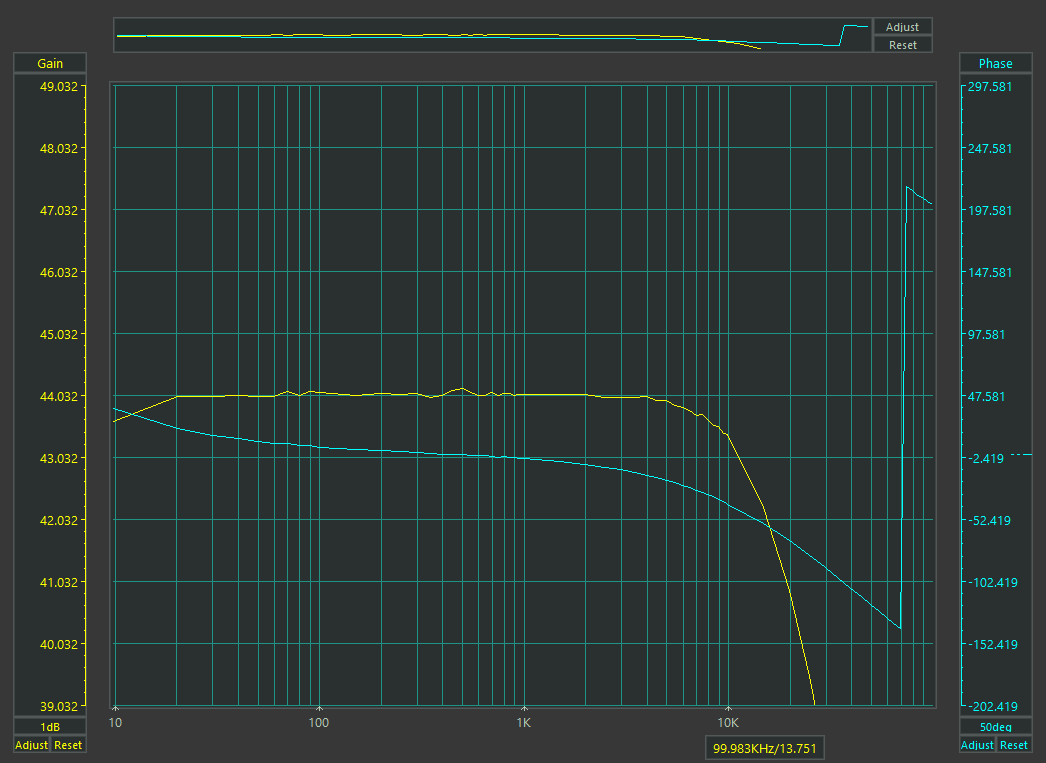
This is a rather modest bandwidth for a Hi-Fi amplifier and, considering the type of amplifier and the market segment in which it was originally positioned, it is probably the least impressive measurement of the entire test.
Conclusions
The Audio Space Reference 3.1 is certainly a fascinating amplifier: four 300B tubes in push-pull, substantial dimensions, an externally very well-finished construction and around 20 watts per channel obtained using one of the most iconic tubes in audio history.
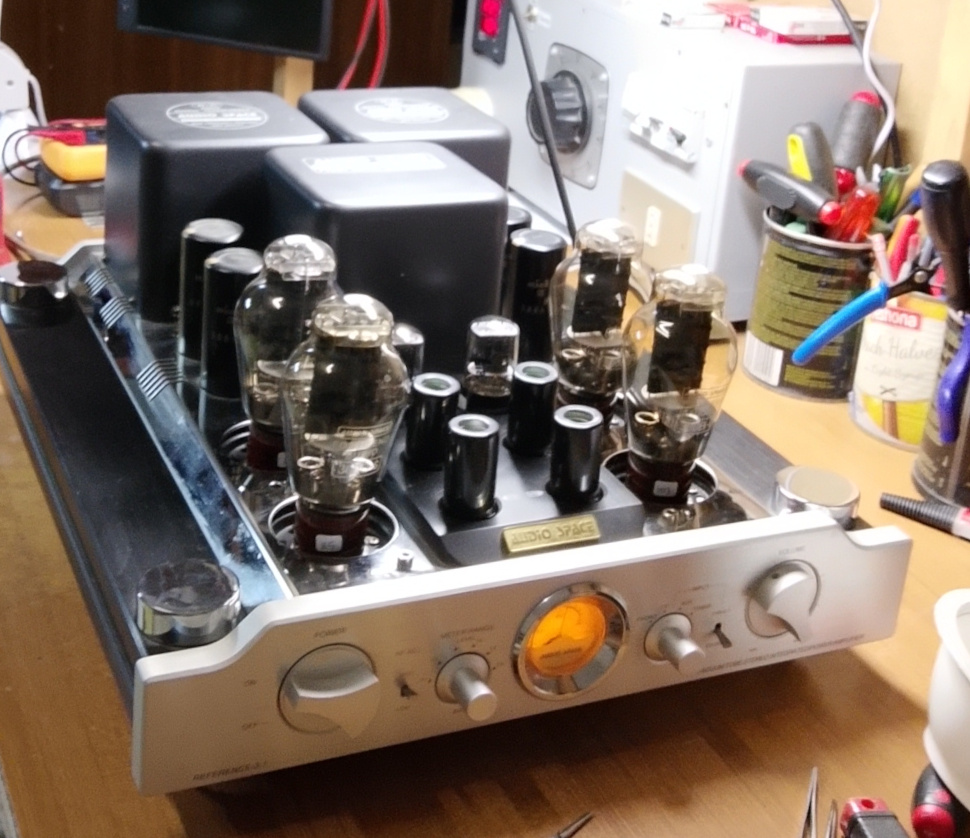
On the test bench, however, my impression was less positive. The contact problems were simply normal maintenance issues and, after many years, finding oxidised tube sockets and switches certainly cannot be considered a design fault.
The situation is different when it comes to the bias adjustment circuit, which provides insufficient adjustment range with some perfectly usable 300B tubes, and especially the difference found between the two output transformers, which was responsible for the permanent imbalance between the channels.
The latter problem was solved by making use of the negative feedback network already present in the amplifier to introduce fine gain adjustment, finally allowing the two channels to be accurately matched.
The measurements also reveal an amplifier with both strengths and weaknesses: the available power is essentially what was promised, with around 16 genuinely clean watts and approximately 20 watts available before more pronounced saturation, but a damping factor of 2.0 and, above all, a frequency response already 1 dB down at around 10/11 kHz are not particularly impressive results.
In the end, the Reference 3.1 returned to proper working order, with stable bias and, most importantly, both channels finally operating at the same level. It remains an impressive-looking and interesting amplifier, but it is also a good example of how elaborate construction and a prestigious tube complement are not necessarily synonymous with equally refined engineering.