If you are looking for audio transformers for vacuum tube amplifiers, custom power transformers, filter chokes, or replacement replicas for vintage equipment, on this page you will find a complete overview of SB-LAB’s work. Every transformer is born from practical experience, real prototypes, and tests carried out directly in the circuit, with particular attention to bandwidth, loss reduction, and correct interaction with the tubes used. From single-ended and push-pull design to the replication of failed transformers, here you will find useful information to understand how to request a component truly suited to your audio project.
 |
All SB-LAB transformers are designed in Italy and manufactured with handcrafted workmanship by specialized personnel. Every model is born from real prototypes tested in-circuit with the tubes for which it was designed, to guarantee reliable performance and concrete results |

Projects for DIY builders and dedicated transformers
In the section dedicated to projects for DIY builders you will find numerous schematics and builds designed for those who want to construct vacuum tube amplifiers and audio equipment. Each project is accompanied by technical information and, when applicable, by the related transformer set specifically designed for that circuit. Browse the complete list of projects and discover the one best suited to your build.

Request Your Custom Quote
To provide you with the most accurate information, I invite you to contact me to request a custom quote. Contact me through the form by indicating the reference project or the characteristics of the transformer you need.
Related articles:
- How an SB-LAB audio transformer is born.
- Dedicated to those who have never listened to a good audio transformer.
Audio transformers for vacuum tube amplifiers
I make audio transformers for vacuum tube amplifiers, designed and tested in real circuits. I focus on manufacturing audio transformers specifically designed for the high-end hi-fi sector. Each of my transformers is first prototyped and tested directly in-circuit with the tubes for which it was designed, and not with instruments that perform unrealistic tests, then hand-wound by experienced personnel using professional winding machines to guarantee maximum precision in the winding process.
For each transformer model I produce, I provide detailed characteristic data, including attenuation values, power, and primary current, together with the measurement test conditions. I have already satisfied hundreds of customers who chose my transformers and confirmed their superiority compared to many other products on the market. If you are looking for a high-quality audio transformer for your hi-fi system, you are in the right place. Choosing my transformers means obtaining a reliable result, based on solid experience in the field and meticulous attention to detail.
In the vast world of theories circulating on the web, you can find both correct information and superstition. The only way to discover what is true and what is false is through an approach based on measurement and testing. It is important to point out that my products have a higher price than many other sellers. This is due to the quality and level of perfection I have tried to achieve. I have dedicated long research, trials, and tests to ensure that my audio transformers meet the highest standards. In addition, the complexity of the windings requires a high level of labor and precision in construction. These factors contribute to the final cost of my products. It is important to underline that many companies offering lower-cost transformers do not carry out the same research, trials, and tests to reach the same levels of quality and perfection, you can read this article about that. I have made conscious choices to ensure that my transformers deliver superior performance and reliability, even if this is reflected in the final price. Ultimately, I believe that the quality and attention to detail I put into my products are what set them apart, offering my customers a high-level audio experience.
I take particular care in reducing leakage inductance and internal capacitances in my transformers. In my output transformers, you will always find resonance frequencies well outside the audible range, even hundreds of kHz in some cases, together with extremely constant primary impedance as the frequency varies. This is a fundamentally important aspect that many winders tend to ignore, but it is essential to avoid intermodulation distortion.
My transformers are built with the right number of sections, neither too many nor too few. I take particular care to position suitable insulation step by step, in order to avoid overlapping turns, internal vibrations, leakage, and other problems associated with poor construction. This is in stark contrast with many winders who claim to be experts in transformer manufacturing, but who simply wind the entire primary directly onto a copper bobbin without using insulation, only to save production time. I also place great importance on the thicknesses inserted between primaries and secondaries in order to reduce capacitances that could affect frequency response. During the design phase, I pay particular attention to minimizing the resistance of the secondaries. This guarantees maximum current delivery and reduces the damping effect. Through these carefully considered construction methods, I strive to offer high-quality audio transformers, avoiding the problems associated with poor construction. My attention to design and the quality of the materials used guarantee optimal performance, with wide frequency response and excellent ability to handle high currents.
If you want an output transformer, contact me, I only need to know the following parameters:
- Single-ended or Push-Pull.
- Anode voltage you wish to use.
- Primary impedance.
- Secondary impedance: I make transformers with 4/6/8 ohm impedance as standard.
- Quiescent current flowing through the transformer primary.
- Power the transformer must deliver to the loudspeaker.
- The type of tube used is essential, because I must consider its internal resistance in the transformer calculation.
- Available finishes: Basic, for hidden installations, completely black with or without covers depending on the size.
- Connection: flying leads, terminals, solder lugs, etc.
I use EI cores made of grain-oriented steel for my transformers. I will carefully calculate the characteristics of your transformer and build it using high-quality materials and the proper techniques to guarantee the best possible results. The prototypes will undergo detailed measurements, and I will provide you with the obtained data together with the test conditions. In addition, when sensible or necessary, I may at my discretion adopt the use of double C cores to meet specific requirements. I am committed to offering audio transformers that meet the highest quality standards. I am ready to customize my products to suit your specific needs and guarantee excellent performance and superior sound quality.
Replacement Transformer Replicas
If you own any kind of amplifier, whether for electric guitar or hi-fi, modern or vintage, with a burned transformer, I am able, in most cases, to replicate the replacement part. However, for this to be possible, the failed transformer must be delivered to me so that I can proceed with turn counting and the precise replication of the part.
I am able to carefully unwind the damaged transformer and create an accurate replica of the part. My goal is to restore the optimal operation of your amplifier, ensuring that the new transformer has the same specifications and characteristics as the original part.
I am ready to assist you in repairing your amplifier and to provide a quality service in transformer replication. Your satisfaction is my priority, and I will do my best to make sure the replacement part is made accurately and works optimally in your amplifier.
Toroidal and Double C “Audio” Cores
The results I achieve using normal laminations are superior to 90% of the products currently available on the market. What truly matters is the final result and not so much the method used to obtain it. I do not wind toroidal transformers because, despite some exaggerated advertising claims, I believe they are not suitable for audio applications. Cores of this type, with high magnetic conductivity, can run into saturation problems and are better suited for power transformers.
As for double C cores, when I have used them, I have not obtained exciting results that I could not also achieve with laminations, at least as far as power transformers are concerned. However, I recognize that their use becomes interesting and useful in the construction of transformers for small signals and small tubes. The same can be said in some situations for ferrites. In practice, I am convinced that every type of core and material has particular characteristics that make it more suitable for certain applications than for others. My choice of materials and cores is based on a careful evaluation of the characteristics required to obtain optimal performance in audio transformers. Read here to learn more.
Power Transformers and Chokes
Custom power transformers: If you provide the transformer design or its characteristic data, I will have it wound perfectly.
To order a power transformer, contact me through this form.
Custom high-voltage power transformers: To provide you with a custom one, you must specify:
- Nominal primary voltage, normally 230V.
- Specify the voltages and currents required on the secondaries, avoiding oversized values.
- Available finishes, also depending on the size of the transformer, for example covers are not available for very small transformers, just as clamps are not available for very large transformers. Basic with mounting frame or clamps. Completely black with or without covers.
- Connection, available as solder terminals or flying leads.
All power transformers have the electrostatic shield / anti-flux turn connected to the grounding wire according to current regulations.
For filter chokes, you must specify:
- Value in Henry
- DC current
- Maximum DC resistance
- Finishes: the same as power transformers.
How to contact me: Through the contact form, click here…
Some builds by DIY constructors
Over the years, many enthusiasts have built amplifiers and projects using SB-LAB transformers. Below are some builds sent by DIY constructors who used my transformers in their projects.
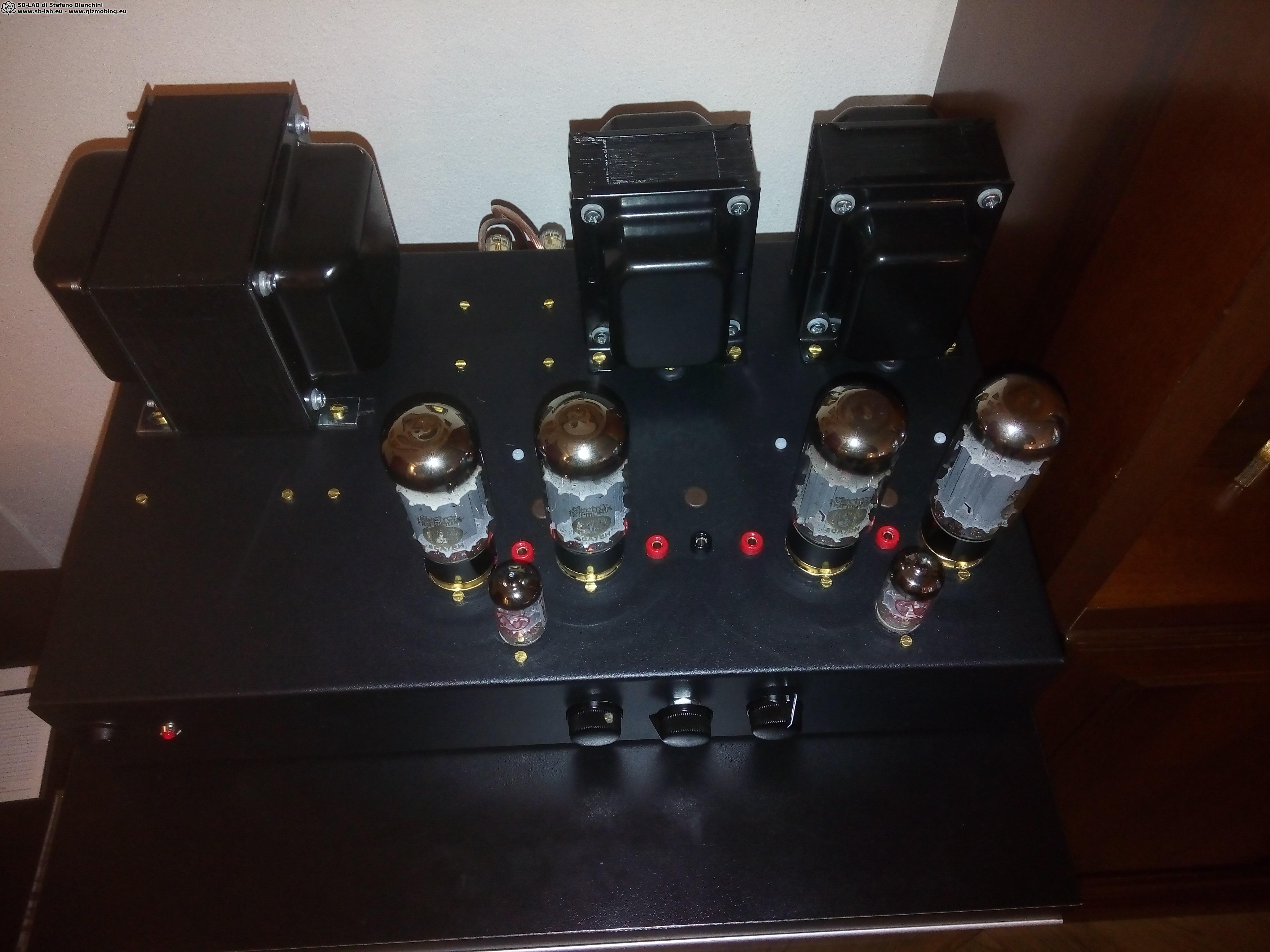
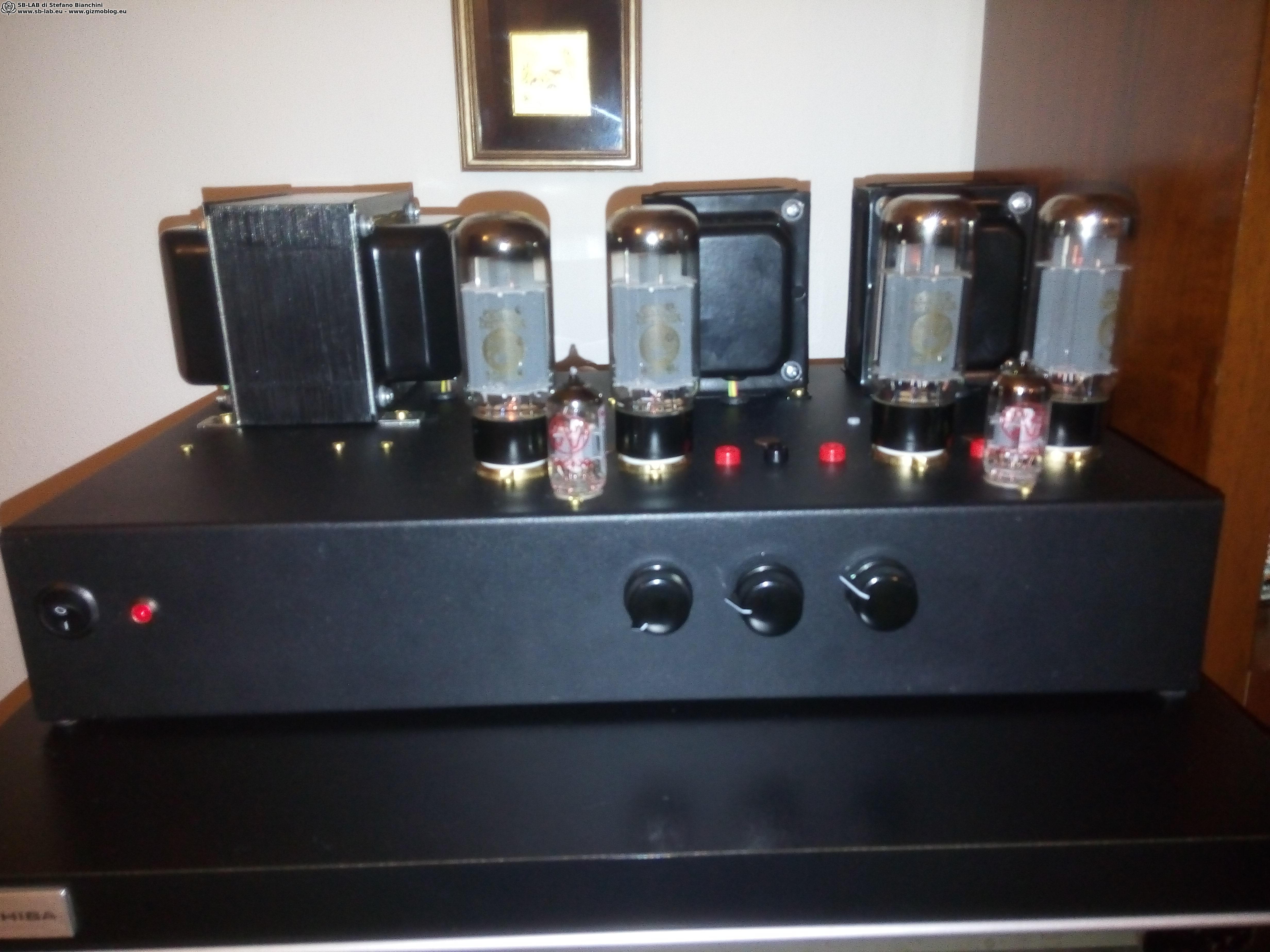
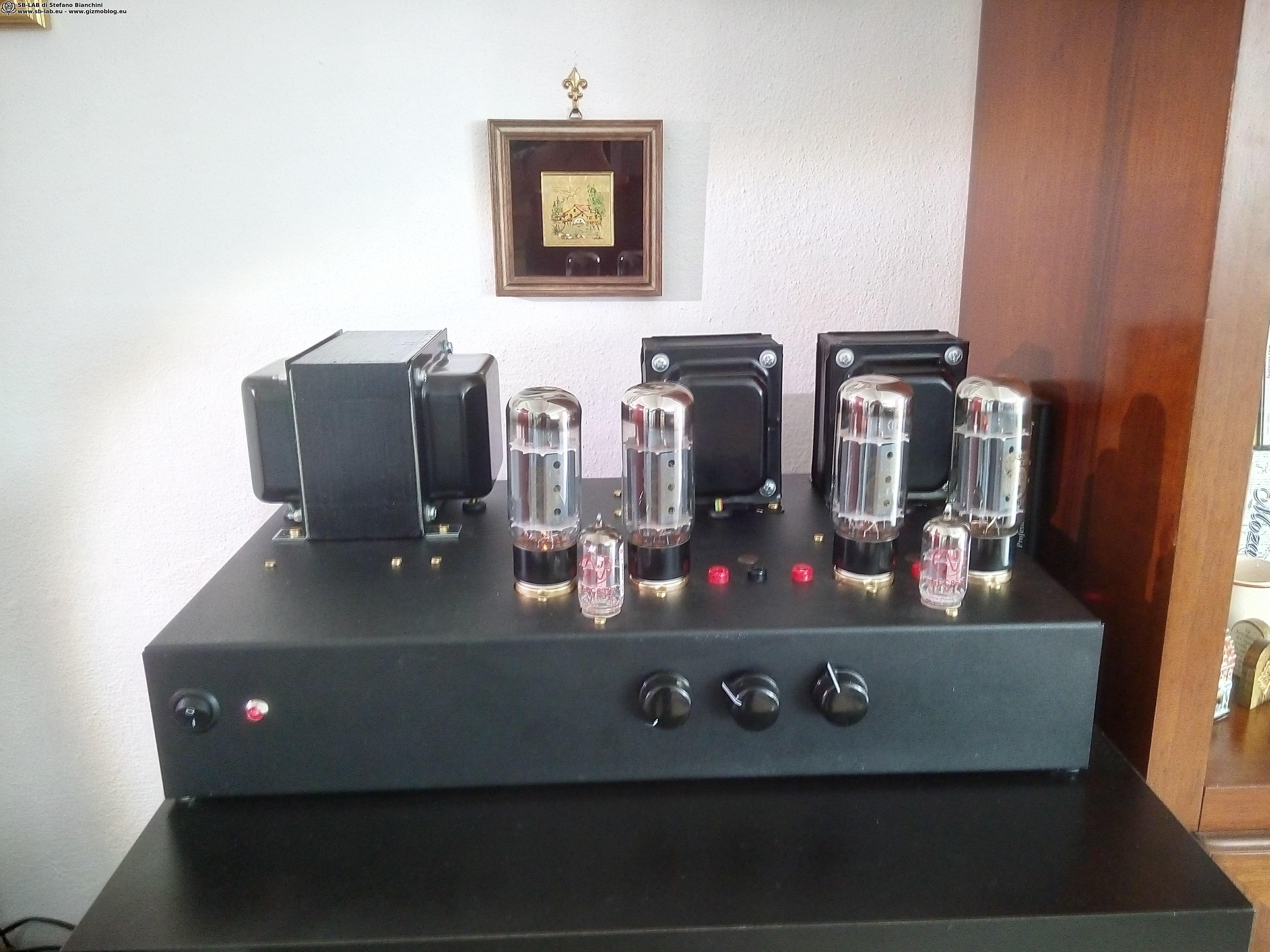
6CA7 amplifier built by Giuseppe
Hello, I have practically reached the end of the undertaking. The amplifier sounds very good, certainly also thanks to the excellent workmanship of the transformers. I used JJ 12AX7 tubes as preamp/splitter and EH 6CA7 as power tubes. I tried various bias settings, I used fixed bias, from 30 to 50mA with Va values from 430 to 450V, with minimal adjustable negative feedback. I did not notice significant differences, even instrumentally, so at the moment I am running it with a conservative bias of 35mA and 440V in class AB. The images include both the prototyping phase and the final assembly.
Best regards
Giuseppe
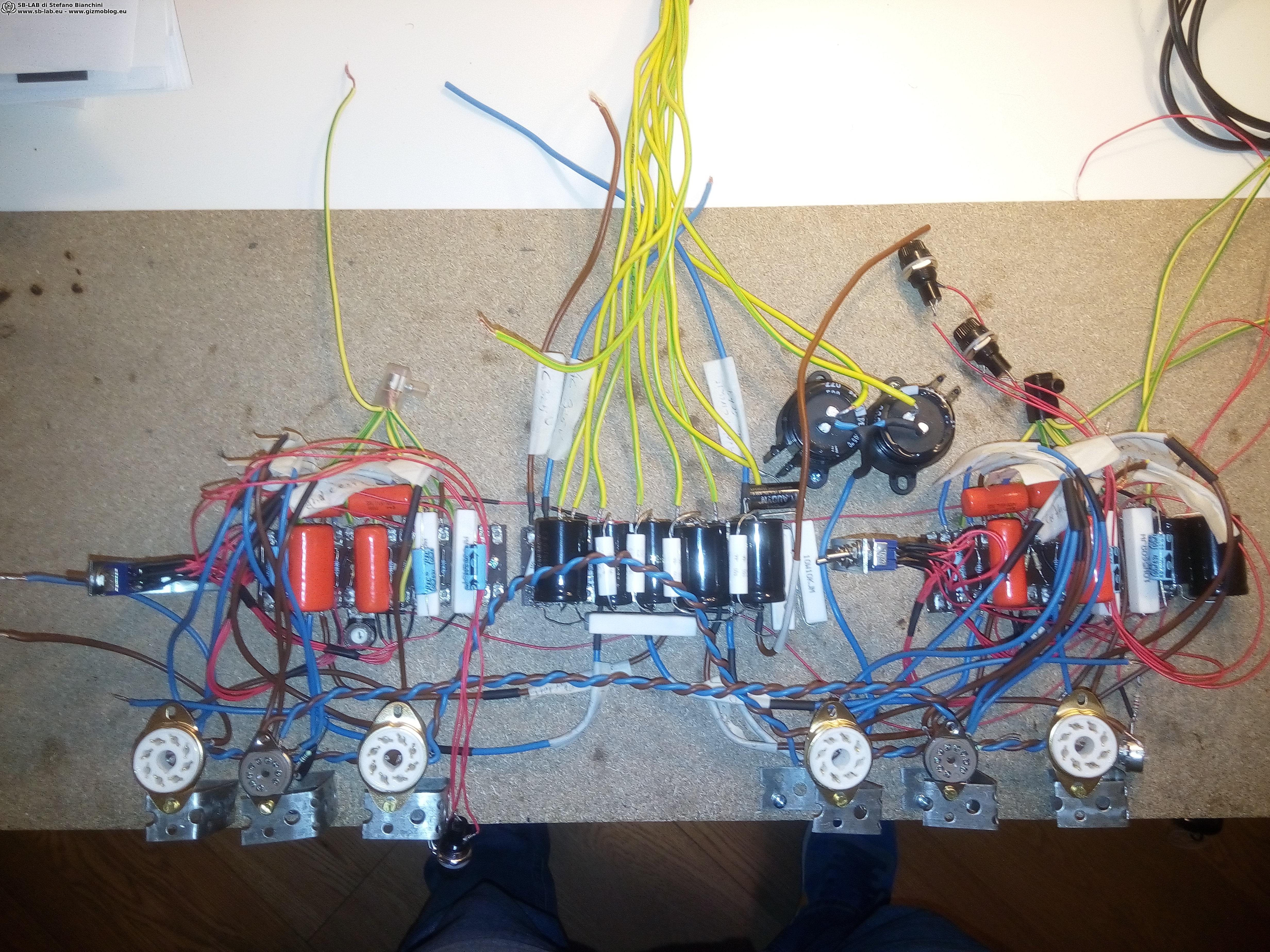
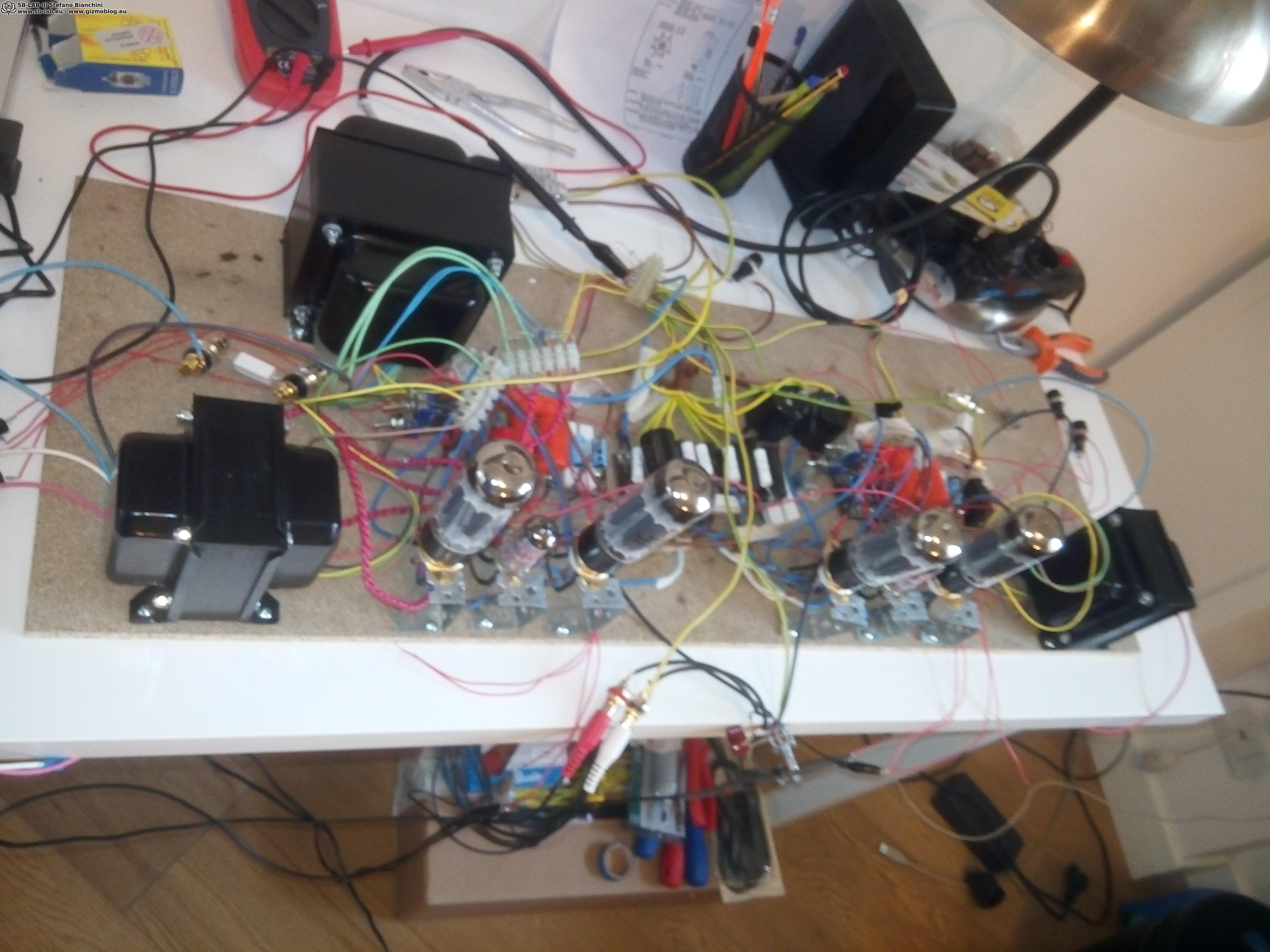
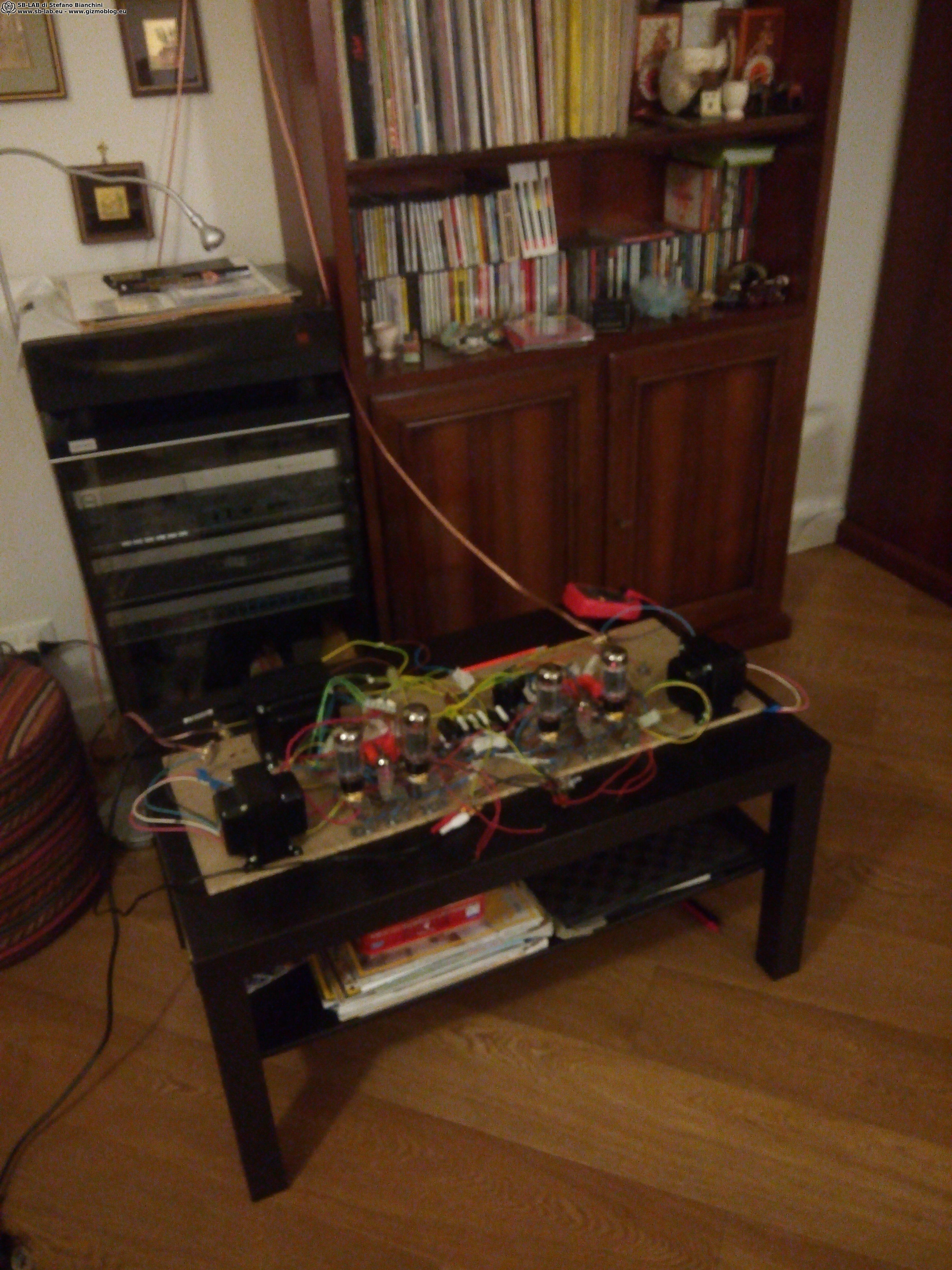
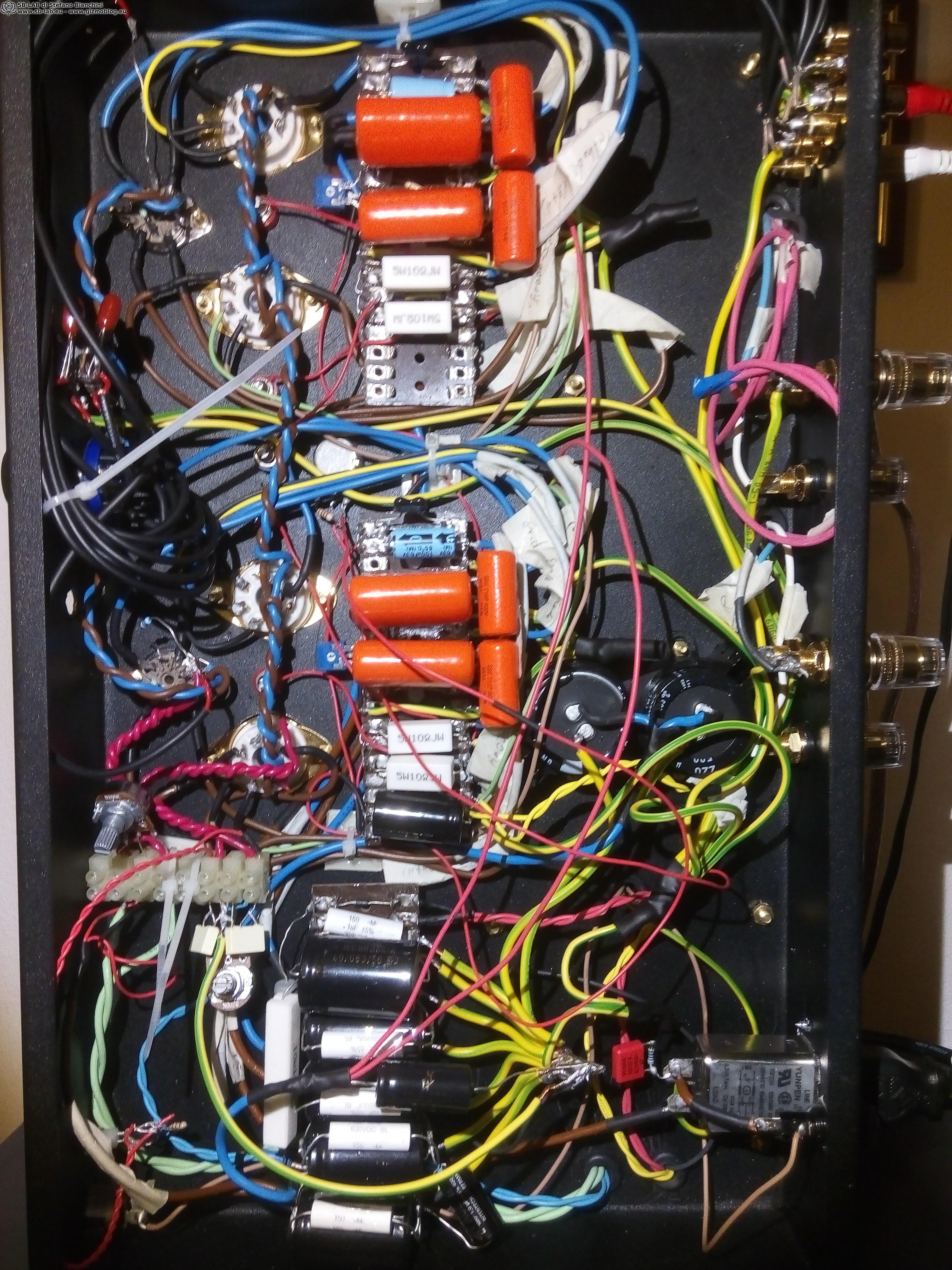
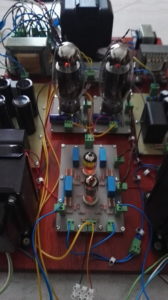
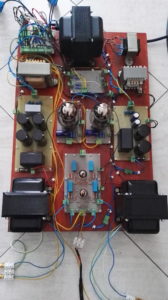
SB-LAB transformers in a KT150 project
Good evening, quite a lot of time has definitely passed, but I had other things to do and therefore I had to postpone the start of the work.
In the end I changed direction completely. Initially it was supposed to be a PSE with two KT66 per channel, but I switched to a single-ended with KT150 tubes. The driver is very simple, with two gain stages in cascade: 6CG7 as input and 6N1P as driver.
At the moment I have only measured the bandwidth at 1 Watt and I would say it goes from about 15 Hz to over 65 kHz. I still need to sort out a few things but an initial listening test gave very good results. The transformer quality is truly very high: it is the first time, after various projects, that I have seen 15 Hz without problems on the oscilloscope.
I am attaching a few photos.
How to correctly size a power transformer
This is a message aimed at DIY enthusiasts who often feel puzzled or do not know how to correctly size the secondaries of the transformers they order. It is understandable that doubts or confusion may arise when searching for information on forums, where many people may have unclear ideas or give unreliable advice.
Example 1: AC filament supply:
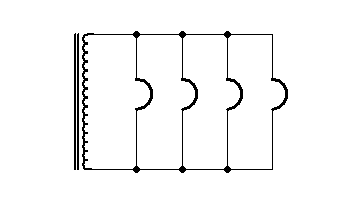
Let us imagine that we need to power four KT88 tubes. According to the KT88 datasheet, the filament of each tube requires a voltage of 6,3V and a current of 1,6A. Since the filaments are connected in parallel, we obtain a total of 6,4A (1,6A x 4). Therefore, a secondary winding of 6,3V capable of delivering 6,4A will be required. It makes no sense to request a 6,5V secondary thinking of compensating for possible voltage drops. Transformer secondaries are already designed to provide the correct nominal voltage when operating at the expected load. Requesting a higher voltage means risking overfeeding the filaments, with a consequent reduction in tube life and the possible appearance of hum in the loudspeakers. With properly executed wiring, using conductors of adequate cross-section and an orderly arrangement of the connections, voltage drops are negligible. Paying attention to these details is essential to obtain stable and reliable operation of the equipment.
Example 2: Sizing the secondary of a DC power supply section:
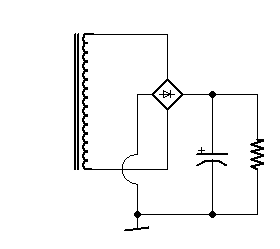
Let us assume that the AC voltage of the secondary must be 100volt and that 200mA flows through the load resistor, we must first calculate the DC power, so we calculate:
100×1,41= 141 volt DC
141×0,2= 28,2 Watt
28,2/100= 0,282, that is 282mA
Simplifying, the AC current is 1,41 times the DC current: 0,200 * 1,41 = 0,282
Therefore, if our circuit draws 200mA of DC current, the transformer secondary will have to provide 282mA of AC current. This calculation is universally valid for correctly sizing secondaries, whether they are connected to diode bridges or vacuum rectifiers. I wrote this short guide because I noticed that many people know the current drawn by their circuit in DC, but do not know how to correctly size the secondaries of power transformers. Sometimes they request in AC the same current that they draw in DC, thus risking overloading the transformer. Other times, without real knowledge of their circuit needs, they request oversized secondaries at random. For example, they may ask for 150mA or 200mA without knowing whether it will actually be sufficient. Even worse, they often request excessively large transformers, increasing costs, size, and weight without any real benefit. It is important to perform the correct calculations and size the transformer according to the actual needs of the circuit, avoiding both overloads and unnecessary oversizing.
To calculate the power supply sections of the equipment you are going to build, you can install this simulation software on your computer. Remember also to update the rectifier list.
Once you have calculated your power supply section with PSU Designer, you must manually calculate the sizing of the secondary, of which you know the AC voltage but not yet the AC current
I kindly ask for precision

I will be glad to satisfy your requests and build the transformers you want. However, if you send me an email with a request such as:
“I would like a transformer with a 230 volt primary and a 300 volt secondary, 100/150 mA”
The first question I will ask you will be: do you want the secondary with a current of 100mA or 150mA? With a current of 100mA, you will get a 30 Watt transformer, while with a current of 150mA, you will have a 45 Watt transformer. This means different dimensions, different power, and different cost. To order a power transformer, contact me through this form.