Scherzo Rework 2.0 Single-Ended Amplifier with ECL82 / PCL82 / 6BM8 Tubes

In response to the growing interest shown by several enthusiasts in “Lo Scherzo” over the past few months, I am excited to present the “Scherzo Rework 2.0” project. This new version, updated in February 2024, was developed to meet the requests of the audiophile community.

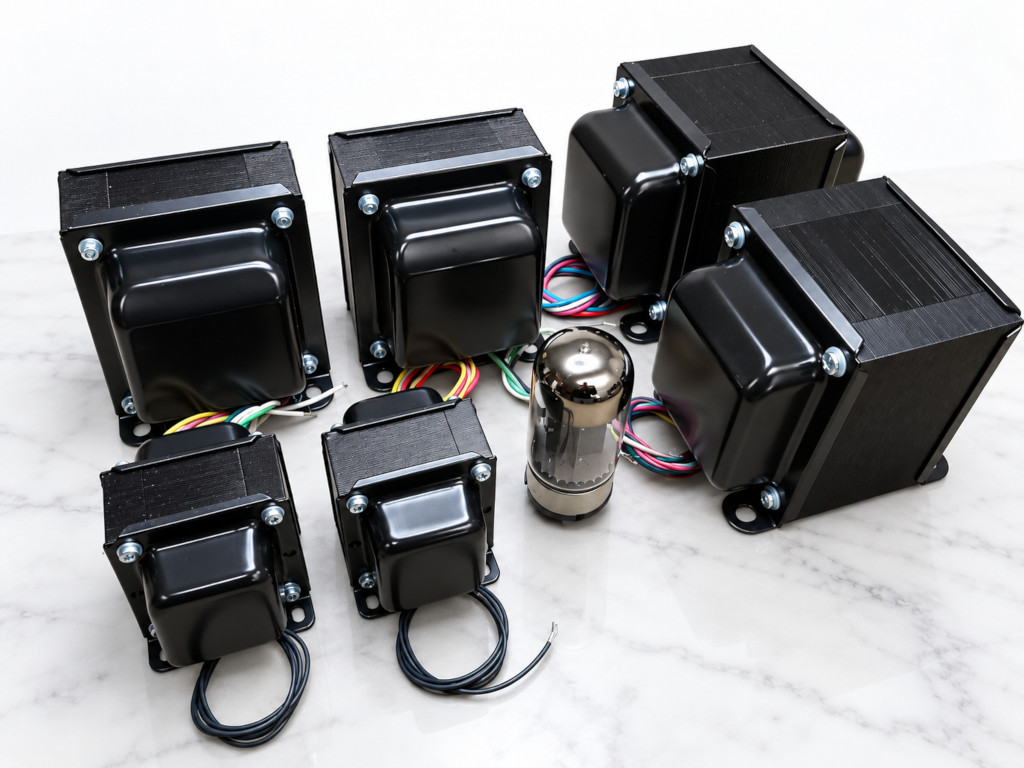
The heart of this new incarnation lies in the revolutionary SE4K5-EL84 output transformers, designed to offer flexibility not only with EL84, but also with ECL82/PCL82. The versatility of these transformers opens up new sonic possibilities, enabling a wide range of tube combinations and delivering an even richer, more customizable audio experience.

The Included Transformer Set

Anyone who purchases the Rework 2.0 kit will receive a complete set of transformers designed and built by SB-LAB, optimized for use with ECL82 / PCL82 / 6BM8 tubes in a single-ended configuration.

The set includes:

  • 2 audio output transformers single-ended with a 5k? primary and 4 / 8 ohm secondaries
  • 1 power transformer, with secondaries for high anode voltage and 6.3V or 13V heaters (compatible with both ECL82 and PCL82)
  • 1 filter choke, designed to ensure a silent and stable power supply, with low ohmic drop and sufficient inductance even at modest currents

All transformers are built with quality laminations and generous sizing, for excellent sonic performance and stable behavior even under the most demanding conditions.

While keeping the educational approach and the simplicity of Luca Chiomenti’s original project, “Scherzo Rework 2.0” provides the schematic and the new output transformers required. Ideal for enthusiasts and DIY builders, this update aims to explore the potential of the new era of “Scherzo Rework 2.0”. We begin by analyzing the original 1996 schematic (click to enlarge), then we will dive into the evolved sonic landscape offered by the SE4K5-EL84 transformers.

On the internet, you can find numerous builds of this project in many variants. Most of these configurations are assembled with the goal of saving money, often using output transformers intended for vintage radios. This approach is understandable, especially among beginners. However, it is important to consider that, with the right care and attention, a circuit like this can reach remarkable sonic levels.

It is common for people to underestimate, incorrectly, the possibility that a project like the Scherzo “Rework”, if built with dedication, can deliver high-level sonic performance. On the contrary, there is the risk that it gets relegated to a marginal role, seen as a simple pastime and, as a result, neglected in real listening due to the perception of lacking sound quality, supposedly worse than even a home intercom.

Differences Between the Original 1996 Lo Scherzo and Lo Scherzo Rework 2.0

Scherzo Rework 2.0 represents a significant step forward compared to the original 1996 design, aiming to improve and optimize several fundamental aspects. One of the first major differences is the removal of the unusual pentode biasing of the ECL82/PCL82 used in the original project. In 2.0, I chose to adopt a biasing exactly in line with the tube manufacturer’s datasheet recommendations. This approach is based on the belief that if the tube designer suggests a specific method, it is probably justified by valid technical reasons.

Unlike the original project, in Lo Scherzo Rework 2.0 there is no provision for triode connection or ultralinear in single-ended. I believe that this practice, which can be explored further, is an option to avoid. In 2.0, the tube runs in pentode mode with the option to enable or disable feedback at will via a switch. This feature provides excellent measured and sonic results in both modes, thanks to the new SE4K5-EL84 transformer.

One of the key innovations in Rework 2.0 is the adoption of a CLC pi-filter power supply, implemented using a model 15S56 choke. This choice contributes to greater filtering efficiency, improving overall audio performance quality.

In addition, I made some minor changes to the values of a few resistors to further optimize circuit operation. These combined improvements make Scherzo Rework 2.0 an advanced choice for audiophiles seeking a superior experience in the world of DIY tube amplifiers.

From Junk to Refinement: The Transformation into Scherzo Rework 2.0

An audiophile enthusiast, browsing the internet, came across an intriguing DIY unit for sale on an unspecified website. The purchase seemed promising until, unfortunately, a cloud of smoke revealed that behind that project there was the work of a skilled ‘cantinaro’. Fortunately, the disappointment opened the door to a unique opportunity.

Determined to change the fate of that unit, the customer decided to entrust his find to the undersigned, a well-known tube amplifier builder. Once it arrived in my hands, the unit revealed its weaknesses: sloppy assembly, low-quality components, and dangerous electrical wiring.

The photo below shows a chaotic tangle of components that looks like it is one step away from a short circuit, suspended on the classic “clothesline” that many junk assemblers adopt in their messy wiring. One could hypothesize that the purpose of this “clothesline” is to use the heat generated by the circuit to dry undershirts and socks when there is no time to listen to music, turning it into a sort of audio multitasking center and laundry station.

I then dove into the project of completely disassembling the unit, freeing it from its original sins. My mission was clear: transform this crude build into an elegant piece of audio engineering. The core of the transformation was the adoption of Scherzo Rework 2.0. This new incarnation introduced substantial improvements, eliminating problematic biasing and adopting a configuration aligned with best practices recommended by the tube manufacturer’s datasheet.

The installed transformers, despite having a larger core than the original 1996 ones, seemed to have been designed with notable effort to faithfully replicate the disappointing results of back then. Configured in triode mode, the circuit humorously delivered a titanic power of 0.39 watt RMS, distorted at that. A truly noteworthy audio feat, although it certainly deserved a transformation in favor of superior sound quality, they did everything they could to make it awful.

The images that follow document the rebirth process of the unit, showing component replacement, the installation of high-quality SE4K5-EL84 output transformers, and the optimization of every detail. The pentode connection and the ability to enable or disable feedback give this amplifier unmatched versatility.

The Truth Behind Transformer Material Costs

People often have the mistaken belief that a less expensive product must necessarily use lower-quality materials than a more expensive one. To refute this idea, I use as an example the disappointing transformers in this “junk” Scherzo, documenting the disassembly and rebuild process through a series of photographs. It is important to emphasize that, to show that material cost is not the only indicator of quality, I chose to wind my SE4K5-EL84 transformers using recycled materials from the existing transformers in this unit.

During this operation, I opened the end bells, removed the original bobbin, wound a new bobbin, and reused the same laminations and end bells from the demolished transformers. Surprisingly, my transformer, despite using 5 millimeters less laminations than the originals, delivers significantly better performance. It is essential to highlight that the time required to wind on the bobbin, whether done well or done poorly, is practically the same.

This demonstration highlights that performance improvement does not depend exclusively on material costs, but rather on the correct execution of the transformer design. A lesson that shows how, sometimes, the real value lies in competence and the craft of construction, not simply in the materials.

The wiring

Let’s now explore the engaging rebirth process of the “junk” amplifier. We begin with the original wooden chassis, shielded with a copper sheet that provides shielding and electrical protection through the earth connection.

We enter the heart of the unit, where the circuit has been expertly wired. Each component is secured with soldered anchors directly on the metal sheet, ensuring a robust and reliable fastening. Here we find no hot glue or clotheslines. This is a journey through the construction of an amplifier that highlights attention to detail and commitment to quality workmanship.

The final result is a Scherzo Rework 2.0 that has regained its audiophile dignity, ready to delight its owner with extraordinary sonic performance. This story shows how even lost causes can find new life, turning into true works of sonic art.

Instrument Measurements: Scherzo Rework 2.0, equipped with the SE4K5-EL84 output transformers, shows a remarkable increase in performance compared to previous versions. Output power now reaches 2.6 watts RMS, with no distortion, compared to the 1.6 clean watts of version 1.0 with the old SE5K6-UNI, and the mere 0.39 distorted watts of the 1996 version. The damping factor increased from 2.22 in version 1.0 to a sturdier 3.1 in version 2.0 with feedback enabled. Damping without feedback is 0.5. It is essential to emphasize that these improvements do not require higher dissipation or current from the tube, but are entirely attributable to the new transformer.

Bandwidth Analysis: When evaluating the frequency response of Scherzo Rework 2.0, it is essential to consider the comparison between the plot with and without negative feedback (NFB). When using a pentode tube connected as a pentode, it is common to notice a less exceptional low-frequency response. This phenomenon is attributable to the tube’s extremely high internal resistance, which would require excessively high primary inductance to obtain deeper bass extension. However, using such high inductance could lead to the risk of transformer saturation, leaving the situation unchanged.

It is important to underline that the limited low-frequency response at zero feedback is a positive aspect, contributing significantly to reducing the characteristic bass muddiness typical of amplifiers without feedback. In this context, the SE4K5-EL84 stands out for its excellent performance, proving its versatility even under these conditions. These approaches, commonly adopted by those who design zero-feedback equipment, are standard strategies to obtain acceptable sound quality even without feedback.

Bandwidth with Feedback Enabled: Thanks to the effective implementation of feedback in Scherzo Rework 2.0, bandwidth is notably wide, extending from 18Hz to 38kHz with a maximum variation of -1dB. This performance helps ensure faithful and detailed frequency reproduction, providing a complete and immersive listening experience. Bandwidth at Zero Feedback: The no-feedback configuration of Scherzo Rework 2.0 offers bandwidth ranging from 30Hz to 32kHz with a maximum variation of -3dB. This choice of presenting bandwidth at -3dB is a small provocation, ironically familiar to those used to hearing about zero feedback without complete specs. Many 300B zero-feedback amplifiers claim bandwidths lower than Scherzo Rework 2.0, even though they often do not specify the dB at all. It is important to emphasize that when you connect the amplifier to real speakers, a compensation effect occurs by ear, with the bass naturally becoming more pronounced without becoming annoying, creating a kind of sonic balance.

THD

Square waves at 100Hz – 1khz – 10khz


Scherzo Rework 1.0: Old Work and Upgrades with the SE5K6-UNI Transformer

In this section, we will delve into the roots of Luca Chiomenti’s “Lo Scherzo” project, a fundamental chapter in the history of audio amplification. However, this journey is not just a nostalgic observation; it is an opportunity to explore how the original project inspired the creation of “Lo Scherzo Rework 1.0” and how this marked a significant step forward in the world of audio.

“Lo Scherzo Rework 1.0” represents a personal commitment to improving the original. By retouching the schematic and using custom output transformers, I tried to bring the project to new sonic heights. The SE5K6-UNI transformer, although declared obsolete in the more recent phases of my creative journey, played a crucial role in shaping the amplifier’s distinctive sound. Throughout this section, I will compare the classic “Lo Scherzo” with my renewed version, highlighting substantial improvements in terms of audio performance. Through a detailed instrumental analysis, we will show how “Lo Scherzo Rework 1.0” is not just a reissue, but a significant leap toward superior audio performance in every respect. Get ready to dive into the evolution of “Lo Scherzo”, from Chiomenti’s inspiration to the innovations introduced with “Lo Scherzo Rework 1.0”.

This Scherzo dates back to 2005 (from a signature under the board)

The unit was working correctly on that occasion, and it was enough for me to acquire the plotted data. Below, I present them in comparison with the plots obtained from the version equipped with SB-LAB transformers.

Original THD @ 0.25Watt RMS: 2.9% SB-LAB THD @ 0.25Watt RMS: 1.99%
(the plot is only zoomed, it does not change the measurement)
Original 100Hz square wave 100Hz square wave – SB-LAB – They look the same…
Original 1khz square wave 1khz square wave SB-LAB – Differences begin to appear…
Original 10khz square wave 10khz square wave SB-LAB – the difference is evident
Original bandwidth: 20Hz -0.4dB / 8khz -1dB SB-LAB bandwidth: 20Hz -0.4dB / 25khz -1dB

Notable differences emerge in the rise time of the two transformers, and consequently in their frequency response, reflecting an appreciable tonal difference. The original transformer has a darker sound, while the SB-LAB one stands out for greater brightness and richer high-frequency detail. This translates into satisfying different musical tastes, as each transformer offers its own unique sonic signature.

The original transformer in this 2005 unit had better bass reproduction capability. While writing the first version of the article, I came across a 1996 build in which the transformer showed lower performance. My only measurement, taken solely for documentation and not for specific interest, was capturing a heavily distorted 20 Hz sine wave.

Therefore, it is plausible that at some point a modification occurred in the transformer design, which should be noted has no brand or clear origin. There is the possibility that the transformer was not of original manufacture, or it could be the result of an alteration. For this reason, we proceed as if I had never carried out this particular measurement, since it was not the subject of an in-depth analysis. Initially, this measurement did not seem of particular interest to me.

As I have already specified, I am not trying to forcefully emphasize the superiority of my products over others. I openly admit when I have had well-made things in my hands. However, it is rare that I am entrusted with things that work well to be fixed. I have nothing against the Scherzo, its creator, or those who made its transformers. I later sold only the 2 output transformers and the choke, as evidenced by the photos you can see below and further down. I never changed the power transformer! This article only aims to make, in some way, a project from many years ago better.

Let’s examine the process of improving an original 1996 Scherzo that was entrusted to me for repairs and upgrades…

Unfortunately, the assembly performed by whoever later sold it on one of the many classifieds sites categorized it as belonging to the “unpresentables” category. If such situations arise, it could be advantageous to buy these examples with the intention of recovering components such as tubes, PCB, the power transformer, and the chassis. However, it is advisable to acquire them at a low price, considering them as faulty goods. It is prudent to avoid plugging them into the mains, even if the seller describes them as working. The definition of “working”, although it should be objective, seems to be interpreted subjectively by many people, as you can see in the following photos.

The circuit faults were quite evident, along with the wonderful solder joints…

I had to clean the PCB of both the old components and the old solder and flux…

Now, let’s focus on the Scherzo output transformers. In the past, my price list included the SE5K6-UNI model, suggested for building the Scherzo. However, to adapt to new needs and improve performance, the SE5K6-UNI has been declared obsolete. To get the most out of your project, I strongly recommend upgrading to the more recent Scherzo Rework 2.0 version. This new iteration incorporates high-performance output transformers, the SE4K5-EL84, which offer advanced characteristics and optimized sound. These transformers are the current and recommended solution for achieving high-quality audio performance in your Scherzo Rework.

The preface of this article contains all the compared measurements. As for the restoration in question, I supplied a pair of brand-new SE5K6-UNI output transformers and rebuilt the circuit using high-quality components.

Unfortunately, capacitors of a certain caliber are bulkier than the originals, forcing me to install some components on the copper side of the PCB. To improve performance, I bypassed the cathode and power supply electrolytics, replacing them with Mundorf and Icel polypropylene capacitors.

The wooden cabinet showed traces of dirt, the painted brass plate was marked by scratches and oxidation, the volume knob was stuck, and the speaker and input connectors, facing each other, were not a pleasing detail.

Nothing that a bit of elbow grease and some paint cannot fix…

After that, I put every element back in its place, making sure to arrange everything neatly and neatly.

I configured the power stages with a fixed triode connection that cannot be changed, obtaining a power of 1.6 watts. Note that the ultralinear connection is neither contemplated nor possible, because the output transformer does not have the tap, for good reason.

The measurements:
Power: 1.6 Watt RMS per channel
THD @ 0.25Watt: 1.9%
Damping DF: 2.22
Bandwidth @ 0.25Watt: 10Hz / 25khz -1dB

Spectrum analysis

Bandwidth on resistive load

And reactive load

Square waves at 100hz – 1k – 10k

Continue reading...

Leave a Reply

This site uses Akismet to reduce spam. Learn how your comment data is processed.

Merope 1.1: Push-pull 6L6GC / 5881 / EL34 / KT66 in triode class A

The new version of the Merope amplifier introduces significant upgrades that expand the versatility and sonic potential of the original design. While preserving the core philosophy, version 1.1 integrates a new power transformer that allows the use, in addition to 6L6GC and 5881, also of EL34 / 6CA7 and KT66 tubes connected in triode mode, simply by adjusting the cathode bias network through resistor replacement. This upgrade opens new tonal possibilities without compromising the circuit philosophy.

Who is Merope?

Merope is one of the seven Pleiades in Greek mythology, daughters of Atlas and Pleione. Unlike her sisters, she is often portrayed as the most shy and reserved, sometimes barely visible in the night sky because, according to the myth, she felt shame for having married a mortal. This delicate and mysterious figure has become a symbol of hidden elegance and silent refinement, qualities that well represent the sonic philosophy of the amplifier that bears her name.

Circuit Architecture

The output stage operates in push-pull triode class A configuration, with self-bias and self-balancing according to the Blumlein principle, which ensures dynamic balance between the output tubes without the need for manual adjustments.

The input stage is based on an ECF80/6BL8, where the pentode works as a current generator cascoded with a long tail formed by an ECC82, while the triode section of the ECF80 acts as the input stage. This architecture provides excellent drive symmetry and precise control of the entire output stage.

Signal path capacitors are kept to a minimum, only two capacitors separate the phase splitter from the output stage, benefiting transparency and signal integrity.

Power Supply and Rectification

Rectification is handled by diodes with filtering in a dual CLC configuration, with one independent cell for each channel, ensuring stable voltage and low ripple. This solution improves channel separation and preserves microdynamics even at low listening levels.

Merope is more than an amplifier, it is a journey into the world of high fidelity audio. Discover sound like never before with this symphony of tubes and advanced technology. Enter the future of audio, where the beauty of tradition merges with modern innovation.

This is a premium project commissioned by “E.S.”. It is a 10 watt RMS integrated amplifier using a push-pull configuration of 6L6GC and 5881 tubes connected in triode mode as the output stage.

Let us see the build made by E.S.


The Premium Project Kit

In the premium version of the Merope project, the heart of the power supply section is based on components manufactured to SB-LAB specifications.

The photo above shows exactly the set that will be supplied to the buyer of the premium project. In addition to the components, the kit includes the complete electrical schematic updated to version 1.1, with precise indications for installing 6L6GC, 5881, EL34, 6CA7 and KT66 in triode configuration, depending on the user’s choice. A solid starting point to build a state of the art hi-fi amplifier.

A Passionate Return After Two Years:

Sometimes passions intertwine over time, and the stories behind projects come to life in unexpected ways. Two years after completing the “Merope” project for our valued customer “E.S.”, it was an exciting moment when he decided to travel to us to share his enthusiasm and experiences related to this unique creation.

A Dialogue in Tubes and Notes:

In an atmosphere filled with passion for audio and tube technology, we sat down to discuss the journey that “Merope” has taken over these two years. The client, animated by his own creation, expressed his satisfaction and his lasting affection for the amplifier he commissioned. A dialogue that went beyond simple technical conversation, revealing the deep bond between the artist and his work.

Detailed Measurements for Complete Transparency:

During the visit, we took the opportunity to carefully measure the performance of “Merope”. This measurement session was intended to provide precise and detailed information, to be shared on our website for a deeper insight into the extraordinary capabilities of this amplifier. We are proud to announce that “Merope” exceeded expectations in all measurements, confirming its status as a true work of audio art.

The Merope amplifier reveals its power and versatility through flawless performance. With an RMS power of 9.7 watts measured before clipping and capable of reaching 11 watts at clipping, Merope stands as an exciting audio experience. Its damping factor, measured at an impressive value of 10, helps maintain stable control of the output. The bandwidth at 1 watt is exceptional, reaching from 5Hz to 100kHz (-1dB) with minimal phase rotation. This result is due both to the outstanding performance of the transformers and to triode connection, highlighting the care and attention in the design.

Total harmonic distortion at 1 watt is 0.74 percent, indicating a very high level of sonic purity. The graphs also include square waves, further highlighting the extraordinary quality of the output transformers. In every aspect, Merope proves to be not only a powerful amplifier but also an example of excellence in audio design.

100Hz

1khz

10khz

A Continuing Journey:

This meeting was more than a simple technical check, it was a moment of shared passion and a renewal of the bond between the creator and the creation. The journey of “Merope” continues, fueled by the affection and dedication of those who believed in this project from the beginning. Its story is now enriched by new chapters, written through conversations, measurements, and the continuous evolution of a work of sonic art. But now let us hear from the owner of Merope:

Listening impressions: I have listened to only a couple of tracks, which I know very well, and I can already say with confidence that I am fully satisfied with the sound, which is very natural and extended in frequency. Compared to the tube amplifier I own, I immediately noticed a substantial increase in bandwidth, especially in the high end, and in clarity. Instruments sound more real. I would like to point out that I did not do any A vs B test by connecting and disconnecting the two units and making comparative tests. It was not necessary because the improvement in sound quality is substantial and immediately noticeable.
Overall experience: I decided to start the adventure of building a DIY amplifier because I was not fully satisfied with my old tube amp and I believe that the cost of hi-fi electronics is in most cases unreasonable and unjustified. After about six months since I first contacted Stefano Bianchini, I am now listening to a 10 watt class A amplifier designed by SB-LAB and entirely built by myself, which sounds better than any device I have ever owned. The experience, however, goes beyond a well sounding device. During these six months I had to study electronics, components, tubes, measuring instruments, and more. This allowed me to learn more in this short period of time than in the previous 20 years of passion for audio reproduction. Today when I read an industry article or a hi-fi review, I do it with different eyes. This experience made me aware that audio reproduction quality is based on good design, correct construction, quality components, mathematics, more than on NOS tubes and 1000 euro cables. Thank you Stefano!
Continue reading...

Leave a Reply

This site uses Akismet to reduce spam. Learn how your comment data is processed.

HiFi USB DAC PCM2707 – Preamplificatore a valvole – Mini DAC valvolare

In the modern hi-fi world, it seems that without a 32-bit / 384 kHz DAC, femto oscillators, and zero quantum-noise regulators, you cannot even listen to “Il ballo del qua qua”. Everything has to have a pompous name, a spec sheet that screams miracle, and maybe a power supply bigger than the one in your power amp.

Yet the reality of listening is a bit different. This article was written to give dignity back to the essentials, with a project that, at first glance, may look minimal, cheap, or even toy-like, but proves that sound quality is not tied to the number of bits or the kilohertz printed on the box. It is mostly about how the signal is treated once it leaves the converter chip. The analog section makes the sound. And when it is done properly, even with a simple foundation, it can outperform products that are far more expensive and pretentious.

After years of testing, listening sessions, and even a bit of mocking of certain audiophile rhetoric, this project became a small classic. And that is exactly where its evolution comes from, a refined, rugged, CE-certified unit, ready to use, yet still faithful to the original spirit.

USB MiniDAC PR-Zero ECC86

The MiniDAC PR-Zero ECC86 is the definitive, professionally built version of the project below, originally born out of curiosity and experimentation. It is still based on the well-proven PCM2707, a synchronous USB converter with a maximum resolution of 16-bit / 48 kHz, more than enough to reproduce any CD accurately, as well as all 44.1 kHz / 16-bit recordings available online.

But the analog stage is what makes the difference. The signal passes through a real ECC86 tube, specifically designed to operate at low voltages, and driven correctly. Downstream, a JFET buffer with BF256 lowers the output impedance, making the DAC compatible even with amplifiers whose input stage is less tolerant, without ruining the musicality of the tube section.

The build uses a printed circuit board, in a compact enclosure, with a well-filtered power supply, switch, LED indicator, robust connectors, and an optimized layout. No flimsy floating “Chinese stuff”. It is a complete, tested, ready-to-use product, made for anyone who wants an entry-level DAC that is not the usual sterile box. It has a real analog soul, warm but genuinely good-sounding, not just good on paper.

It does not pretend to “destroy” multi-thousand-euro DACs, but in its price range, and even above it, very few units can offer the same sonic personality, technical coherence, and build care. It is perfect for anyone taking their first steps into tube hi-fi, for anyone who wants a enjoyable second system, or simply for anyone tired of digital smoke-and-mirrors and who wants to listen to music, not firmware.

Kit PCB + Transformer + PCM2707 Carrier Board

For those who prefer DIY but want to start from a solid and proven base, the PR-ZERO PCB is also available, ready to be assembled and paired with a dedicated power transformer, custom designed specifically for this circuit. An ideal solution for anyone who wants to build their own tube DAC starting from reliable parts, avoiding compromises on power supply and layout. Contact me if you are interested in purchasing the PCB + transformer kit.

Below, you will find the original article that started it all.


Low-voltage version with ECC86

To test my ideas, I bought on eBay a small synchronous USB DAC board based on the PCM2707 chip, with a maximum resolution of 16-bit at 48 kHz, spending under 10 euros, specifically €5.69. At first glance it might look like a cheap little board, but the goal was not to build yet another desktop toy. The point was to see what could be achieved by pairing this inexpensive converter with a real tube preamplification stage, not a simple passive buffer or some random op-amp.

As the first modification, I removed the jack connector and the two electrolytic capacitors on the output (marked with a red star in the photo), so I could interface the signal directly to the new analog stage, eliminating anything that could degrade it unnecessarily.

I also removed the yellow RCA connector, which many might mistake for an input, but is actually a S/PDIF output that is basically useless in the context of this project. At that point I mounted everything on a perfboard, and given the weak output level of the PCM2707, too low to properly drive most amplifiers, I added a real tube preamplifier stage based on the ECC86, a tube specifically designed to operate at low anode voltage.

On that point, an important note. Online you often see projects that use tubes at low voltage, but not tubes designed to work at low voltage. People use ECC82, ECC83, ECC88 and similar, which were designed to run at 150 to 250 V, and instead feed them with 12, 24, or 30 volts. The result is a signal with very high impedance, heavy distortion, and worse, early degradation due to cathode poisoning (cathode poisoning), a real and well-documented phenomenon that causes progressive loss of performance.

That is why I chose the ECC86, a tube developed for vintage tube car radios, designed to work correctly at low voltage, with no compromises and no long-term damage risk. A technically correct solution, not a gimmick imitation. Here is the premium schematic:

To complete the project I made a 3D-printed plastic enclosure, a choice driven both by cost and by a bit of provocation toward those who build devices with absurd price tags, often with performance that does not match the cost. Everything was finished with a switch and a power LED, to keep it simple and functional, with no useless frills.

In listening tests, in a room acoustically treated by professionals and with top-reference loudspeakers, this little DAC surprised us with its sound quality, airy, detailed, bright, with performance far beyond what you would expect if you only looked at the cost or the spec sheet.

Out of curiosity, and partly as a challenge, we compared it against a commercial DAC costing around €3,000, featuring an AK4495S converter and a built-in tube stage, using the same chain and 24-bit / 192 kHz files. You would expect an abyss between the two. On one side, a cheap DIY project based on a 5-euro board, totaling around €150 including labor. On the other, a branded high-end product sold as the ultimate solution. And yet, no.

You could hear a difference, sure. The €3,000 DAC had a finer grain, and a sense of greater control in the micro-details. But the real sonic gap was much smaller than the price gap. To put it plainly, it was not like going from an intercom to a studio setup, but more like going from 500-grit sandpaper to 1000-grit. Except the jump was not from €150 to €300, it was from €150 to €3,000.

I am convinced that even less experienced builders, as long as they are curious and willing to pick up a soldering iron, can build this project with little expense and great listening satisfaction. The result is enjoyable, musical, and concrete, far from the idea that “cheap project equals mediocre sound”.

Of course, nothing prevents you from using this tube stage with higher-performance DACs, maybe with 24- or 32-bit converters, if you want an upgrade while keeping the analog character. The only important caution is not to load the ECC86 output too heavily. It is still a low-voltage tube, but it runs at about 1 mA of anode current, so it should be interfaced with amplifiers that have an input impedance of at least 47k?. Going below that would force the tube to operate outside its optimal range. As for compatibility, the DAC is plug & play, recognized without additional drivers by all operating systems: Windows (from XP onwards), Linux, and macOS.

Variant with external 24 VDC supply and output buffer

This version of the circuit was developed at the request of “G.M.”, to be paired with a DIY solid-state power amp that already had a 24 VDC power supply. The core project is the same, but in this case an adaptation was necessary. The amplifier had an input impedance that was too low to be driven properly by the ECC86 alone, which performs best with much higher loads.

To solve that, an output JFET buffer stage was added, useful to lower the impedance and allow the DAC to interface easily with the power amp. The result keeps the sonic character of the ECC86, while improving compatibility with a wider range of amplifiers.

Comment from “G.M.” received by email:

I am astonished, stunned, speechless, and moved to tears. It cannot be, it is not real. I finally managed to connect everything and just to test it I hooked up two worthless speakers, but the sound is unimaginable. I finally have an idea of what definition, soundstage, and bass presence are. I cannot wait to connect it to more serious speakers. You have no idea how grateful I am to you.

Thank you, thank you, thank you. With music you made me discover a new world. I believe I should also thank your grandfather who supported you in your passion. We will talk again later, thanking you again, best regards.

ECC82 variant

In this version, instead of the low-voltage ECC86, an ECC82 powered at high voltage was used, for those who want a sound with slightly different characteristics and can handle higher anode voltages. In the photos you can see a 9AU7, which is simply a variant of the 12AU7 with a 9-volt heater instead of 12. Functionally, the difference is limited to the heater. Electrical behavior and performance remain practically identical. Below is the premium schematic:

The little box for this one was 3D-printed in brown plastic because it was meant to match the c-rust 6jz8 power amp.

If you are interested in buying the finished unit, you can contact me by clicking here.

“S.C.” build of the ECC86 version

Finally finished.
It took forever for the DAC to arrive, but in the end it came out well and it sounds good!

Continue reading...

Leave a Reply

This site uses Akismet to reduce spam. Learn how your comment data is processed.