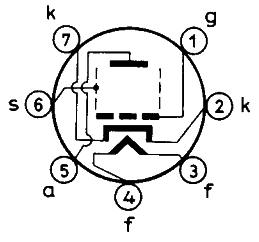
I wrote this article to clear up the doubts of several people who occasionally ask me questions about electrical schematics they find online, made and published by the usual self-proclaimed gurus who think they know everything (but actually know nothing). These schematics contain gross and very serious errors. In this article I will focus specifically on the suppressor grid. Before getting to the key point, let’s do a quick review…
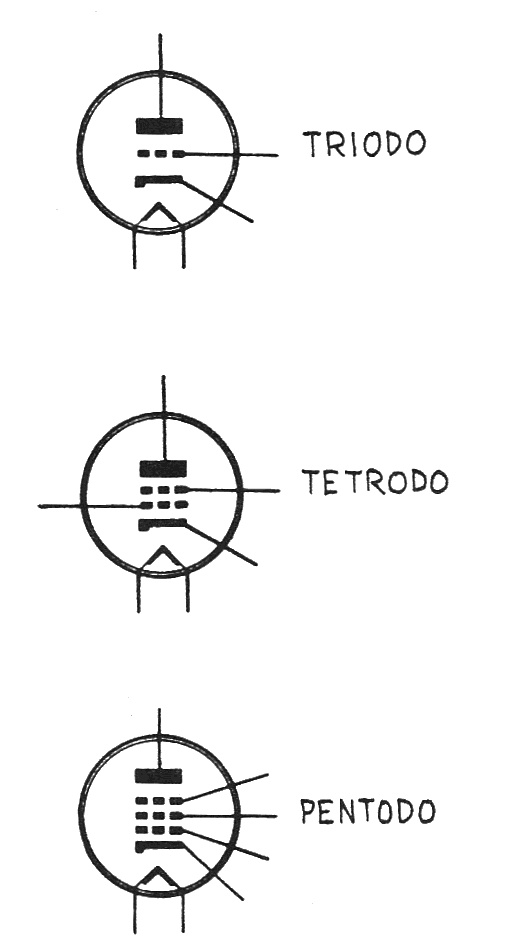
These three types of tubes differ in the number of grids inserted inside them between cathode and anode. The triode is the simplest amplifying tube, with only the control grid. The tetrode contains two grids: the control grid and the screen grid.
Triode and its Phantom Negative Feedback
Explaining this is rather amusing to me, but not everyone will understand why. One of the major technical limitations of triodes at the time was the parasitic capacitance (Miller effect) between anode and control grid. If there is a signal on the grid, the plate will show the same signal amplified and inverted in phase. The internal capacitance between anode and grid causes an intrinsic negative feedback 😆 which limits the maximum operating frequency of the triode. In radio transmission this limited the frequencies at which transmitters and receivers could operate.
The Screen Grid and the Dynatron Effect
To eliminate the parasitic capacitance between anode and control grid, the screen grid was introduced, which—as its name suggests—“shields.” It is polarized at a fixed positive potential, preventing the signal present on the plate from feeding back to the control grid. Thus the tetrode was born. However, tetrodes suffered from a defect: the screen grid accelerates the flow of electrons toward the anode. When these electrons impact at high speed (imagine many bullets hitting water and causing splashes), they provoke the emission of electrons from the plate, starting a secondary emission that leaves the anode and is then attracted to and absorbed by the screen grid, creating a reverse current between anode and screen.
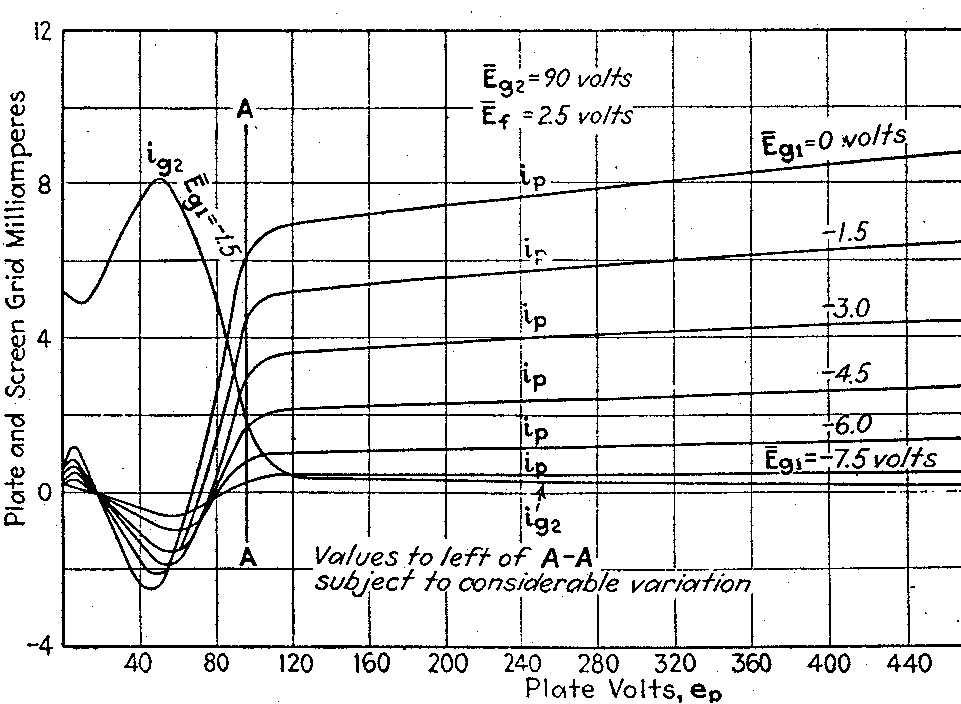
This effect is commonly called secondary emission, but the specific name is the dynatron effect. The dynatron effect causes many operational problems in a tetrode, ranging from noise to a region of negative-slope curves that leads to instability and spontaneous self-oscillation of the tube. In fact, at the time a circuit called the Dynatron Oscillator was created that exploited this flaw. An example of a tetrode is the UY224, whose curves you can see above. Despite the brief use of the dynatron oscillator (which was not very necessary since there were many other ways to make a tube oscillate), the problems caused by the dynatron effect were very troublesome and tetrodes soon disappeared.
The Pentode
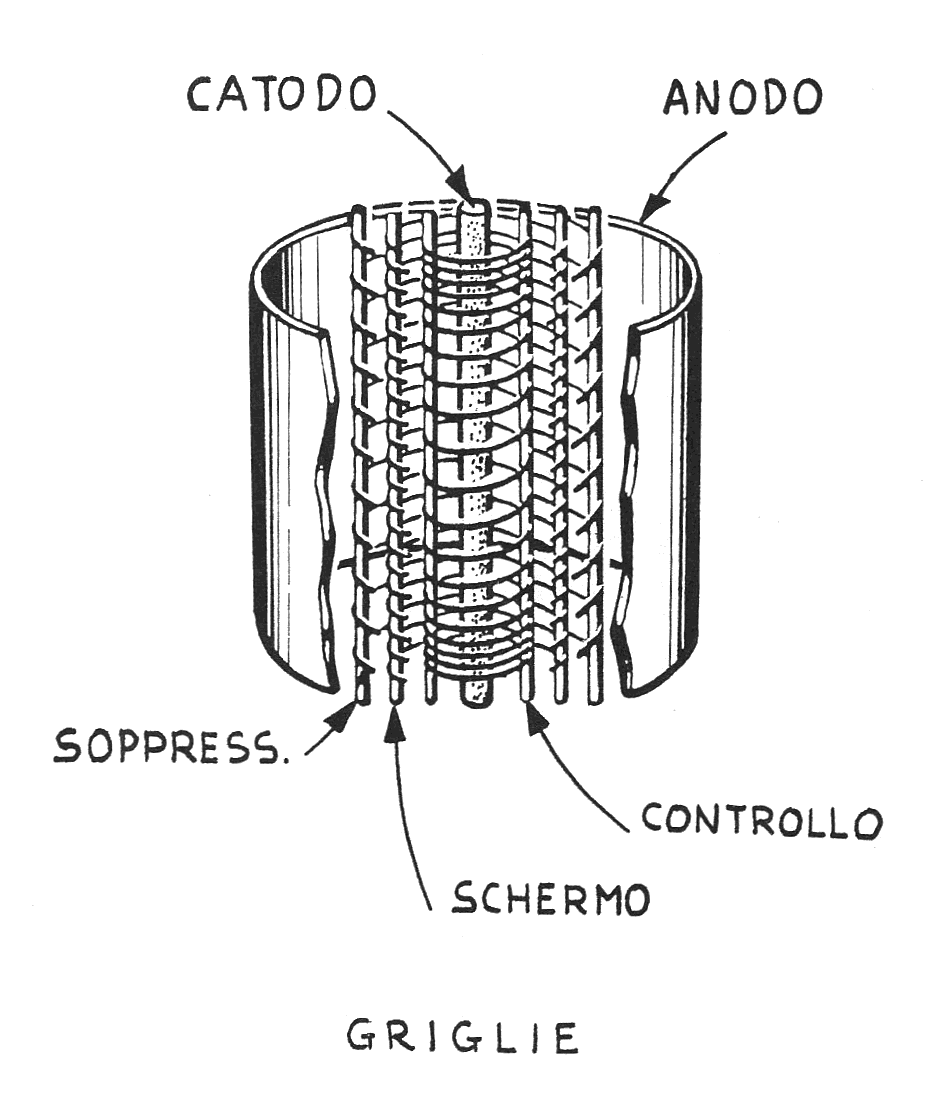
After the tetrode, the pentode was invented by Gilles Holst and Bernhard D.H. Tellegen in 1926. It can be considered an improvement of the tetrode. A third grid (commonly called G3) was added between plate and screen grid, called the suppressor grid. The suppressor grid essentially acts on secondary emission, suppressing or at least attenuating its effects. Normally this electrode is connected to the cathode, internally or externally; in the latter case through a dedicated pin on the socket that allows the pentode to be used as a triode by tying the suppressor and screen grids to the plate.
The electrical coupling between cathode and suppressor grid ensures the cathode potential is present in the area where secondary electrons appear, without drawing current and without requiring any special power supply arrangements. Therefore the suppressor grid should be considered at zero or ground potential when internally tied to the cathode, or when the relevant pins on the socket are shorted together. Moreover, the presence of this grid further reduces grid-to-plate capacitance compared to the tetrode, thereby reducing internal feedback.
Since the plate is positive relative to the cathode and the cathode is connected to the suppressor grid, the suppressor remains negative with respect to the anode. Consequently, the electrons of secondary emission emitted from the plate are repelled by the suppressor grid and returned to the plate. This prevents reverse current between anode and screen, even if the screen voltage momentarily exceeds that of the plate. All these reasons explain why the pentode has been so widely used in amplification circuits.
The Beam Tetrode
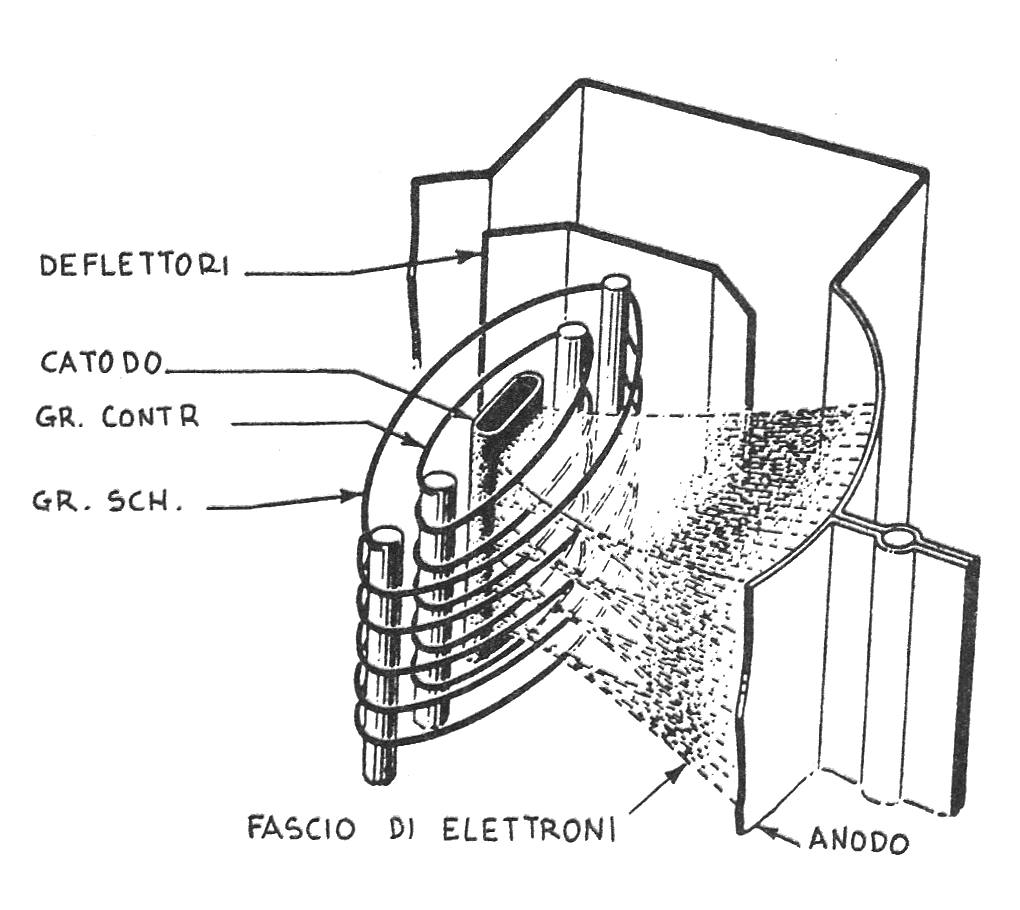
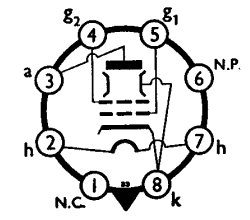
The invention of the pentode was patented, and the patent holders demanded hefty royalties from manufacturers wishing to make pentodes. Some companies decided to bypass the third-grid patent by inventing the beam tetrode. In a beam tetrode, the third grid is replaced by a sheet-metal deflector with two windows that channel the electrons into a concentrated beam. Secondary electrons that do not return parallel to the beam but travel in different directions encounter the deflector and are prevented from causing problems. In the two images below you can see the internal construction of a pentode and a beam tetrode, as well as their schematic symbols.
| Beam Tetrode | Pentode |
 |
 |
 |
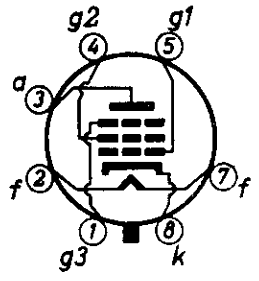 |
Note that after the early days the specific schematic symbol for the beam tetrode was seldom used, and both pentodes and beam tetrodes were generally drawn with the generic pentode symbol. So it is not unusual to see KT88 (beam tetrodes) shown with a pentode symbol, since they are effectively equivalent, having achieved the same result in two different ways.
Beware of Gurus Who Don’t Understand the Suppressor Grid
As I wrote above, most pentodes and beam tetrodes have G3 internally connected to the cathode and therefore not directly accessible—but not all! Some pentodes have G3 brought out to its own pin (like the EL34, for example) and have no internal connection. This could be because manufacturing made it easier to connect G3 to a pin rather than bridge it internally, or to allow full triode connection where G3 is also tied to the anode, or to provide an alternative use. For example, the 6BA6 is a 7-pin miniature pentode used as an IF amplifier in many 1950s/60s radios where G3 often received the circuit’s AVC negative voltage to vary gain; or the 307A transmitting pentode where an audio signal could be applied to G3 to amplitude-modulate an RF carrier applied to G1…
Whatever the technical reason or alternative use, G3 must always be correctly connected—NEVER LEFT DISCONNECTED or FLOATING! Leaving it free lets the tube oscillate or behave unpredictably. I refer to those who have published (and still publish) schematics with the EL34 and its pin 1 (G3) left unconnected, and to those who email me asking to buy transformers to build such circuits (the presence of such a serious mistake calls the entire schematic into question). I am 41 years old and knew that G3 must be externally connected in these cases since I was 13. Newbies who build these circuits see the EL34’s G3 unconnected in the schematic and leave it unconnected in their build! Someone once asked me why the FM tuner in his system was disturbed when he powered on his EL34 amplifier built from such a schematic. If you find a schematic with an EL34 and pin 1 left unconnected—discard it.
Out of curiosity I tried to capture with an uTracer the curves of an EL34 with G3 left unconnected. I expected to see distorted curves, but instead acquisition was impossible because each time the tube started oscillating and froze the uTracer CPU, causing a computer error.
Curiosity: Suppressor Hacking
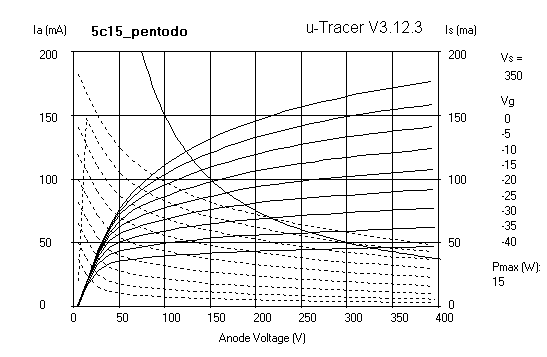
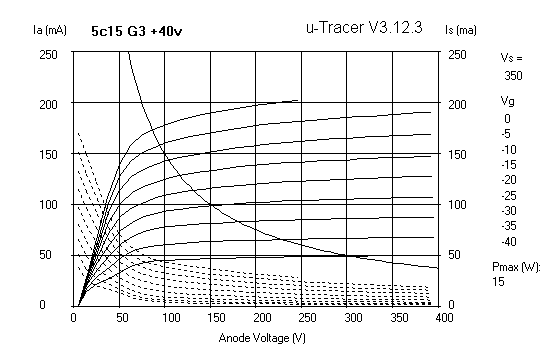
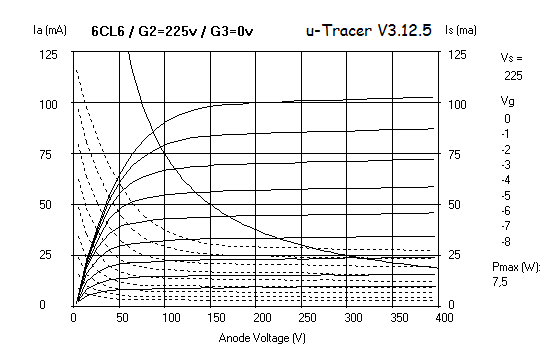
I call “Suppressor Hacking” a technique already known among enthusiasts worldwide who, experimenting with curve tracers, discovered that by biasing G3 with a slightly positive voltage instead of tying it to the cathode, one can increase the linearity of pentodes. This reduces G2 current on the left side of the graph and straightens the plate curves. This is not documented in any official datasheet (as far as I know) and requires a curve tracer to find the optimal voltage to apply to G3. If it is too positive, G3 starts drawing electrons that never reach the plate, lowering the plate curves and eliminating any benefit.
I already explained in this article how I achieved about 1 watt more output in a SE amplifier using a 5C15 tube (equivalent to the 307A) and I include here the curves in both modes…
| G3 = 0 volt | G3 = +40 volt |
 |
 |
6CL6 Tube
| G3 = 0 volt | G3 = +30 volt |
 |
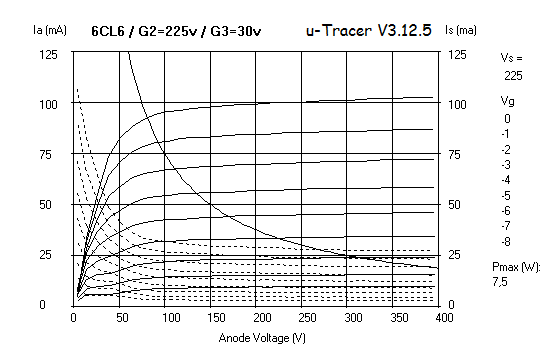 |
In both sample cases the slight positive bias on G3 produced a good improvement in the tube’s electrical behavior in the low-voltage region. When I have time (and remember) I will also acquire the EL34 curves and update this page. PS: this trick seems to work only with pentodes and not with beam tetrodes, where it is always advisable to connect G3 (or rather the deflector) to the cathode.
G3 and Triode Connection
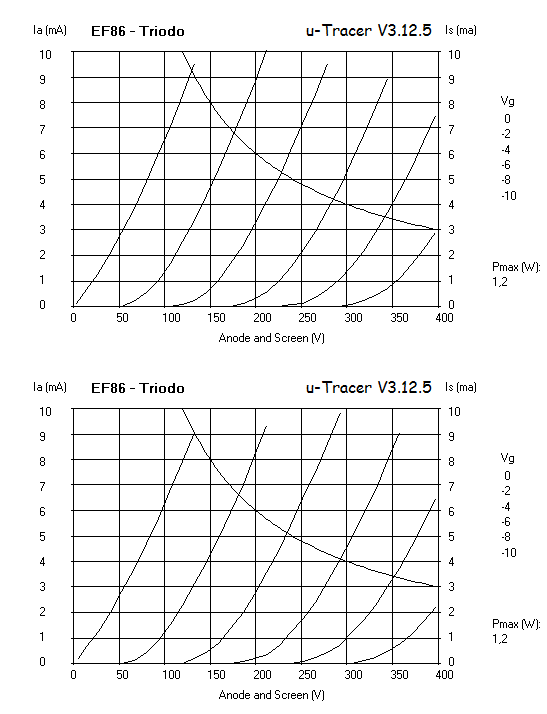
Although many are used to connecting only G2 to the anode when wiring a pentode as a triode, when G3 is available on its own pin it is preferable to connect it to the anode as well instead of to the cathode. This causes a slight decrease in the internal resistance of the triode obtained. In the animated gif below you can see the curves of an EF86 connected as a triode with A+G2 and with A+G2+G3. The difference is small but visible: when G3 is also connected to the anode, the slope of the curves decreases slightly.
Secondary Emission in Triodes
Triodes also suffer from secondary emission, though in these tubes the destabilizing effects are absent because there is no positive screen grid to attract electrons, only a negatively biased control grid that repels them. Nevertheless, secondary emission in triodes can cause noise. Various techniques are applied to limit this phenomenon, from coating plates with carbonaceous (graphite) material—microscopically porous like a sponge and thus able to trap escaping electrons—to using mesh plates made of a fine screen instead of solid metal, and even odd hybrids called beam triodes.
With the advance of technology and higher radio frequencies, pentodes—originally created to reach frequencies where triodes could not operate—were partly replaced by miniaturized triodes designed to work at very high frequencies but with much lower noise (many grids produce more noise) than pentodes. This is essential when amplifying very weak signals such as those captured by FM or TV antennas. It’s no coincidence that all tube radios with FM use a double triode ECC85 in the tuner. Beam triodes are the ultimate expression of this branch of tube electronics. They appeared in the TV era, used exclusively in UHF tuners where noise from secondary emission could otherwise make reception impossible. They are triodes but have a beam-deflector screen like a beam tetrode. Examples include the EC95, EC97, and EC900 (and their P versions with series-heater filaments). Below is the internal diagram from the PC900 datasheet.