In modern Hi-Fi systems it is quite common to see people wanting to “warm up” the sound of their setup, especially when it is solid-state. Others, who already own tube equipment, look for a way to further refine its performance. The most common answer? Add a tube preamplifier. Unfortunately, in most cases this solution is not only useless, but ends up creating more problems than benefits.
Modern sources and excessive gain
Today’s sources, CD players, DACs, streamers, already provide a generous output level, often higher than 2 volts RMS, more than enough to directly drive a power amplifier. Inserting a preamplifier into this chain almost always means unnecessarily increasing the overall system gain. This leads to several issues:
- Difficult and overly sensitive volume control
- Channel imbalance caused by standard potentiometers, often inaccurate at low listening levels
- Hiss, hum, and background noise
- Constant need for “tube rolling” in search of quieter tubes, even when the installed ones are perfectly fine
In short, the beloved preamp turns into a source of complications. I have seen countless cases of people struggling with unexplained hum and noise, when simply removing the preamplifier from the chain made every problem disappear. The only ones who truly benefit are the usual “gurus” ready to sell gold-and-diamond stepped attenuators or magical devices to eliminate noise.
The misconception of tube buffers
The most popular alternative among low-cost Chinese products is the tube buffer: dual triodes in cathode follower configuration, therefore with total feedback, which do not amplify anything and merely “pass” the signal… but with a glowing tube inside, which looks impressive. Often powered at low voltage, these circuits do not add any real “tube sound”: at best they introduce a slight dullness and some poorly defined distortion. They are simple solutions, but fundamentally useless, giving the impression of doing something while in reality doing very little.
The real alternative: tube audio processors
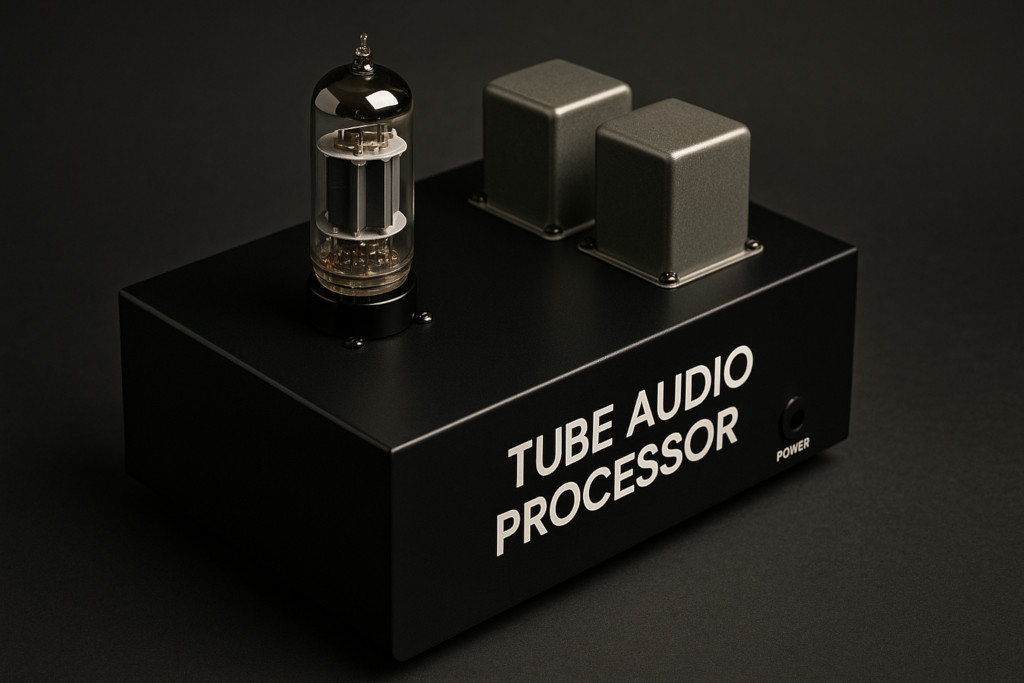
If we truly want to add tube character to our system, we need a different approach: the tube audio processor.
What really makes the sound “tubey”? It is not enough to have just any tube glowing inside the chassis. You need a tube that actually amplifies, that generates the correct harmonic signature, and above all a transformer, a fundamental component to round off the response and provide that “openness” so appreciated in tube sound.
The combination tube + transformer is what truly brings to life the warm, three-dimensional sound many listeners are looking for. And there is more: thanks to the transformer, it is possible to bring the output signal level back down to its original value, thus avoiding the useless gain increase typical of traditional preamplifiers.
What we obtain is not a preamplifier, not a buffer, but a true signal processor in class A, capable of imprinting the full, elegant, and harmonic tube signature onto the sound, without total feedback, without excessive gain, and without unnecessary complications.
But like all good things, this also comes at a price. A true tube audio processor is not just a tube thrown in there and poorly powered, where the signal goes in and comes straight out. No: it requires at least two well-designed output transformers, and careful construction to prevent them from picking up 50 Hz hum or other environmental noise. It requires a serious power supply, proper shielding, and a well-thought-out layout. It is a solution that, yes, has a higher cost, but it is also the only one capable of truly delivering authentic tube sound, the kind that enhances the system without compromising dynamics or introducing problems.
Technical demonstration
Below you can see an LTSpice simulation that illustrates the concept in detail: how a simple tube in an amplifying configuration, coupled to a well-designed transformer, can shape the harmonic content of the signal in an elegant and musical way, without altering the output level or introducing noise.
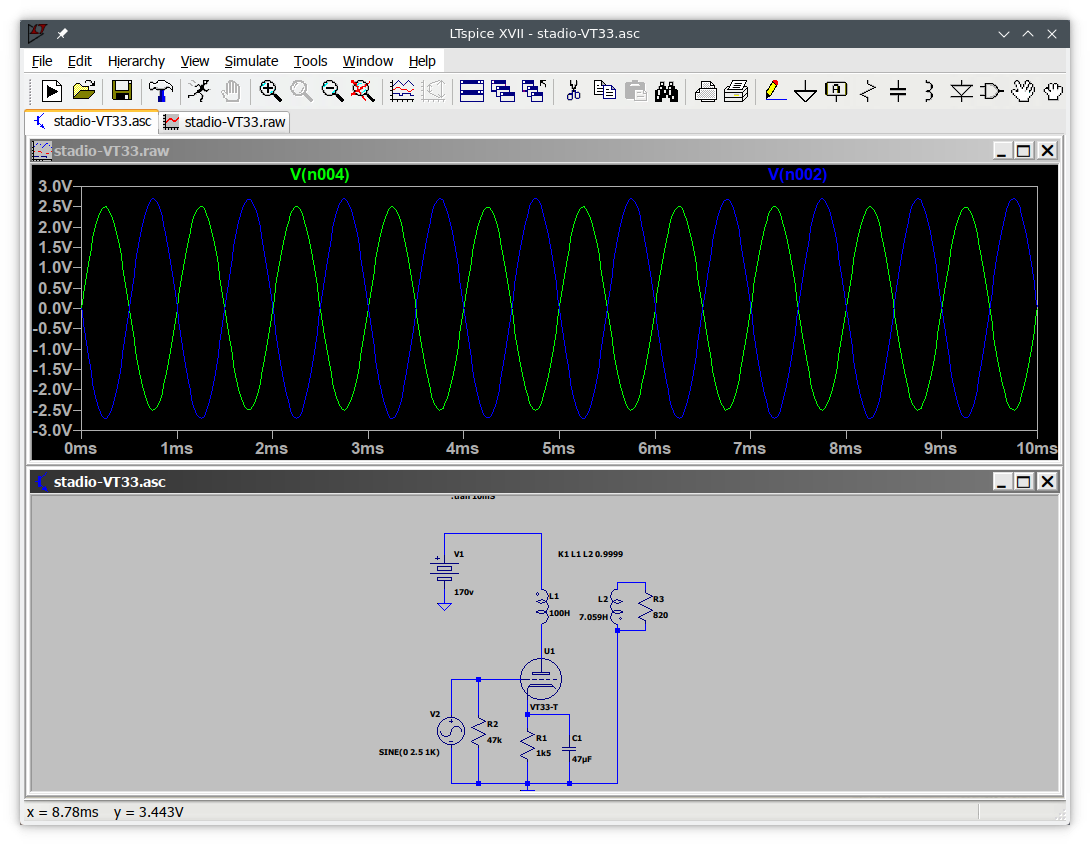
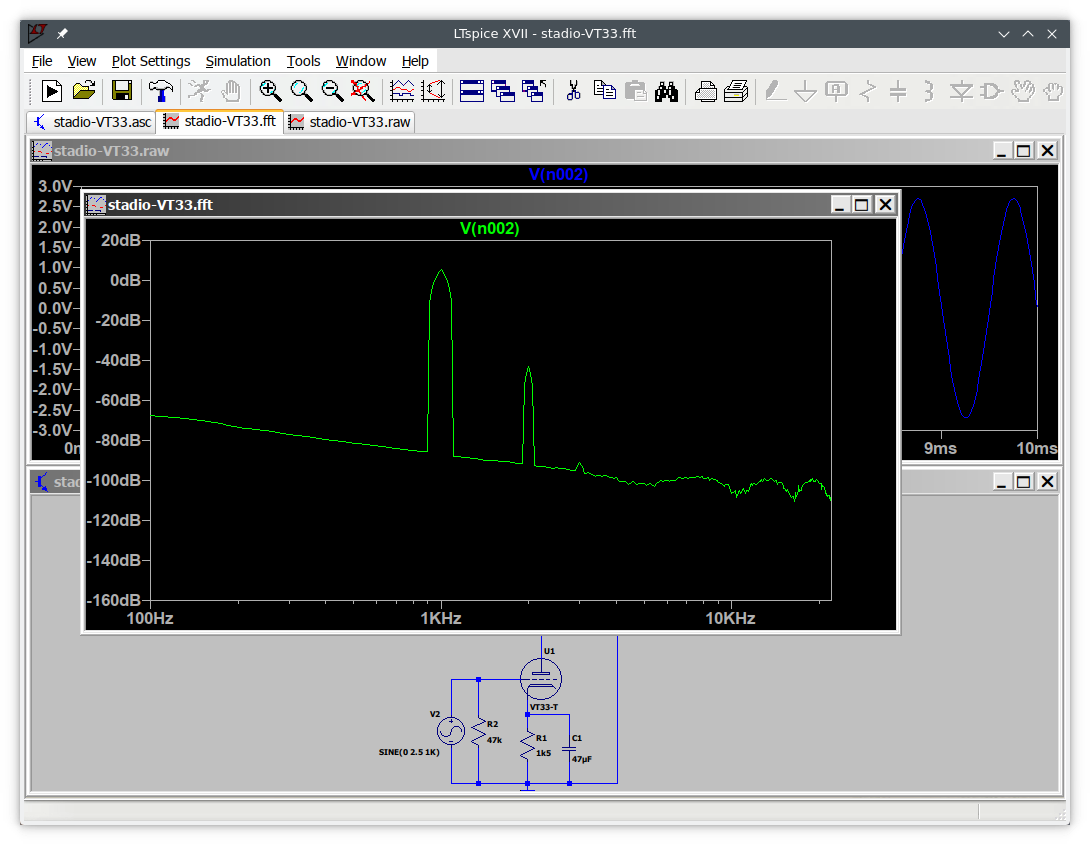
The screenshot below shows the stage of a tube audio processor based on the VT-33 wired as a triode, the same circuit that forms the basis of the Baryon Omega project. The circuit operation is simple yet effective: the signal enters the grid of the VT-33, is amplified, and transferred to the output transformer, which features a primary of 8500 ohm and a secondary of 820 ohm. In green you can see the input signal, in blue the output signal, slightly larger but already enriched by the second harmonic and a barely noticeable third harmonic, as shown in the following screenshot.
This technique is applicable to many tubes, provided they do not have excessively high internal resistance, a condition that would make the design of a suitable interstage transformer difficult or even impractical. The site already features two ready-to-use tube audio processor projects:
- the Neutrino, based on 6SN7 / 6J5 tubes and all their equivalents,
- and the Baryon Omega, built around the VT-33 wired as a triode.
Anyone interested in building a custom processor, or in obtaining transformers tailored to a specific tube, can contact me directly. We will evaluate together the best solution to integrate true tube sound into your system.