This article was written as an update to a previous version. Over time I received reports from some customers about YouTube videos in which certain individuals question what I wrote about damping factor and negative feedback in audio amplifiers. I therefore decided to revise the text to clarify a few points better and remove room for misunderstandings or fanciful interpretations.
My intention has never been to promote a particular design philosophy, but simply to explain how things really stand from a technical point of view. Damping, negative feedback, and the interaction between amplifier and loudspeaker are concrete, measurable subjects that have been studied for decades. On this basis it is possible to have a serious discussion.
It is curious to note that some sellers of zero feedback tube amplifiers have tried to disprove the arguments presented in my articles, but in doing so they have often ended up confirming the very concepts they were trying to deny. In the attempt to demonstrate that it is possible to obtain high damping without negative feedback, examples and calculations were presented that were simply wrong. From the very beginning I have always maintained one very simple thing: to obtain a minimally reasonable damping factor in an audio amplifier it is almost always necessary to use at least a small amount of negative feedback. And it is interesting to see how some of those who criticize this position then openly declare that they use a certain amount of feedback in their own designs. This, in fact, confirms the importance of negative feedback as a real technical tool and not as an ideological taboo.
The damping factor in brief
The loudspeaker is a mechanical system in motion. When the cone is pushed forward or backward by the current flowing through the voice coil, its mass and the elasticity of the suspension come into play. This means that the movement does not stop instantly when the electrical signal changes or is interrupted. Like any mechanical system with mass, the cone tends to continue moving due to inertia.
We can imagine the behavior of the loudspeaker as a series of oscillations that gradually die out. The cone continues to move for a few cycles before stopping completely. This phenomenon is called damped oscillation.

The real behavior of a loudspeaker is influenced by many factors: the mass of the diaphragm, the stiffness of the suspension, the volume of the enclosure, the mass of the air involved, and the resonances of the system. All these elements contribute to the way the speaker reacts to the music signal.
The damping factor describes the amplifier’s ability to control this movement. In practice it measures how well the amplifier is able to brake the cone when it tends to continue moving due to inertia.
An amplifier with a high damping factor is able to exert more effective control over the loudspeaker. On the other hand, with low damping the cone is freer to oscillate, following mainly its own mechanical resonances.
Said like this, it would seem that it is enough to design amplifiers with extremely high damping. And in fact with transistors it is easy to achieve very high numbers. With tubes the situation is different and, fortunately, the reality of listening is also more complex than a simple number on a datasheet.
The damping factor is only one of the parameters that define the behavior of an amplifier-speaker system. Frequency response, linearity, transient response, the real impedance of the speakers, and many other factors also come into play. Tubes have particular characteristics that influence these interactions and explain why amplifiers with relatively low damping can still offer musically very convincing results.
The damping factor technically
If you look for information on the Internet about damping factor, you will find everything. Some articles present it as the only parameter that matters, others claim that it is completely irrelevant. As often happens, both positions are the result of commercial interests more than technical reasoning.
On one side there are sellers of transistor amplifiers who insist on enormous damping values and suggest that below certain figures the sound is automatically mediocre. On the other side some sellers of zero feedback tube amplifiers claim that this parameter has no importance at all.
Then there is an even more curious third category: those who declare completely invented damping values. It is not uncommon to see zero feedback tube amplifiers advertised with DF values of 100 or 200. In practice, when they are actually measured, they hardly exceed a value of 2. The reason is very simple: without negative feedback it is physically impossible to obtain such numbers with tubes, and probably even with solid state.
Even more curious is to see people criticizing my articles by saying that damping means nothing, while at the same time carefully avoiding declaring the damping factor of the amplifiers they sell. The reason is simple: often those values are much lower than what they themselves would consider acceptable.
The problem is not discussing design philosophy. The problem is when false data are spread or half truths are told to convince customers who do not have the tools to verify technical claims.
Many audiophiles claim that measurements do not matter and that the only important thing is listening. In reality the two things cannot be separated. If two amplifiers really have the same electrical parameters, they will sound very similar. When they seem different, it is often because the declared data do not match the real ones.
The damping factor is not the only parameter to consider, but it is still one of the many elements that influence the final result.
The damping factor is defined as the ratio between the load impedance and the amplifier output resistance, indicated as Rout.
That is: Damping = Load impedance / Amplifier output impedance
The load impedance is that of the loudspeaker connected to the amplifier. In tube amplifiers it is important to connect the speaker to the corresponding transformer output, so for example an 8ohm speaker to the 8ohm tap.
Rout instead represents the internal resistance of the amplifier as seen by the load. It is as if there were a resistor in series between amplifier and loudspeaker.
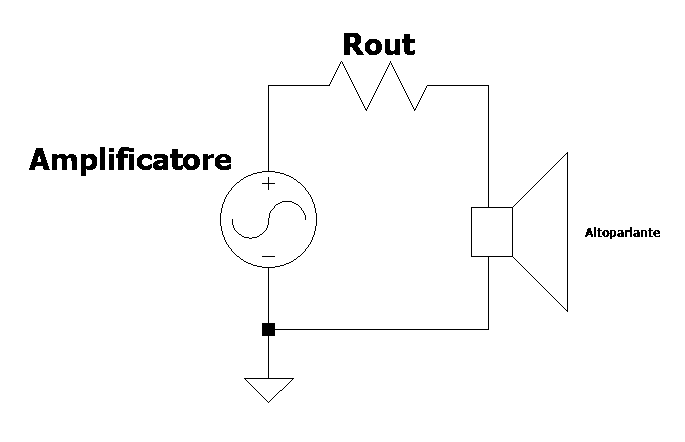
To better understand the concept, we can imagine an ideal amplifier capable of supplying infinite current. In this case Rout would be zero. In reality, however, there is always a certain internal resistance that limits the deliverable current and therefore the ability to control the loudspeaker.
If we know the damping factor, we can derive Rout. For example, a DF of 80 on 8ohm corresponds to a Rout of 0.1ohm.
Supporters of transistor amplifiers often claim that with very high DF values, above 100, there can be no speaker control problems. This is true up to a point, but it does not automatically mean that the sonic result is better.
Many enthusiasts discover tube amplifiers ????? because they find their sound more natural and less fatiguing than many transistor amplifiers. The problem arises when one goes from one extreme to the other: from amplifiers with too much feedback to amplifiers with too little damping.
In practice the goal is to find a balance between loudspeaker control and tonal quality.
In my experience, both in audio and in many other fields, people tend to take extreme positions. Some prefer to eliminate feedback completely, others aim only at extremely high damping numbers. In reality the best solution almost always lies in the middle.
Designing a good amplifier requires testing, measurements, and listening. There is no magic formula. It is a matter of balancing various parameters while trying to reduce the overall problems.
In the tube world, my experience leads me to prefer amplifiers with moderate negative feedback. This avoids both the sterile sound of overly feedback-heavy circuits and the typical problems of no-feedback circuits, where the speaker cone is poorly controlled and the bass becomes bloated and imprecise.
A tube amplifier with moderate feedback must have sufficient damping to control the loudspeakers while maintaining good musicality at the same time. To achieve this result, one fundamental element is the output transformer. If the transformer has limited bandwidth, applying feedback can worsen the result.
The problem is that there are not many manufacturers on the market capable of producing high quality output transformers. For this reason many designers are forced to choose between low damping or a lot of feedback with side effects.
Effects of damping factor on the frequency response of the loudspeaker
The impedance of a loudspeaker varies with frequency. When this impedance combines with the amplifier’s Rout, the frequency response of the amplifier-speaker system can change, sometimes significantly.
These variations are perfectly measurable. They are not mysterious phenomena perceptible only by ear. In many cases they even reach one or two decibels and are therefore clearly audible.
Many audiophiles prefer to ignore these aspects and rely only on listening tests, continuously changing equipment in the hope of accidentally finding a combination that sounds good. Without measurement tools this process can take years and lead to spending a great deal of money.
Measurements do not replace listening, but they help to understand what is happening and narrow down the field of testing.
The variations in frequency response caused by amplifier-speaker interaction can range from a few tenths of a dB up to 2 dB or more. The following graphs were obtained using my reactive load that simulates a three-way loudspeaker.
The first graph shows the frequency response of a tube amplifier A with moderate feedback on a resistive load.
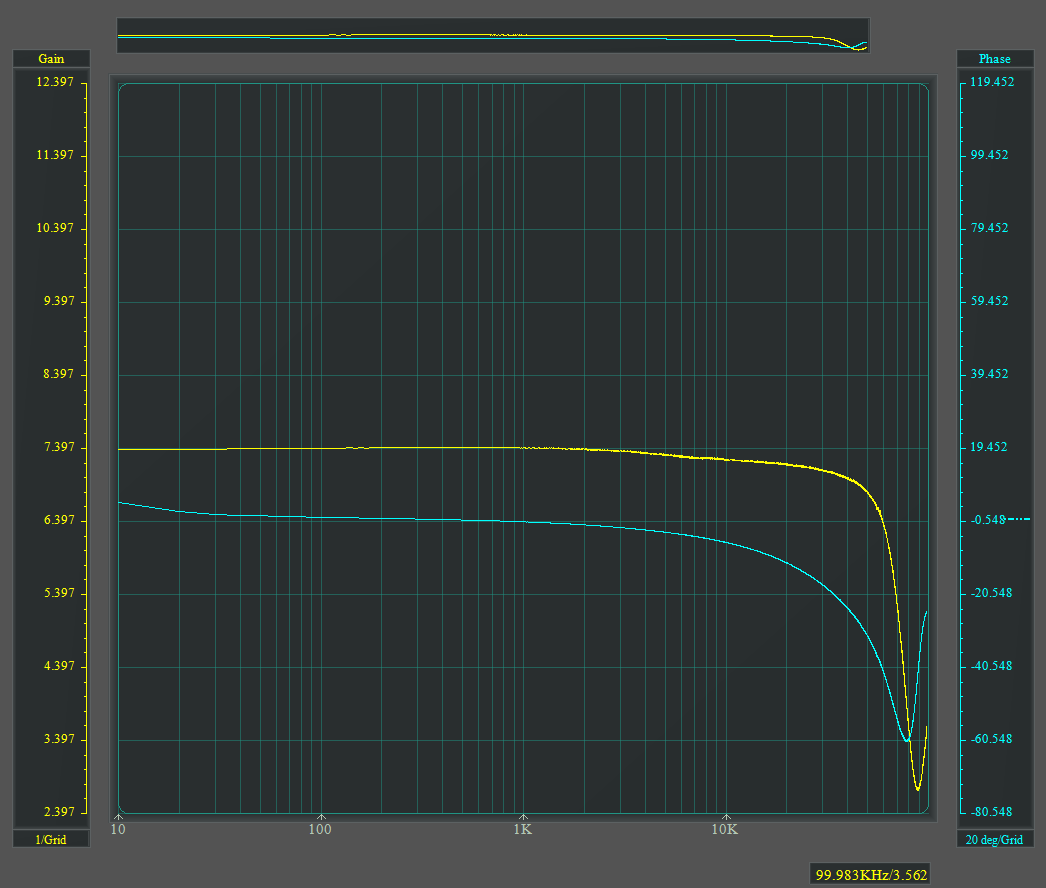
In the second graph the same amplifier works on a reactive load, therefore under conditions more similar to the real ones. A variation in the response can be seen, but the behavior remains fairly controlled.

In the following graph, instead, we see a tube amplifier B zero feedback. In this case the response is much more influenced by the load and distortions become evident both in amplitude and in phase.
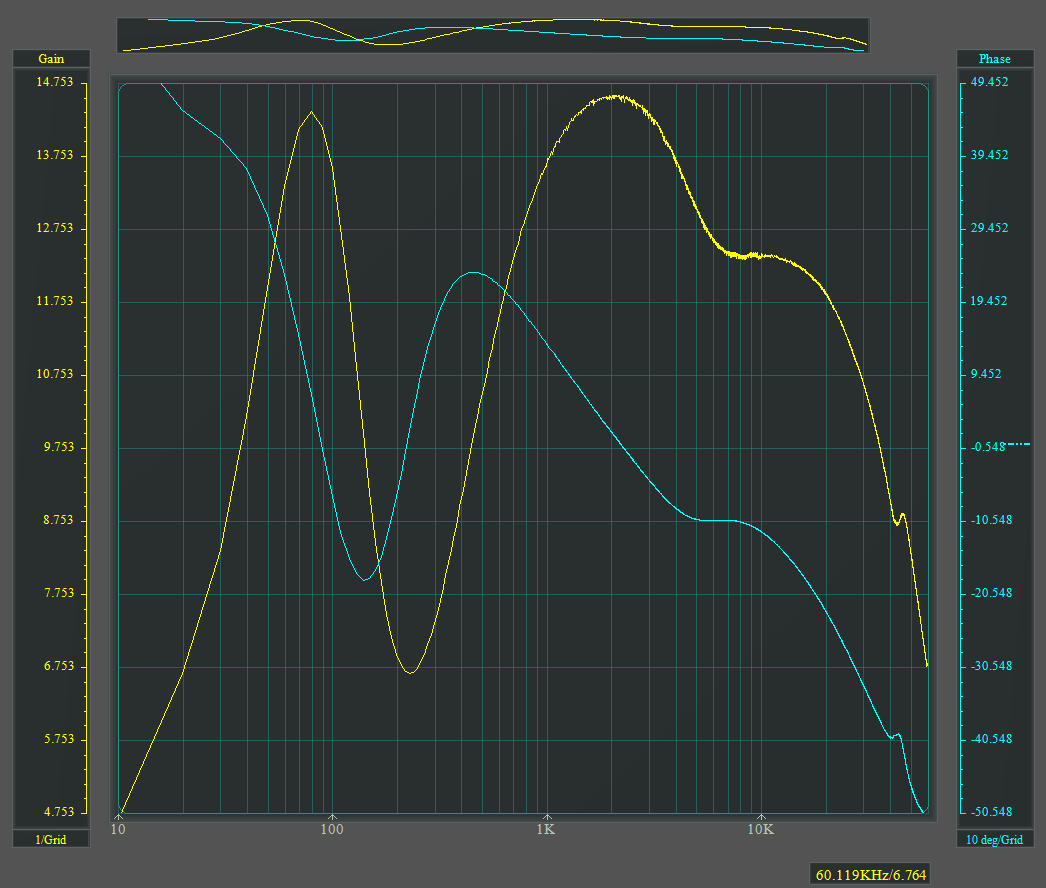
None of these examples is perfect and the behavior always changes with the connected loudspeaker. However, it is clear that by increasing damping the system tends to come closer to the ideal response.
How to increase the damping factor
Staying in the world of tube amplifiers, there are several ways to increase the damping factor, that is to reduce the output Rout. Some are more effective than others and often involve compromises.
- Reduce the leakage inductance of the output transformer. Good coupling between primary and secondary allows the output tube to better sense the behavior of the loudspeaker. Transformers with very high leakage inductance worsen damping. Values around 10 mH are already reasonable. Going lower by increasing transformer sectioning could have negative effects on high frequency response.
-
Use tubes in parallel. Connecting two identical tubes in parallel halves the internal resistance and this can improve damping. The problem is that the internal resistance of tubes still remains high, especially in pentodes, so the improvement may be insignificant. In addition, tubes are never perfectly identical. Even if selected, they can drift apart over time and create distortion or instability problems. For this reason I prefer to use a suitable tube rather than many tubes in parallel.
-
Use negative feedback. It is the most effective method for increasing damping. Unfortunately it is also one of the most misunderstood subjects. When applied correctly and with suitable transformers it does not introduce audible problems. The real limit is the bandwidth of the output transformer. If the transformer introduces significant phase rotation, feedback can cause instability or worsen the sound. With well designed transformers, however, concrete advantages can be obtained without side effects.
For me, designing a HiFi amplifier is a bit like tuning a racing car. You cannot improve only one parameter while ignoring everything else. Lightening the body is of little use if the wheels are made of wood. You may be interested in reading this article about natural zero feedback damping.
Measuring the damping factor
To measure the damping factor it is necessary to determine the output resistance of the amplifier, that is Rout. The simplest method consists of applying a sinusoidal signal to the amplifier and measuring the voltage at the terminals with and without load.
The load must be a resistor of known value, equal to the impedance of the transformer tap being used. For example 8ohm on the 8ohm output.
The voltage divider formula allows Rout to be derived by knowing the no-load voltage, the voltage with the load connected, and the value of the load resistor.
Rout = (voltage without load – voltage with load) / (voltage with load / load resistance)
Example: if 8V are measured on 8ohm with load connected and 10V without load
Rout = (10 – 8) / (8 / 8) = 2
The damping factor is then obtained as:
DF = Load resistance / Rout
So 8 / 2 = 4
Be careful when measuring damping
The measurement requires temporarily disconnecting the load while the amplifier is operating. With tube amplifiers this operation is not without risk. If the amplifier is properly designed and uses transformers with good bandwidth and moderate feedback, usually nothing dangerous happens. The problem arises with some heavily feedbacked commercial amplifiers that can go into oscillation when the load is removed. Under these conditions transformers or tubes may be damaged, especially in high power equipment. For this reason, anyone without experience should avoid this measurement.

If you want to carry out tests safely, it is possible to use a variac and power the amplifier gradually while monitoring with the oscilloscope what happens at the output without load. With reduced supply voltage, any oscillations remain limited and do not cause damage. If instead you see that the amplifier becomes unstable, it is better to give up the measurement.
As an alternative there is a safer method that consists of switching to a different load, for example 22ohm, without completely disconnecting the load. Using Ohm’s law it is still possible to derive Rout. To make this procedure easier I also built a dedicated instrument that automatically switches between loads and calculates the damping factor. Here you can find the full article about the instrument and the measurement method.
The myth of “high current” amplifiers
It is often said that an amplifier drives loudspeakers better because it is more “high current”. In reality this phrase means nothing from a technical point of view. If an amplifier delivers 10 watts into a load, the current is determined simply by the power and the load resistance. Two 10 watt amplifiers will supply the same current into the same load. There are no amplifiers that are “more high current” at the same power.
The current in a resistive load is calculated as:
I = SQRT(P / R)
Where:
- I is the current in Amperes
- P is the power in Watts
- R is the load resistance in ohm
If two amplifiers deliver the same power into the same load, the current will be identical. The perceived differences derive from other factors, very often precisely from the damping factor.
When someone says:
- “I hear slow and bloated bass”
- “The amplifier is not current capable enough”
You can be sure that the real problem is damping that is too low.

It is therefore better to avoid fanciful terms and speak about real parameters such as power, frequency response, distortion, and damping factor.
So what damping value should an amplifier have to sound good?
Let’s look at the table below…
| Damping Factor | Notes |
| Zero feedback tube amplifiers claiming damping factors of several hundred units. |
Values that belong to fantasy. In zero feedback tube amplifiers, even exceeding DF 4 is difficult. Much higher claims are certainly marketing. |
| 24 and above | Values that are almost unattainable with a tube amplifier. Typical of transistor amplifiers or extremely feedback-heavy tube amplifiers. |
| Values from 15 to 20 | Possible with some circuit techniques and very high quality transformers. If implemented badly they can sound worse than lower values. |
| Values from 8 to 14 | Typical tube amplifier with moderately high feedback, and if there is also a good output transformer the result can be good, but it may sound similar to a good solid state unit. |
| 5-8 | Optimal value! |
| 2 |
Typical value of many zero feedback amplifiers. Under these conditions the result depends greatly on the loudspeaker used. The bass tends to be bloated and poorly controlled, the sound becomes congested in more complex passages, and the result changes noticeably depending on the connected speaker. They may be barely acceptable only with simple loads, such as full-range speakers or horns. Bass reflex speakers should be avoided. |
| DF values below 2 |
They often indicate poor design or very low quality transformers. The sound becomes confused, dominated by the resonances of the loudspeaker and lacking real control. In practice these are very poor quality amplifiers, useful at best for dismantling and salvaging a few components. |
Over time I have come to the conclusion that for low power tube amplifiers a damping factor between 5 and 10 represents a good compromise. A little more is advisable with higher power. A value around 3 or 4 can also be acceptable, but only with powers on the order of a couple of watts and no more.
Then there are those who exaggerate…
Some transistor amplifiers declare damping factors above 1000 or even 40,000. In practice these numbers have no real usefulness at all.
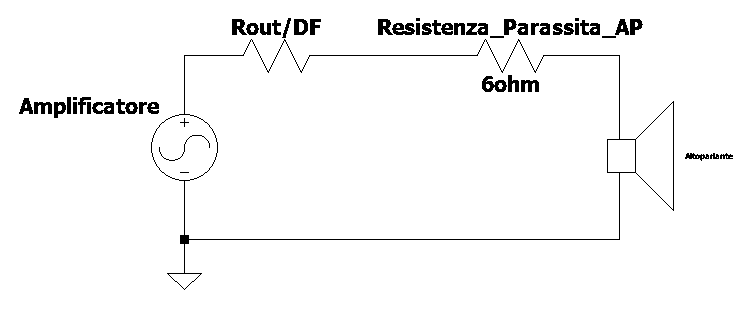
In the real system there are always other resistances: those of the cables, the speaker voice coil, and the crossover components. These resistances add to the amplifier’s Rout. If the loudspeaker already introduces several ohm of parasitic resistance, reducing the amplifier Rout from 0.1ohm to 0.001ohm changes practically nothing.
However, to obtain enormous damping factors, very high amounts of feedback are used. This can make the sound sterile or unnatural. Here too the best solution is balance.
Sound manipulators: the trick of cutting low frequencies in zero feedback amplifiers
There is also another interesting phenomenon in the world of zero feedback amplifiers. Some designers try to hide the defects of low damping by deliberately cutting low frequencies. By reducing the energy in the bass range, the effect of bloated bass is attenuated and the illusion of a more controlled sound is created. In reality this simply means removing part of the musical signal.
Sound manipulation techniques
One technique consists of recommending loudspeakers that naturally produce little bass: full-range drivers, horns, or open baffles with small cones. In this way the amplifier’s limits become less evident. On the contrary, bass reflex loudspeakers or systems with good low frequency extension are discouraged because they would make the problem obvious.
Transformers with low primary inductance: designing a transformer with reduced primary inductance leads to a natural cut in the low frequencies. The result is a sound that seems more controlled but is actually incomplete.
Transformers with a core close to saturation: another technique consists of designing transformers with high inductance on paper but that operate close to saturation in the presence of the DC current of the tubes. Under these conditions low frequencies become distorted or attenuated.
Example of distortion caused by core saturation
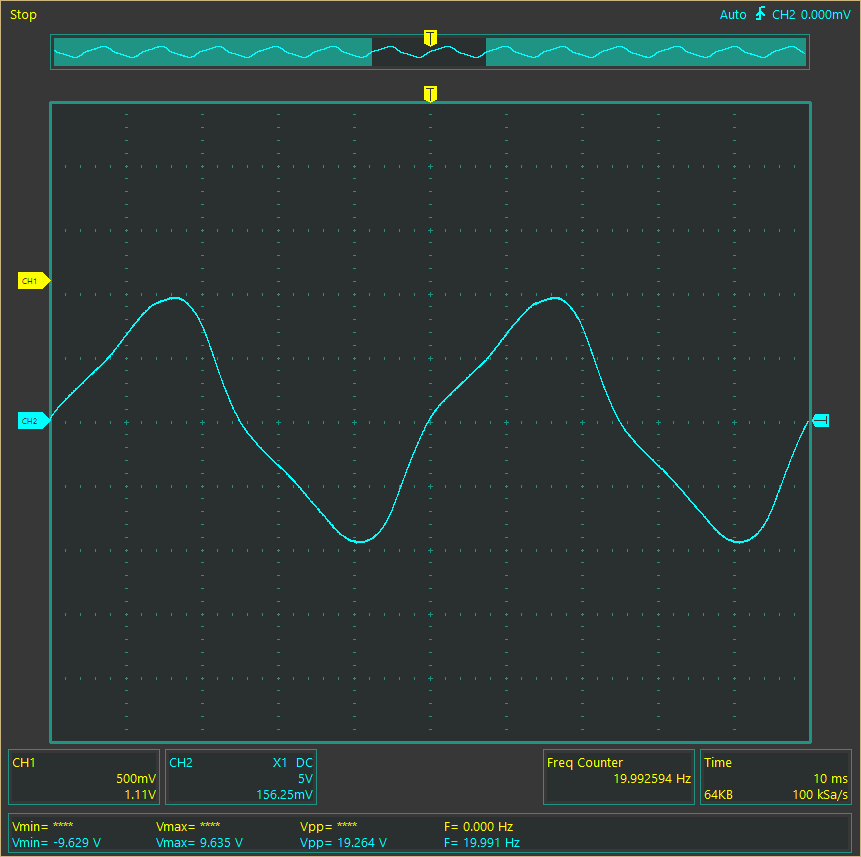
These solutions do not improve the fidelity of the system. They only serve to mask the defects of amplifiers with damping that is too low. A good amplifier should be able to reproduce the entire audio spectrum without tricks. Cutting low frequencies to hide a problem is not a serious technical solution.