In this article I want to talk about voltage stabilizers and their role in tube HiFi. If I were a charlatan disinformer, I could start with exaggerated and suggestive speeches to ignite the fantasies of those fascinated by bizarre theories: I could tell you that voltage stabilizers are circuits full of negative feedback, and that this, by coming into contact with your audio circuit, “contaminates” it with the disease of feedback. According to these beliefs, feedback would propagate by mere proximity, emitting a kind of invisible radiation capable of destroying the purity of sound.
But since I am not a charlatan disinformer, I will explain the reality. Voltage stabilizers are devices designed to maintain a constant output voltage, regardless of variations in the input voltage or the connected load. They work by detecting the output voltage and comparing it with a reference value, then adjusting the current flow accordingly to ensure a stable and safe power supply. This is essential to ensure that electronic circuits operate correctly and reliably, without being subjected to sudden voltage variations that could negatively affect performance.
In the world of HiFi and tube equipment, voltage stabilizers can be indispensable. For example, in phono preamplifiers, microphone preamps or headphone amplifiers, even the smallest residual ripple in the power supply can be amplified by the circuit, reappearing as audible hum. In these situations, the use of huge banks of capacitors and multiple pi-filters could solve the problem, but at a high cost, both economically and in terms of space. Fortunately, voltage stabilizers offer a more compact solution and, with a bit of intelligence, can guarantee the same stability with much less bulk and expense.
However, like every component, stabilizers are not perfect. One of the possible disadvantages is the generation of white noise, due to the error amplifier circuit, which monitors the output voltage and compares it with the reference. This noise, in the vast majority of cases, is so low as to be irrelevant. But if you power a circuit with extremely high gains, that noise could be picked up, amplified, and become an audible hiss.
How to solve this problem? Should we perhaps surrender to anti-feedback hysteria? Create a colossal triple-pi filter with gigantic inductors and huge capacitors, requiring a second chassis and costing three times the rest of the system? No. The solution is much simpler and more efficient: just use a small and simple inductor. By inserting an LC filter after the voltage stabilizer, we can eliminate most of the residual noise without unnecessarily complicating the design or the budget.
24i13 – 24i14 Inductors: Ideal for Filtering Voltage Stabilizer Noise
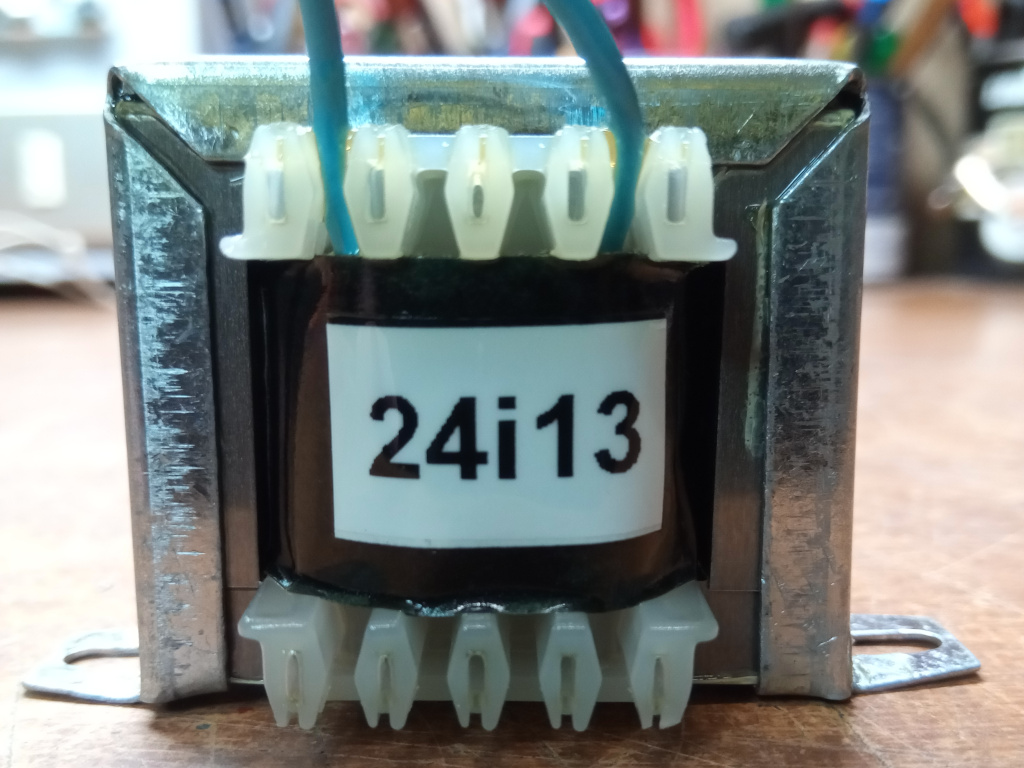
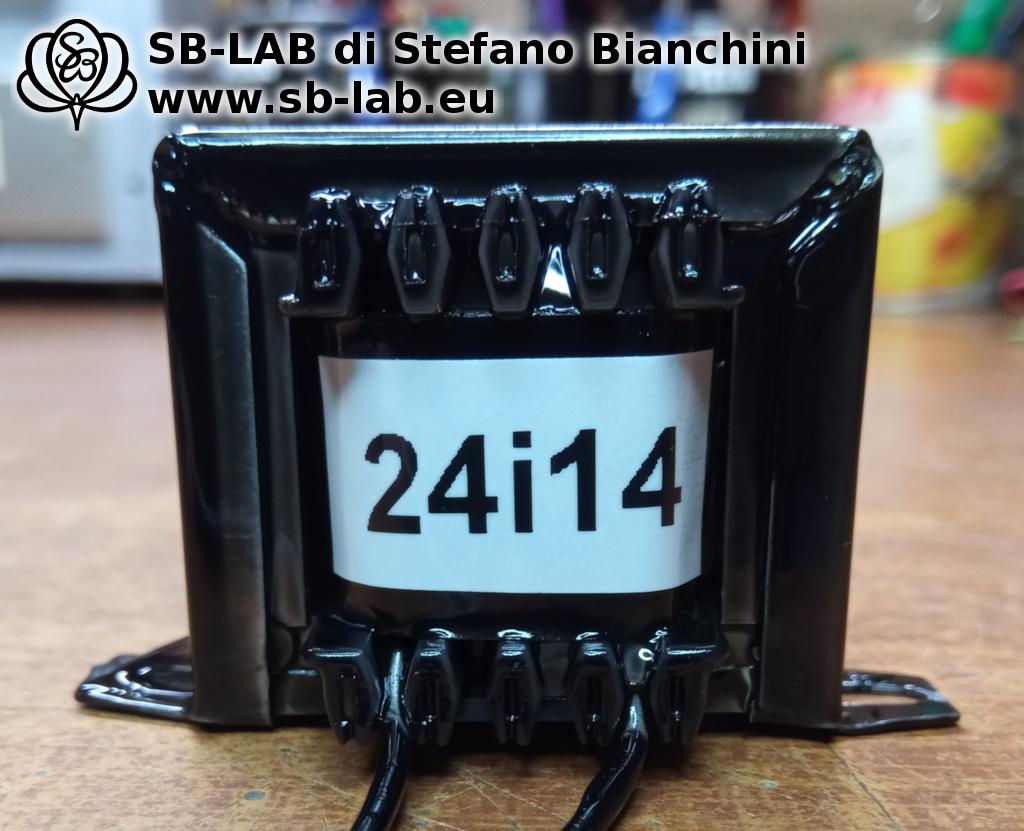
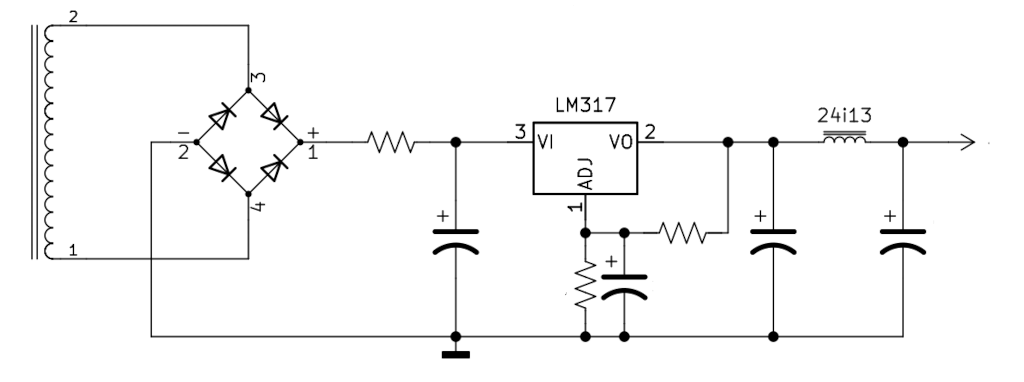
Continuing with the topic of noise filtering in voltage stabilizers, I present the 24i13 inductor, a 50mH component with a DC resistance of 1.2 ohm. In this case, I implemented a voltage regulator based on the LM317, and filtered its output precisely with the 24i13 inductor. The 24i14, on the other hand, is a 200mH inductor.

In the images, you can observe the oscilloscope measurements, showing the noise detected before and after the inductor.
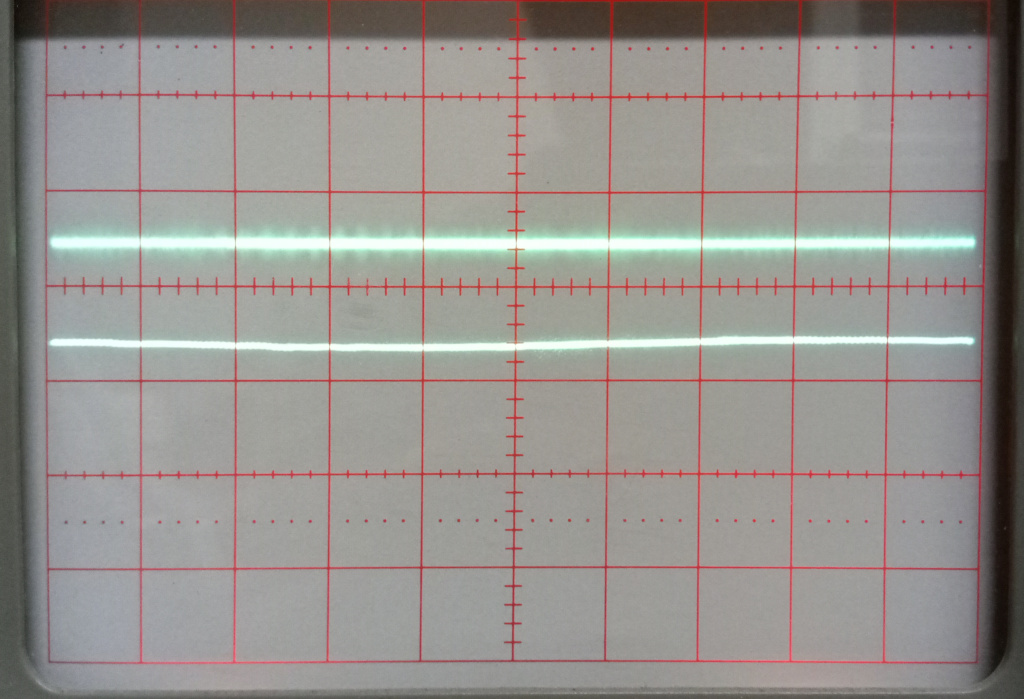
Even though the oscilloscope is at the limit of its resolution (5mV per division), you can still notice that the upper trace, representing the regulator output before the inductor, looks thicker and blurrier. This is due to the presence of wide-spectrum noise (white noise) generated by the regulator. Instead, the lower trace, obtained after the LC filter with the 24i13 and a 3300uF capacitor, is much thinner and cleaner. This demonstrates how the inductor can significantly reduce noise.
Just adding a large capacitor after the regulator would be useless, because the output impedance of the stabilizer is so low that the capacitor would not be able to suppress the noise effectively. Here comes the 24i13, which, with its ability to filter currents up to 600mA, is ideal for applications such as filtering the filament supply of a tube.
I specifically designed the 24i13 for this purpose, in the context of a recording studio microphone, where the slightest interference in the filament circuit can cause unwanted noise in the audio signal. Thanks to its features, the 24i13 is perfect for microphone or phono preamps, where it can, for example, power the filaments of up to four 12AX7 / ECC83 tubes (if powered at 12V, pin 4/5), ensuring a clean, noise-free supply.
A key advantage of using the 24i13 compared to a traditional RC filter is its ability to offer greater noise rejection with significantly lower voltage drop and less heat dissipation. In RC filters, the resistor used to attenuate noise causes a voltage drop, and part of the energy is dissipated as heat. With the 24i13, instead, the inductance does the filtering work without introducing significant resistance, resulting in better efficiency, reducing both voltage drop and heat production, with minimal impact on the overall system performance.
An interesting comparison is between the 24i13 and the 24i8 500mH inductor. The 24i8 are much bulkier and more expensive, since they are designed for passive filtering of 50/100Hz ripple, typical of unstabilized power supplies. These inductors must be sized to block the lowest frequencies, which requires a larger core and wire size.
In contrast, the 24i13 are much more compact because they are designed to filter wideband noise, which has very few low-frequency components. This allows size and cost reduction without sacrificing effectiveness in reducing high-frequency noise, such as that generated by voltage regulators or other wide-spectrum sources.
One aspect to keep in mind is that the 24i13 is not suitable for filtering plate power supplies, even stabilized ones. In plate supplies, in fact, capacitors of much lower capacity are used compared to those required by the 24i13, which has only 50mH inductance. In this case, it will be possible to use one of the many plate filter chokes available in my catalog. The 15S60 1.75H 200mA, for example, is certainly a good choice to ensure effective filtering and a clean plate voltage when using a stabilizer.
| Model 24i13 | ||||||||||||
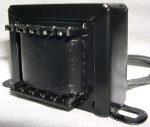 |
Filter choke 50mH, 600mA DC, RDC 1.2ohm | |||||||||||
|
||||||||||||
| Model 24i14 | ||||||||||||
|
Filter choke 200mH, 250mA DC, RDC 3.6ohm | |||||||||||
|
||||||||||||
To order, contact me by clicking here
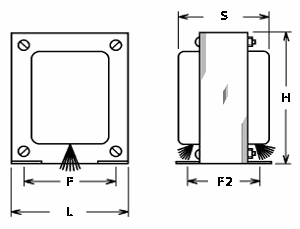
Dimensions caption