Correctly measuring passive filters, crossovers, and transformers requires not only adequate instrumentation, but also a power source capable of driving real loads without introducing significant limitations or distortion. Function generators and bench instruments alone are often not sufficient when characterizing passive devices designed to operate at non-negligible power levels.

In this article I show how a common transistor amplifier, today easily found on the second-hand market, can be reused as a service amplifier within a measurement setup. Paired with an oscilloscope featuring an integrated function generator, it becomes an effective tool for measuring the frequency response of impedance translators, passive filters, and crossovers, with reliable results that are directly comparable to real operating conditions.
This solution allows us to obtain precise and reliable results in the characterization and analysis of these devices. Not only do we give new life to an old, neglected amplifier, but we also use its renewed power to explore the properties of impedance translators and filters.

There are countless transistor amplifiers from the 1990s like this, often available at very affordable prices online and at flea markets. Personally, I bought this one for 50€. For what I wanted to build, it was perfect. The main goal is to obtain accurate measurements of crossover filters and impedance translators, but also of output transformers using a bench measurement setup. For this reason, it is necessary not only to have suitable measurement instruments, but also a solid-state amplifier capable of providing the power required by the device under test. Sound quality is not critical, what matters is that it can deliver a certain amount of power.
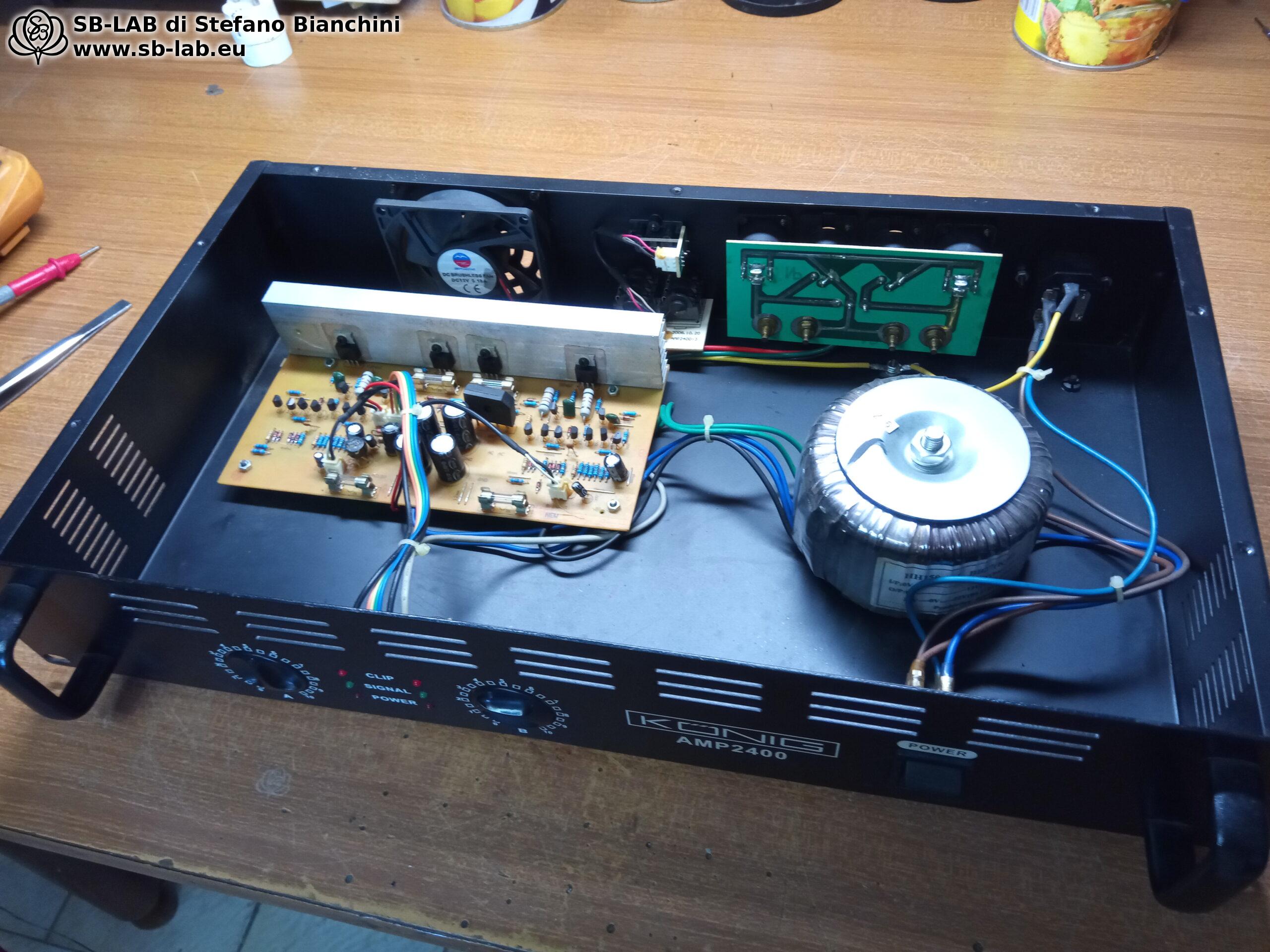
The photo above shows the Konig AMP 2004. As can be seen in the figure below, its circuitry is essential and minimal. There are no flashing colored lights, tone controls, or filters, just a pure power amplifier, free of superfluous elements that could interfere with the signal. This type of amplifier is ideal for use in a measurement setup, since it does not require modifications to adapt it for this purpose. After a thorough cleaning with compressed air and contact cleaner, it is ready to be used.
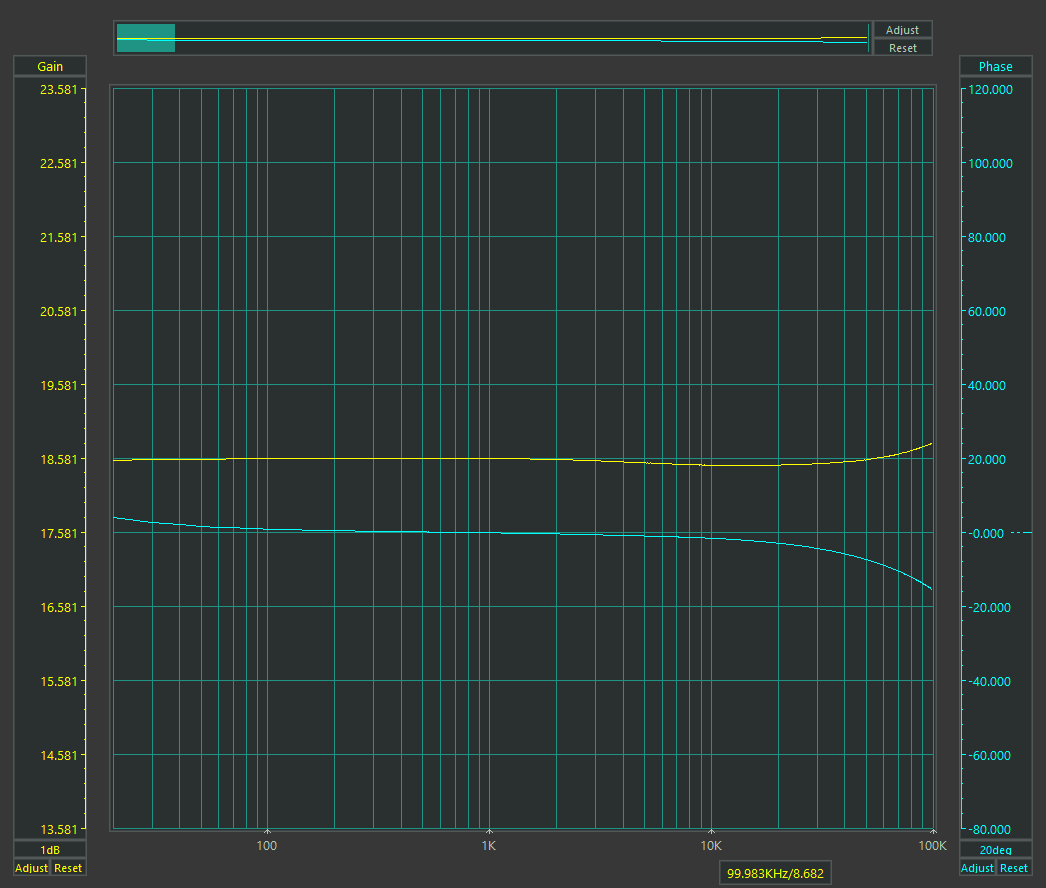
I measured its frequency response, which is practically a flat line up to about 100k. The phase response is also excellent.
In these photos you can see it being used to measure an impedance translator that I discuss in another article.
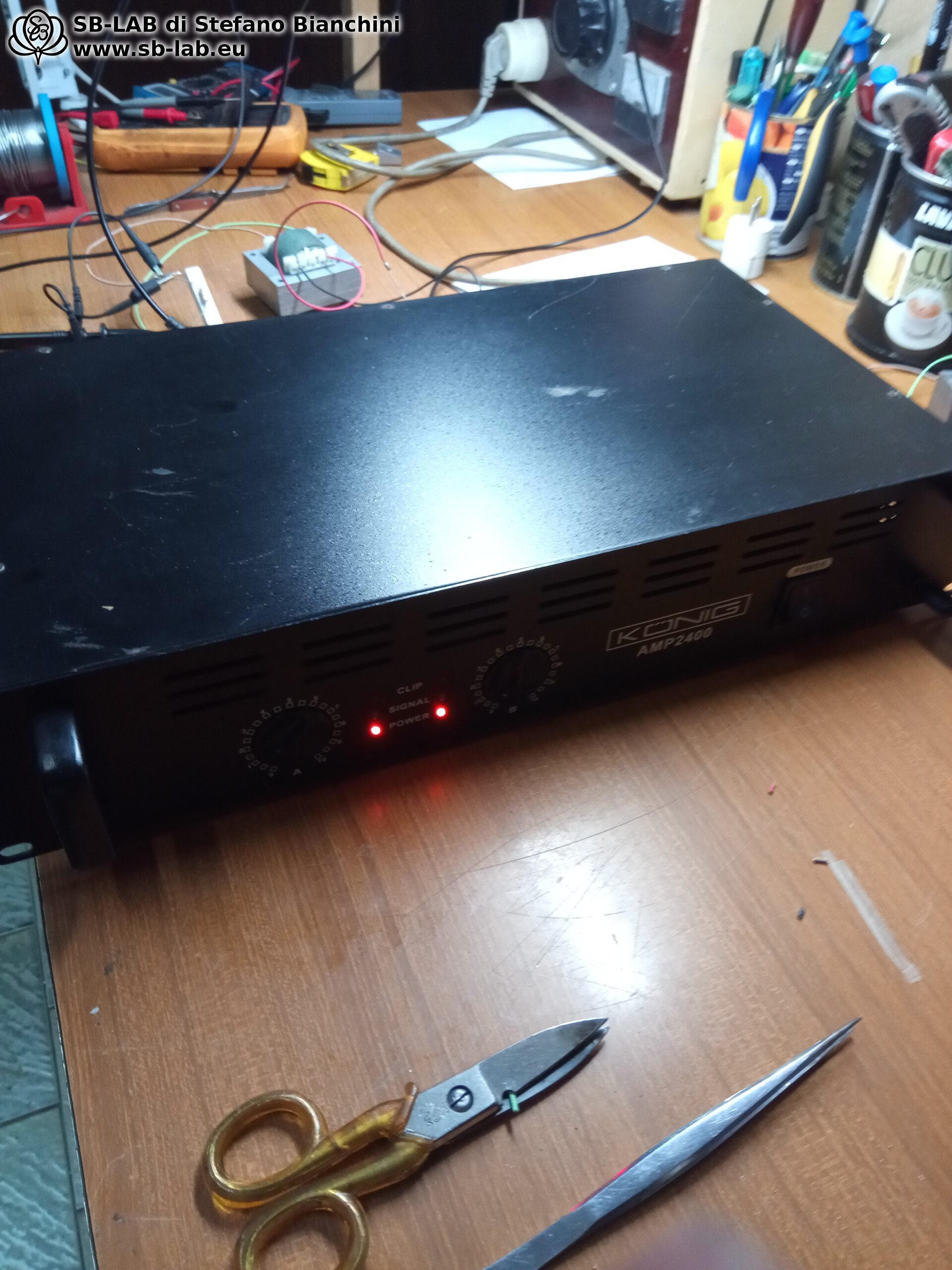

It has banana speaker terminals that also allow the use of bare wire, unlike certain horrible spring-loaded terminals that risk causing short circuits or breaking. In addition, it provides inputs for both channels using either mono jacks or RCA connectors, which is very convenient for interfacing with a function generator.
To acquire bandwidth plots of a filter or a transformer, I use a two-channel digital oscilloscope with an integrated digital function generator, called DDS. During bandwidth measurement, the DDS outputs a frequency sweep. The first probe is connected to the input of the device under test, while the second probe is connected to its output. Let us assume we need to measure an impedance translator transformer, understood here as a passive impedance matching transformer, sometimes referred to as a transmission line. The connection will therefore be as follows:
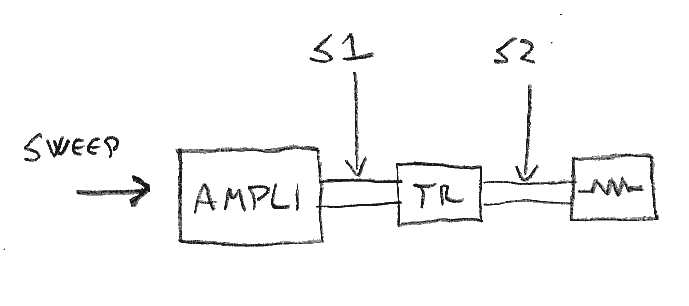
From left to right we have the sweep signal generated by the DDS entering the amplifier, which provides power to the translator TR. The latter interfaces with a resistive load. The two probes S1 and S2 are connected respectively to the input and output of TR. The resulting plot is calculated as the difference between S1 and S2 and therefore represents only the frequency response of TR. It does not matter what the frequency response of the amplifier is, as long as it is capable of providing power. Instead of TR, there could be, for example, a loudspeaker crossover filter, and with this system it is possible to perform various measurements on crossovers as well.
Let us now look at the test of an impedance translator with this measurement setup
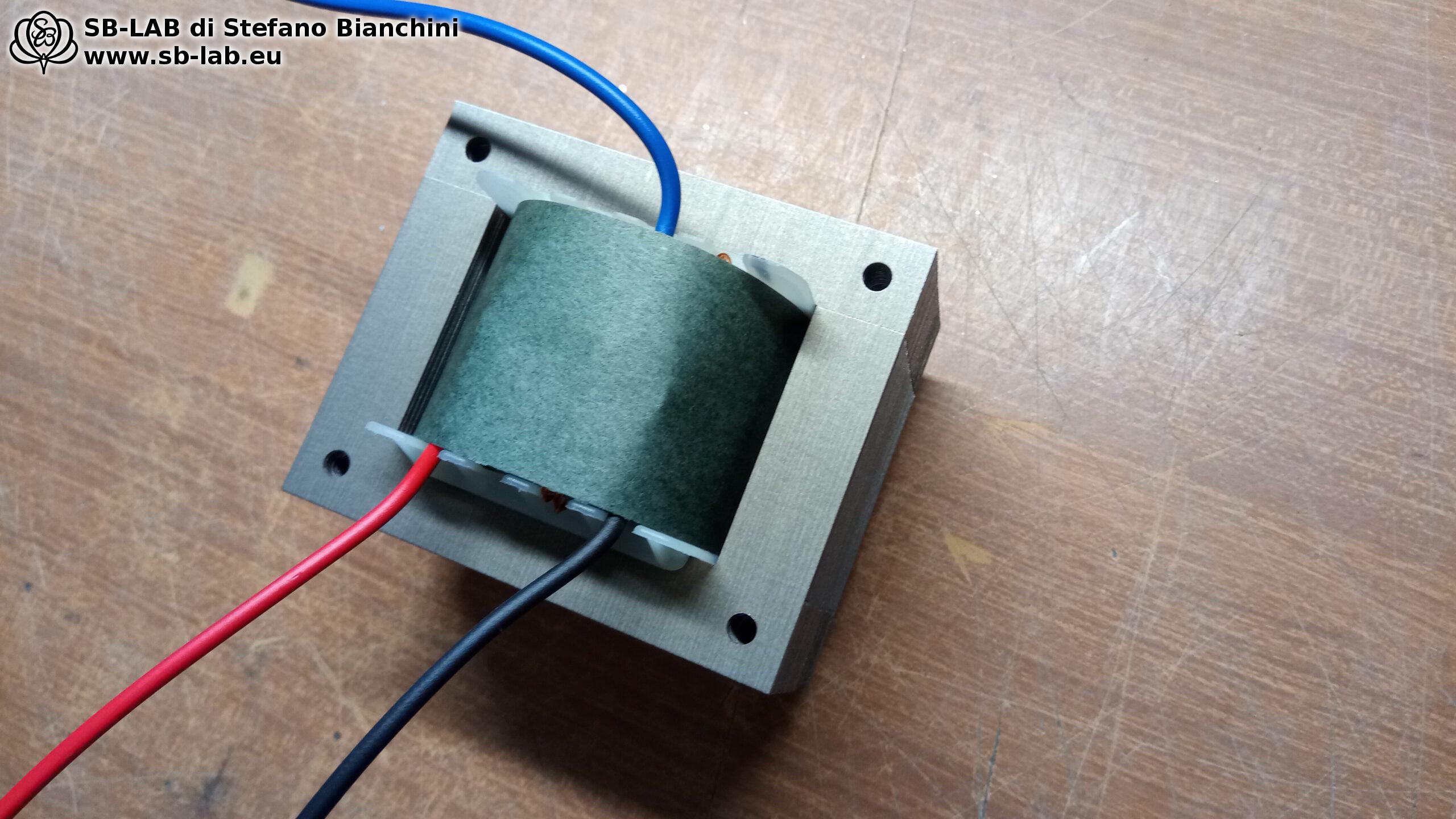
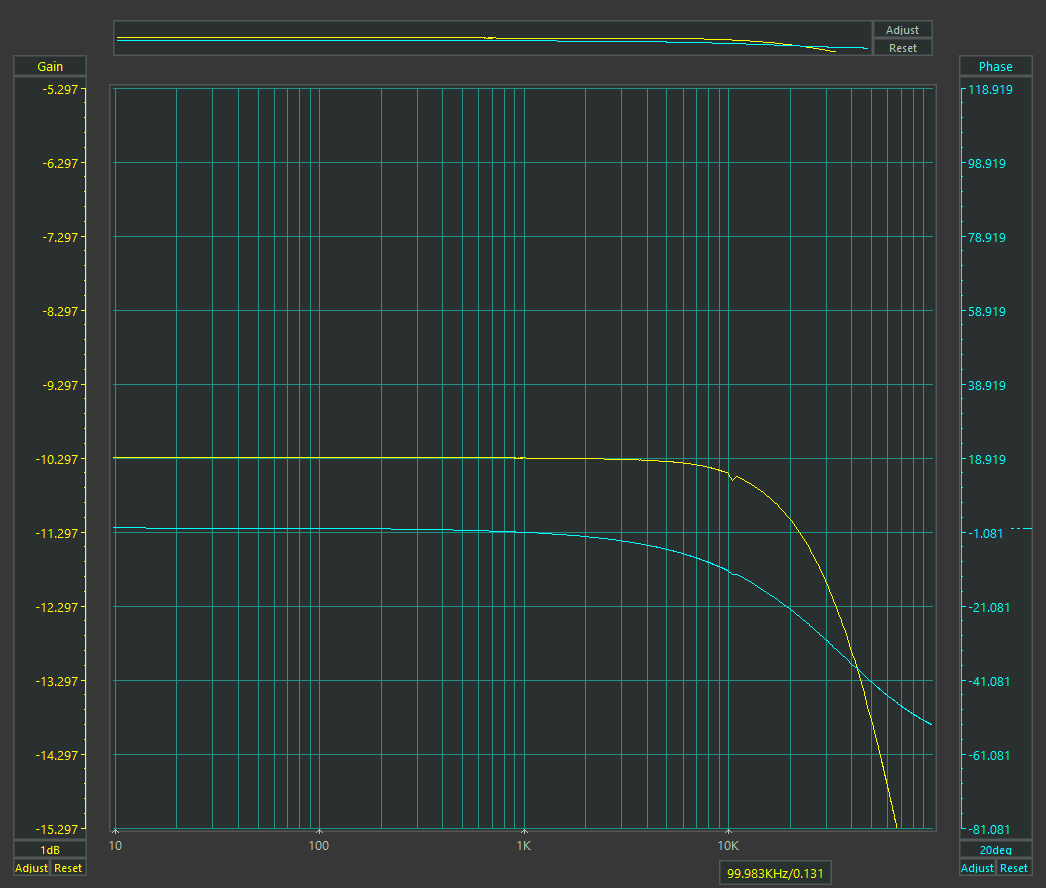
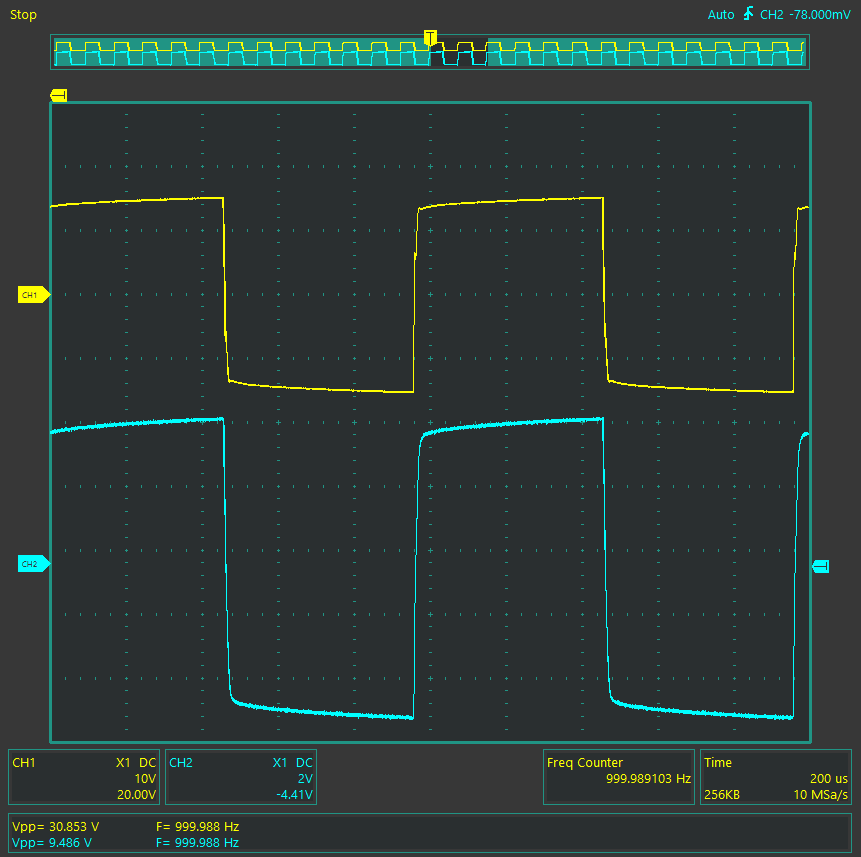
I was asked to prototype 100 Watt impedance translators, with 16 ohm input and 2 ohm output, in order to couple 2 ohm subwoofers to a solid-state amplifier that expects to see a 16 ohm load and cannot directly drive a 2 ohm load without risking failure. I wound the sample and tested it using the measurement setup just described.
And this is the frequency response of the translator…
Square wave at 1 kHz
The measurement setup works perfectly. I therefore hope to have given some recycling ideas to readers who might have one of these old amplifiers in their basement and not know what to do with it. With a minimum of method and appropriate instrumentation, even hardware considered obsolete can become a valid measurement tool.
Measuring the bandwidth of an output transformer connected in reverse
A practical method for measuring the bandwidth of an output transformer consists in connecting it “in reverse”, that is, driving the secondary instead of the primary. In this case, the 8 ohm secondary is connected to the output of the service amplifier, while a load resistor having the same value as the internal resistance of the tube that would drive that transformer under real conditions is applied to the primary. The principle is to recreate as closely as possible the dynamic operating conditions of the transformer, while working at low power and with relative safety.
This method provides results reasonably close to reality in the case of push-pull transformers, where the absence of a DC component does not represent a significant limitation. The frequency response obtained, especially at mid and high frequencies, is generally reliable and allows a correct evaluation of the transformer behavior in the audio band. In the case of single ended transformers, however, the measurement is inevitably partial. Since it is not possible to inject the DC magnetizing component, one obtains a good indication of the upper bandwidth limit, but not a realistic picture of low-frequency behavior, which critically depends on the DC operating point. For single ended transformers, the use of a dedicated tester that can correctly simulate the bias conditions therefore remains valid.
| Single Ended | Push Pull |
 |
 |
It is essential to pay the utmost attention during these measurements. When driving the transformer from the secondary, very high voltages can develop across the primary, potentially dangerous both for the operator and for the instrumentation. Excessive signal levels must be avoided, and it must always be verified that the oscilloscope probes and connected instruments are suitable for the voltages present, in order to avoid damage to the equipment or situations of personal danger.
Amplifiers poorly suited to these applications
Not all amplifiers are suitable for use as service amplifiers in a measurement setup. The first to be avoided are those I define, in a deliberately tongue-in-cheek way, as “Christmas trees”.

Plastic supermarket amplifiers, full of colored lights, displays, sound effects, preset equalizations, DSPs, and filters of every kind. These devices are not designed as linear power amplifiers, but as entertainment products, and the signal often passes through digital processing chains that can unpredictably alter amplitude and phase. Using them in a measurement setup means introducing uncontrollable variables that easily falsify the results.
Another poorly suited category is that of class D or PWM amplifiers. In many cases, during bandwidth measurements, these amplifiers reveal false resonances or artifacts related to the switching frequency of the chip and the output filters. These high-frequency components can appear in plots as anomalies that do not belong to the device under test, making it difficult to distinguish the real behavior of the measured device from that of the amplifier itself.
Finally, attention should be paid to amplifiers whose negative speaker terminal is not referenced to ground. In these configurations, typical of certain bridged topologies or particular power stages, direct connection to measurement instrumentation can create interfacing problems or even dangerous situations for the instruments. Without adequate precautions, such as differential probes or specific isolation, this type of amplifier is not recommended for reliable bandwidth measurements, or at least it is inconvenient to use.