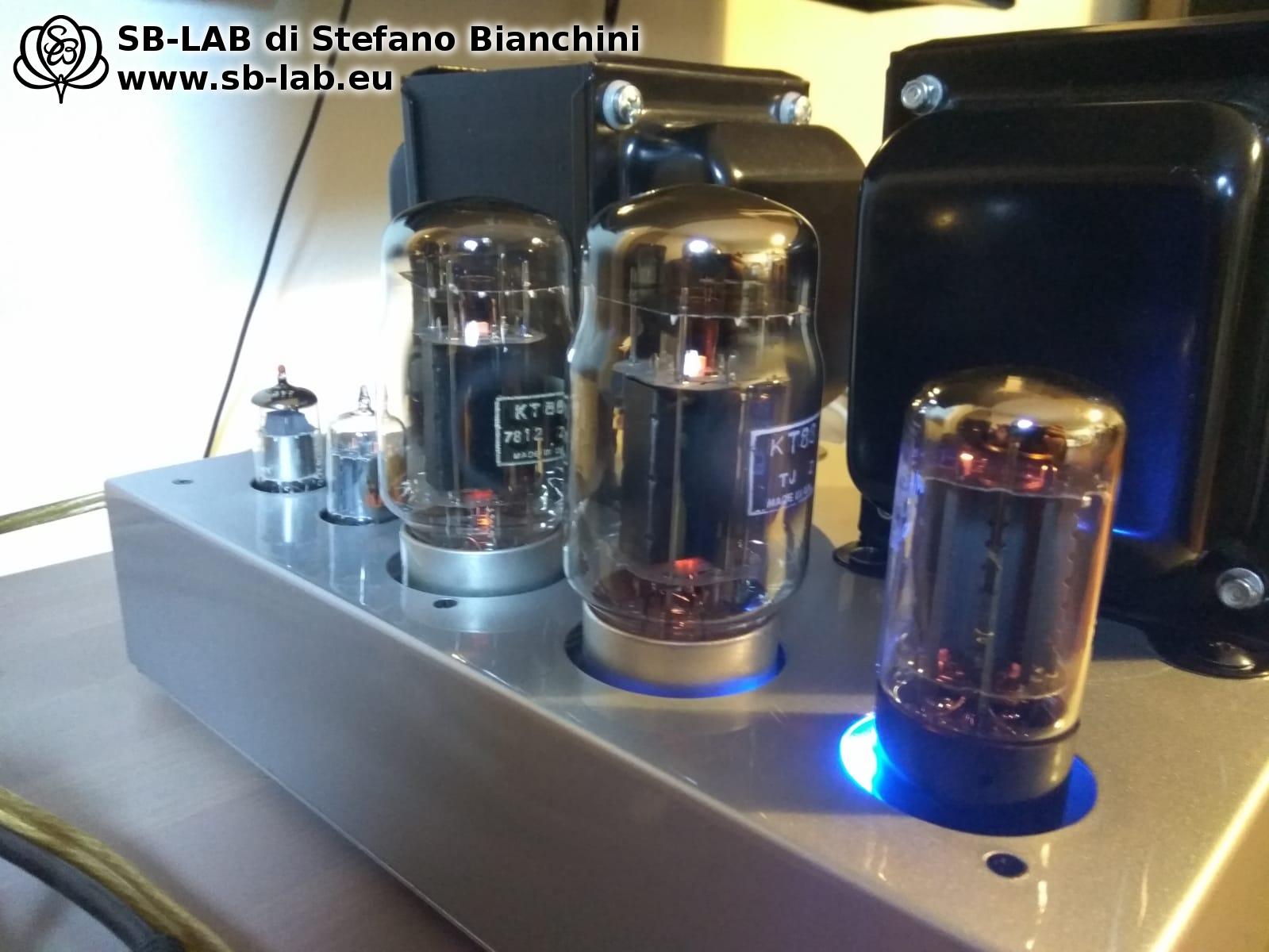
In this article we analyze in detail the overhaul of a classic Leak-inspired circuit, built by an enthusiast using SB-LAB transformers. We will see how, starting from a vintage design that was not optimized, it was possible to achieve clearly superior performance through careful tuning and targeted modifications.
The goal is to show how important it is to adapt a circuit to the real characteristics of the components used, especially when you want to get the most out of high-quality transformers. You might also be interested in the project of the same amplifier, but with diodes instead of a rectifier tube. Click here…
The case: Hashimoto KT88 UL Push Pull redesigned
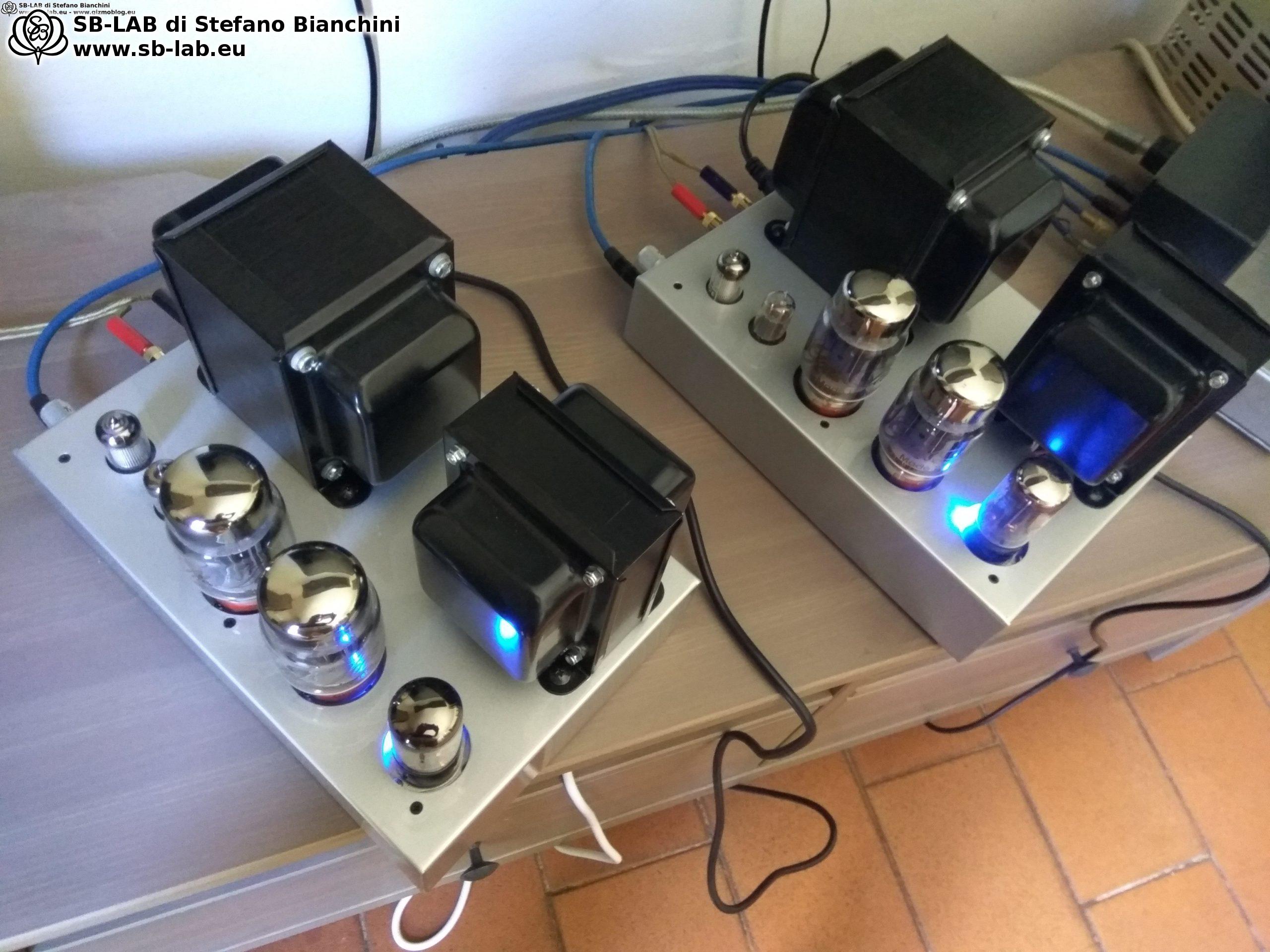
It was 2017 when I published, in the Readers’ projects section, a short article dedicated to a customer build that used a set of transformers purchased from me. The title of that article was “Fabrizio’s KT88 monoblocks”. Below, separated by the lines, you can find the original page.
I’m publishing the photos of the monoblocks built by Fabrizio with SB-LAB transformers.
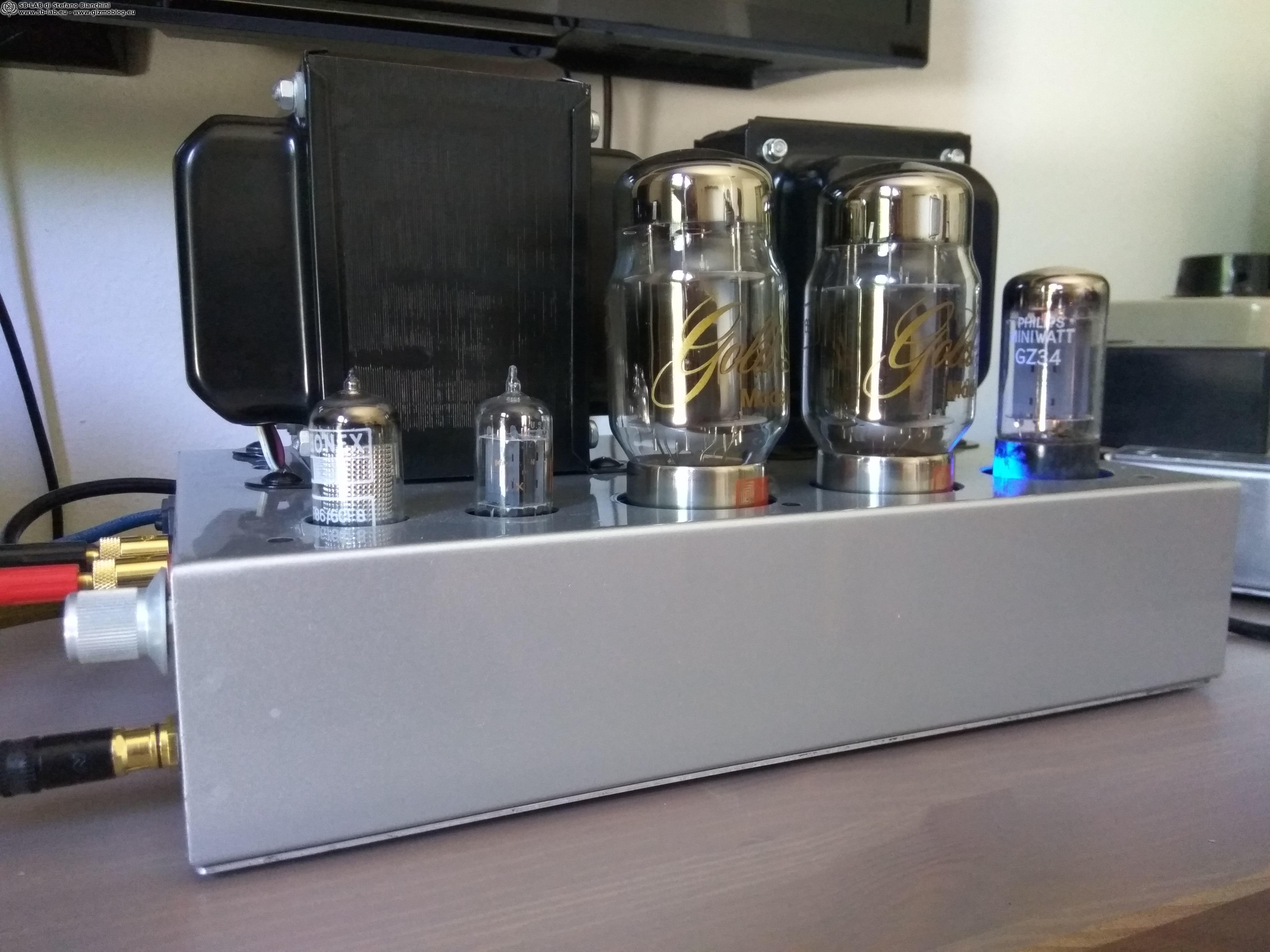
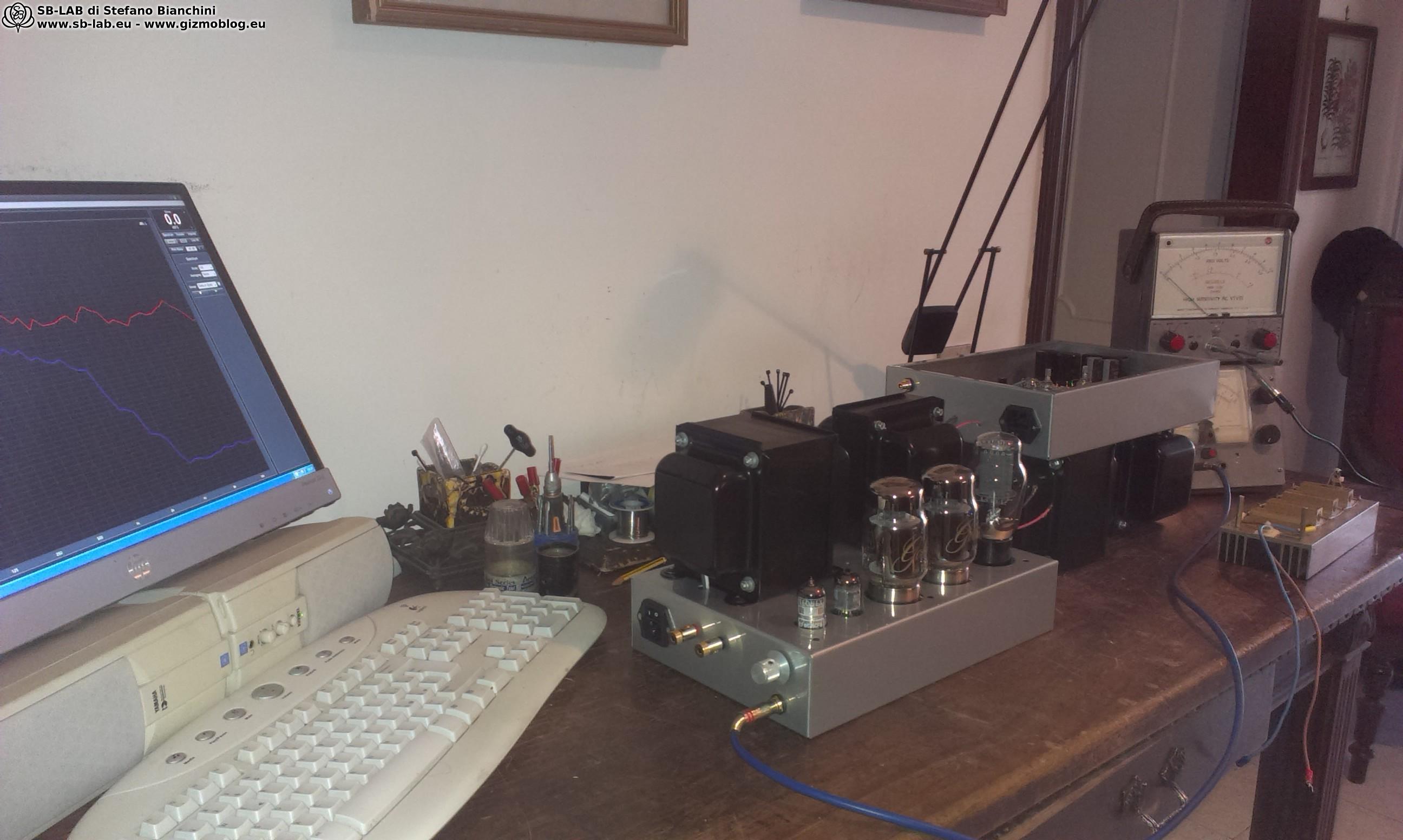
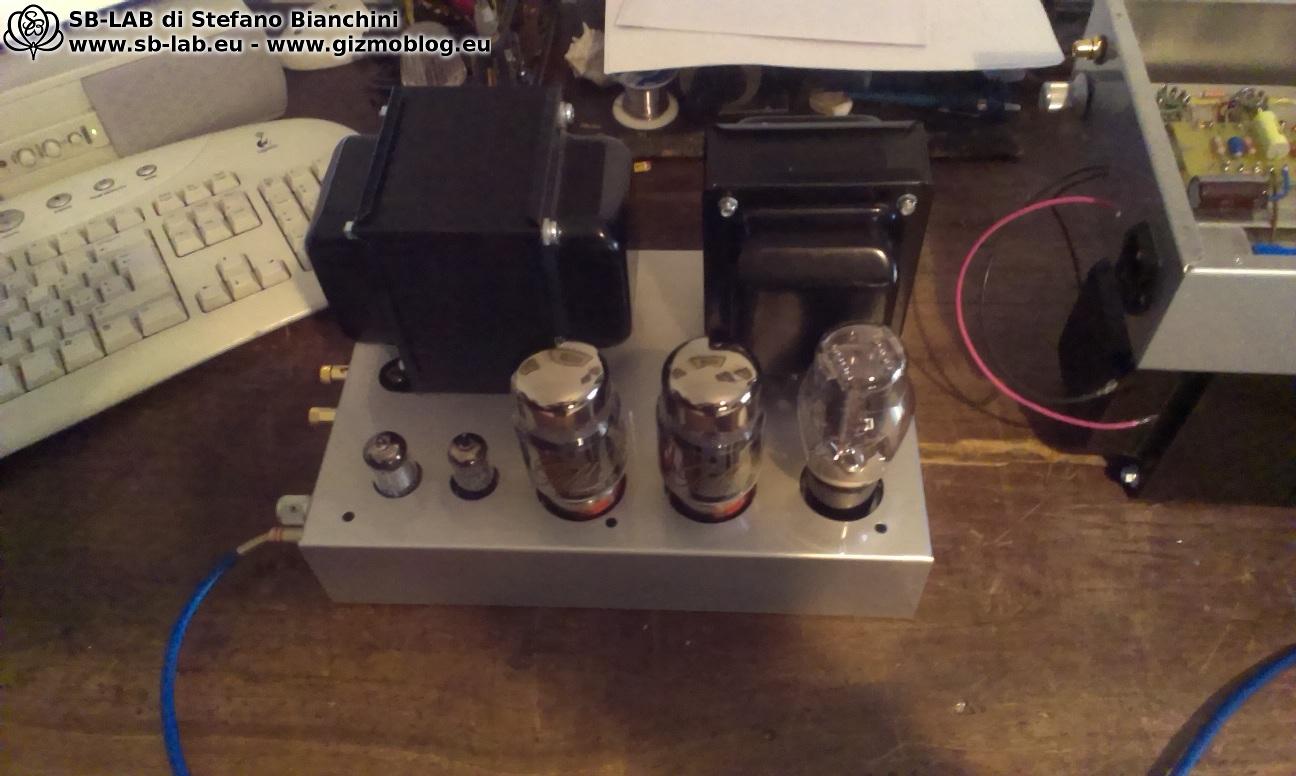
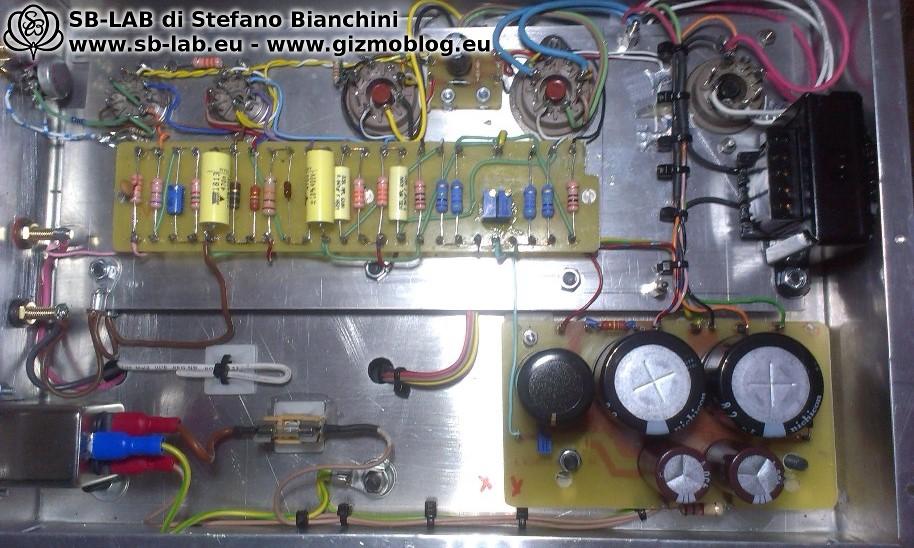
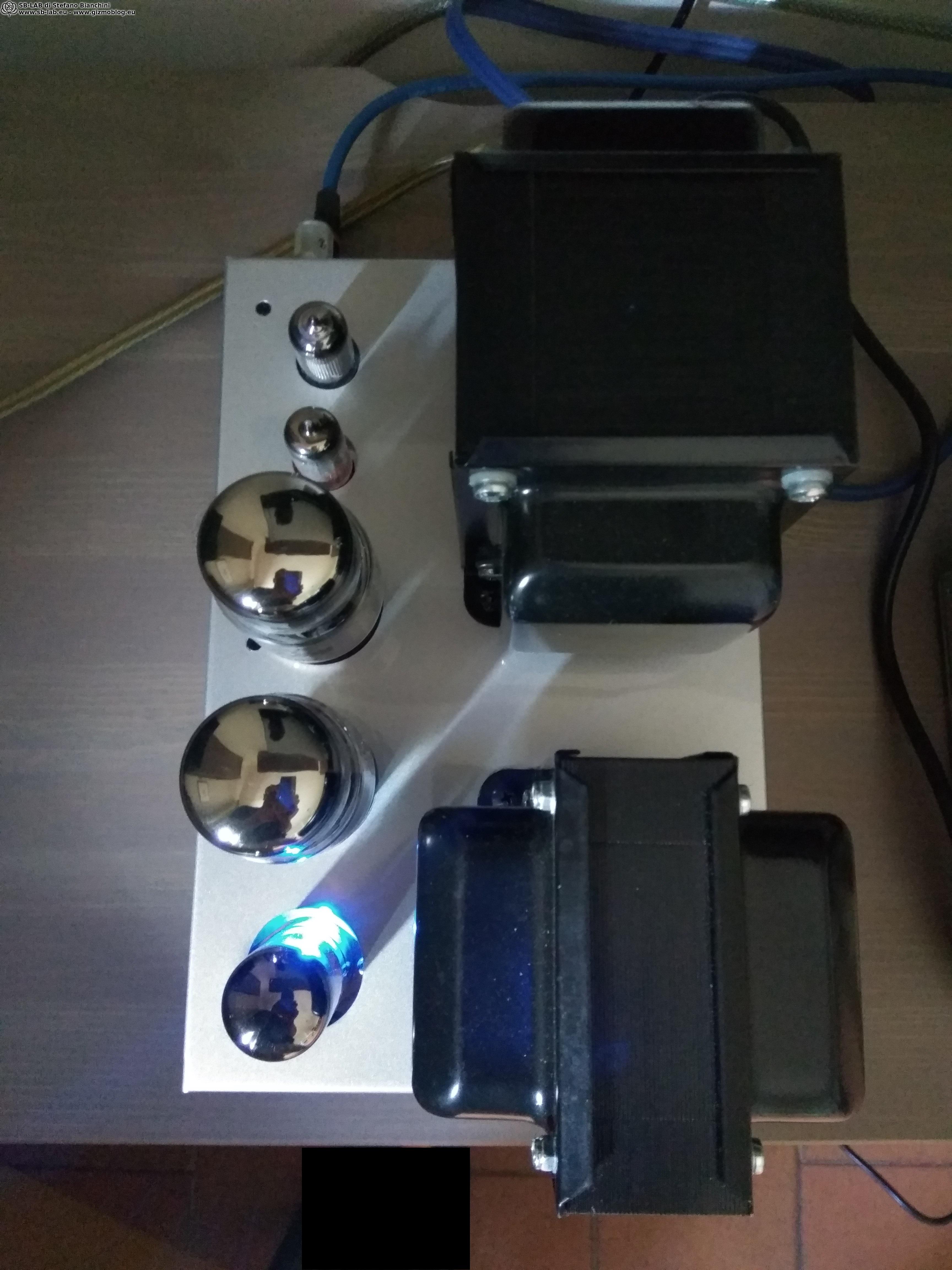
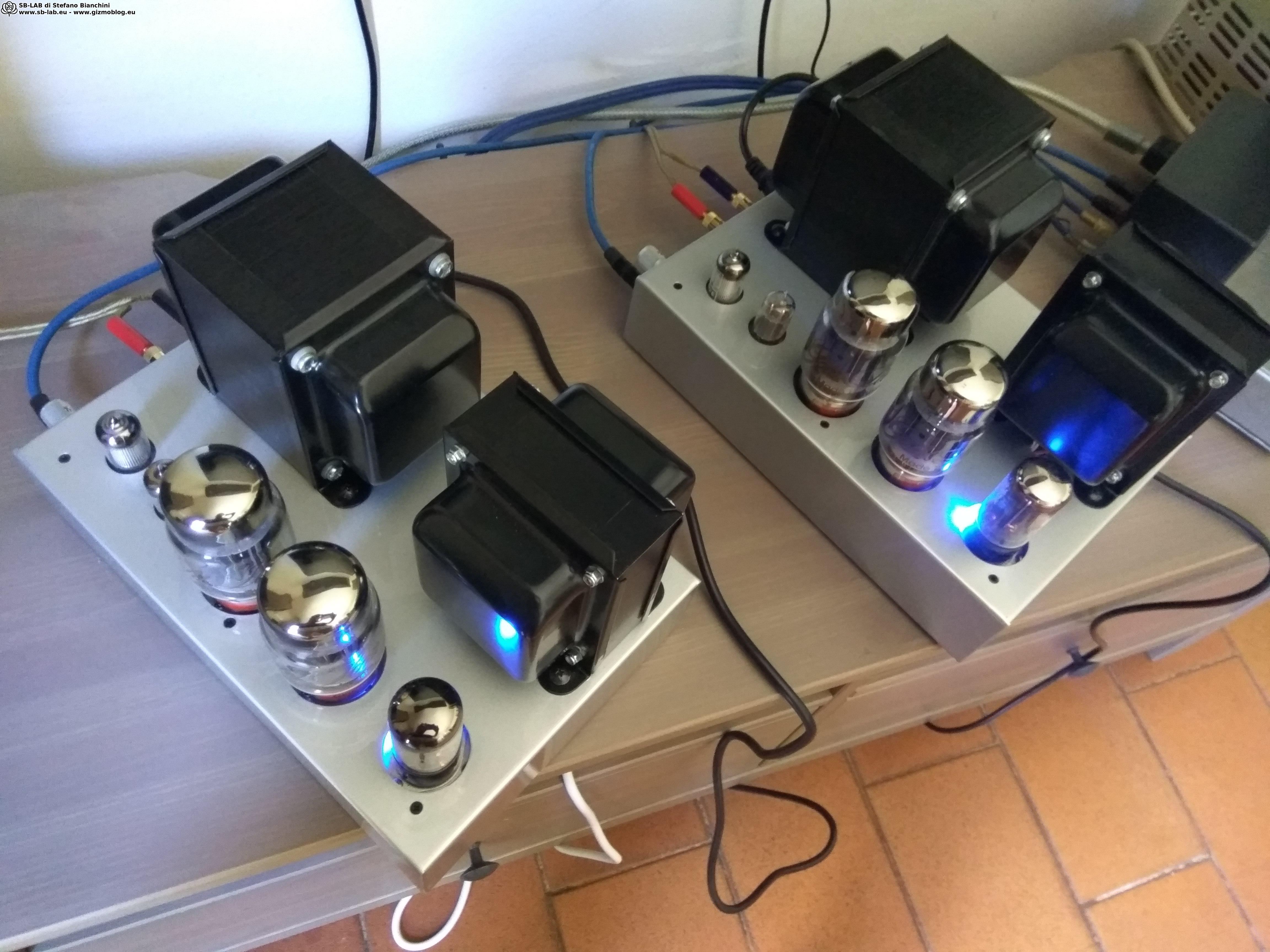
Hi Stefano, as promised I’m sending you the images and some technical data about the two monoblocks built around the transformers I bought from you. The measurements may not be championship-level like those of your wonderful Allbireo, but they are stable units and they really sound good. Could your output transformer have been exploited better? Absolutely yes, but the circuit choices adopted and the tuning carried out later led to this:
The tubes used are: an EF86 at the input, followed, in direct coupling, by a 12AU7 phase splitter. The phase-splitter circuit used is a long tail pair, KT88 output tubes. In the power supply section a 54UG was used initially, then replaced in the final version by a GZ34.
Technical data measured at 50 watt RMS (optimal power):
Power supply 460 Vcc – BIAS 50 mA
Harmonic distortion: 1 kHz – 50 W 0.22%
Harmonic distortion: 60 Hz – 50 W 0.8%
Harmonic distortion: 10 kHz – 50 W 1.2%Bandwidth at 50 W:
+0.5 dB at 20 Hz
-3 dB at 50 kHz
NFB: 15 dBInput sensitivity: 0.5 V 1 kHz
Input impedance: 100 Kohm
Signal-to-noise ratio: 102 dB
Then, in 2020, I receive this email:
Hi Stefano, I am ***, I own two KT88 PP monoblocks built using your output transformers, power transformers and filter chokes. The work was published in the “Readers’ projects” section on your site under the title “Fabrizio’s KT88 monoblocks”.
Getting to the point: at the time, when I sent you the photos and the schematic of the monoblocks, you kindly suggested via email a series of valid and possible modifications to implement on the circuit, to improve the measurements and the sound quality of the amplifiers. Since I don’t consider myself a technician, but I can appreciate (a lot) your technical arguments and your way of thinking about hi-fi, if you are willing to give me instructions I would like to modify the two monoblocks according to your indications.
I could also be satisfied with how they currently sound: very rich, fairly detailed, full of bass and “warm”, even too “warm and thick” for my taste. Since I like things optimized as much as possible and considering there is room for improvement, I would like to apply the modifications you suggested or those you will consider most appropriate.
I have already addressed in the past the topic of the bandwidth of a transformer, but for a long time I have also wanted to tackle the bandwidth of an entire circuit. It is a fairly complex subject, which deserves to be explained with concrete examples and instrument data, so as to make it clearer for readers.
The typical case is when someone takes a schematic found on the internet and builds it using my transformers, or any other transformer different from the one the schematic was designed and tuned for. In these cases, you cannot avoid changing something: a schematic found online must always be adapted at build time, unless you use exactly the same transformers required by the original project.
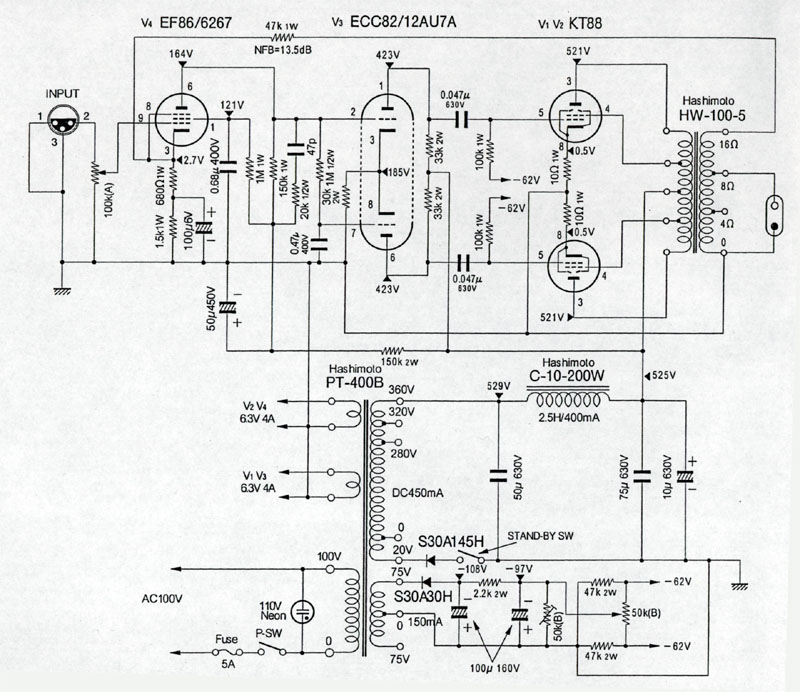
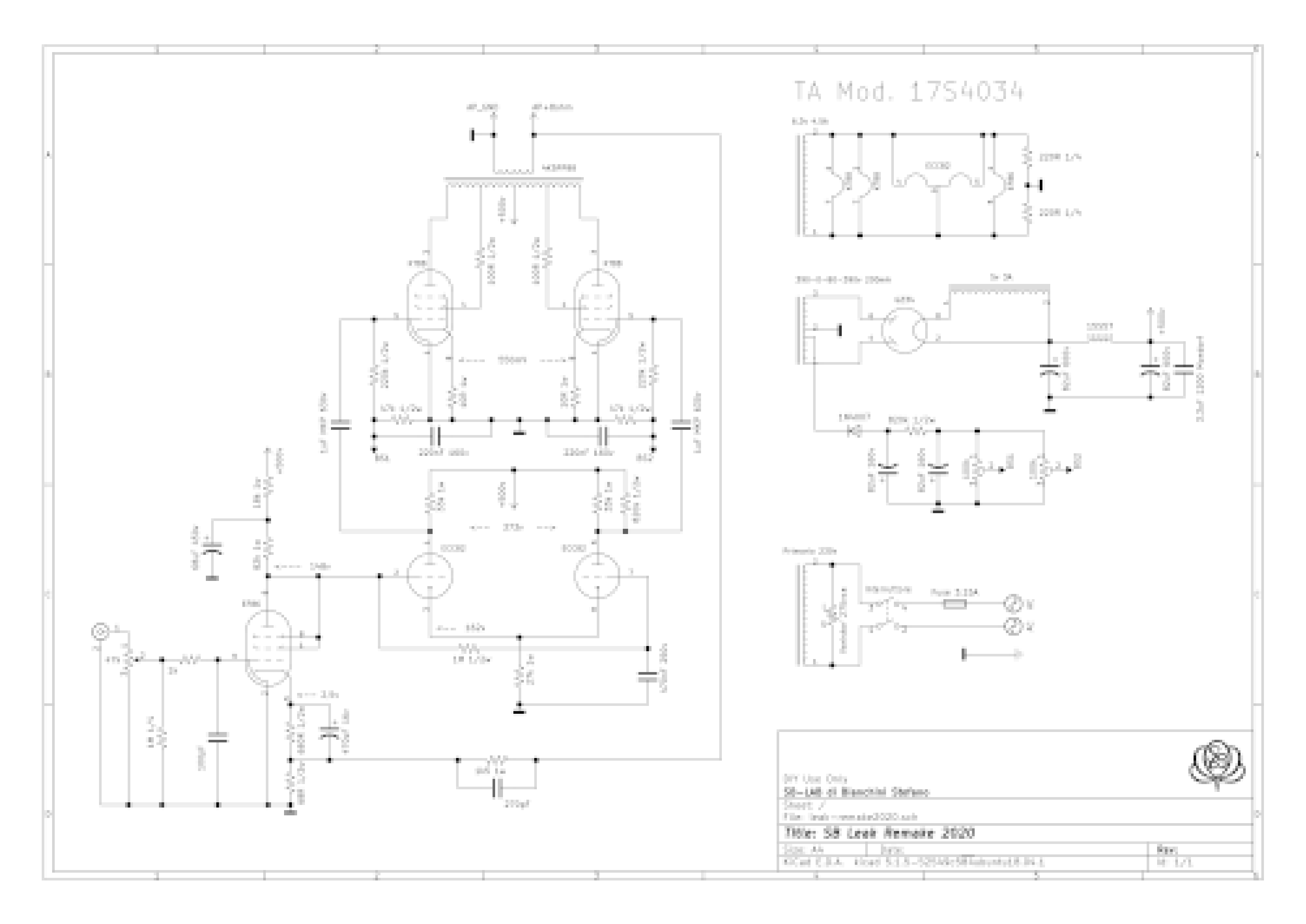
To go deeper into the matter, let’s use Fabrizio’s monoblocks as an example. Below you can find the schematic (which, as it is, I do not recommend copying without real tuning), with the four most problematic points highlighted in red.
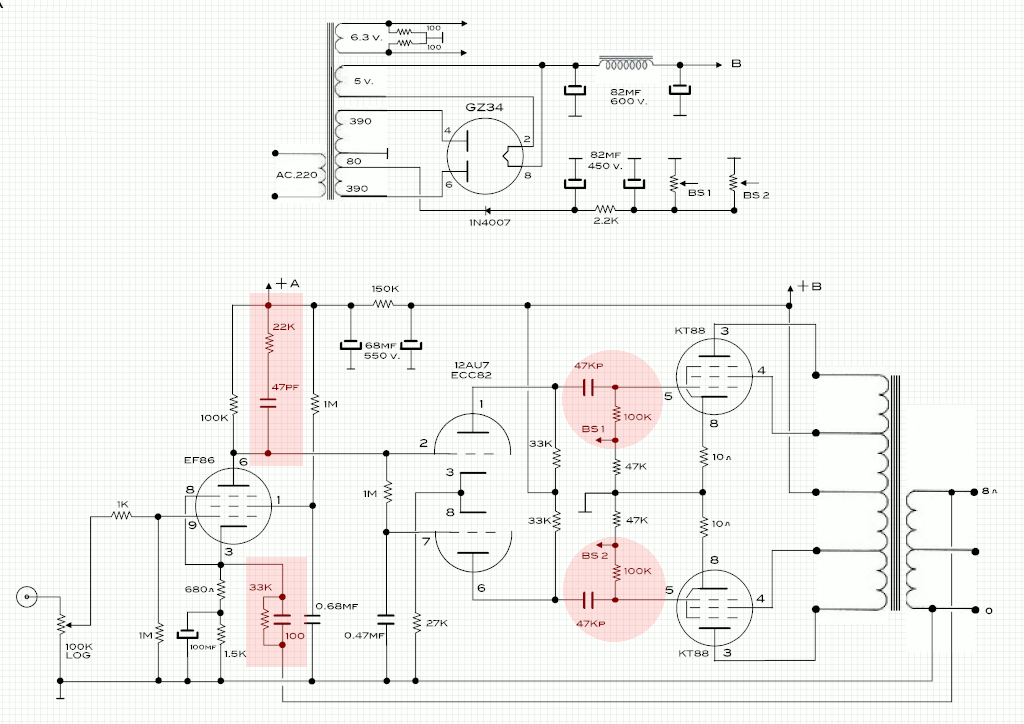
This schematic actually derives in turn from a Hashimoto schematic, whose full article you can find at this address…
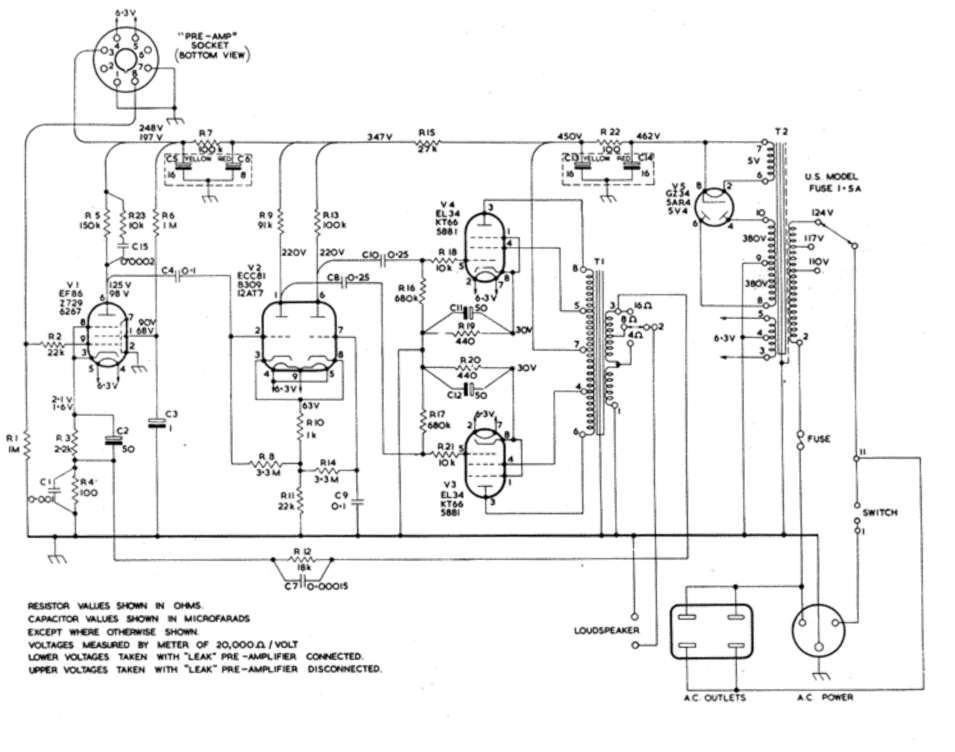
Not even the Hashimoto schematic is truly original: it derives from an even older schematic, dating back to the late 1950s, used in the famous Leak amplifiers. In the image below you can see the schematic of the Leak TL25, from which many similarities emerge. All Leak schematics of that era followed a very similar basic layout: they mainly varied the output tubes and the phase-splitter type, while the EF86 was always present. In short, they were all fairly similar to each other. I cannot say precisely which Leak model Hashimoto took inspiration from, but the historical reference is quite evident.
Let’s now move to the problem Fabrizio ran into. He was looking for a modern sound: lively, bright, airy and clean. He saw my transformers as the key to achieving this goal, but when he built his Leak clone he ended up with a very warm, thick-sounding amplifier, with a typically “1950s” character.
In the DIY world, the belief persists that a single component can determine the final sonic result on its own. So you hear things like “tube X sounds like this”, “tube Y sounds like that”, and the same goes for transformers, capacitors, resistors, and so on…
A line of reasoning that almost borders on magic: as if inserting one element were enough to give the entire amplifier a certain sonic personality. It’s a bit like thinking that by fitting a Ferrari steering wheel to a Panda, it suddenly becomes a supercar. Got the idea?
As always, reality is far more complex than the stereotypes people build in their imagination. The sonic result of an amplifier depends on the whole set of components used and, above all, on how they are made to work together.
Some claim that KT88 have a thick sound and bloated bass, while 300B would be bright, airy and endowed with an immense “soundstage”, and so on with an endless list of clichés.
The truth? I myself have made KT88 (and even cheap TV tubes) sound bright, open and with controlled bass. At the same time, I have listened to many 300B amplifiers that sounded closed-in, limp and completely unlistenable. “Yeah, but there are 300B!”. So what? If the circuit is designed badly and built even worse, it will sound bad anyway, even if you put in two tubes that cost 1,800 euro each.
Coming back to Fabrizio’s project, the main cause of the sonic result he obtained was the adoption of a 1950s schematic used without the proper modifications. In fact, the final sound does not depend only on the tube or the transformer, but on the whole set of components and, above all, on the schematic the amplifier is based on. At this point, let’s take the schematic in question again and analyze together what I consider the main issues…
How did Leak design in 1958? Well, first they drew the theoretical schematic, then they produced the transformers, built the prototype and finally tested it. Many DIY builders are convinced it all ends there: you assemble the first components you happen to have and the job is done (and unfortunately many really do it that way).
In reality, after assembling a prototype, whoever truly knows what they are doing moves on to the tuning phase. And tuning certainly does not mean adding 5,000-euro cables, magic stones, or conical feet strictly in odd numbers.
It means carrying out detailed instrument measurements, analyzing the circuit’s real behavior and, as a consequence, making the necessary schematic changes to optimize performance or correct any defects.
We also have to start from a fact: the Leak output transformer from 1958 was nothing special. I’m sorry for vintage nostalgics, but that’s the reality. At the time they used laminations of lower quality than those used today even for normal power transformers, and there was no interest in pushing toward higher performance.
Vintage transformers were weak both in the low end and in the high end: basically, almost all of them were centered on the midrange. This is because recordings of that era also had little bass and little treble, so manufacturers did not worry about building amplifiers with wide bandwidth. On the contrary, back then bandwidth that was too wide could have become a problem, because it would have highlighted turntable motor rumble on the speakers and various hiss caused by noisy components such as composition resistors, primitive wiring, and so on.
For those who love these old amplifiers, this is not a criticism. If you like that midrangey, vintage sound, that’s perfectly fine. But here we are talking about building, in 2020, a tube amplifier with a modern sound, transparent and detailed. I wanted to make this clear so as not to attract criticism from Leak enthusiasts: these are vintage units with a vintage sound, and it is right to appreciate them for what they are.
Going back to our Leak designer: once the prototype was powered on, I can assume he ran into problems of self-oscillation, parasitic triggering, or pickup of RF noise. To fix it, he inserted a snubber (20 kohm + 47 pF) in parallel with the 100 kohm anode resistor of the EF86 (pink rectangle at the top left). This snubber was intended to suppress a disturbance identified at about 169 kHz. Fabrizio, not having a 20 kohm resistor, used a 22 kohm one. Same thing? No, because 22 kohm with 47 pF cuts at about 154 kHz, so it is not the same at all.
But there is an even more important point: what sense does it make to keep this snubber if neither the output transformer nor the wiring are the original Leak ones? The disturbance that Leak solved might not exist in Fabrizio’s build, or it might appear at different frequencies, which would first have to be identified and then possibly suppressed with the correct resistor and capacitor values.
Here is the first example of an element that cannot simply be copied as-is. In a modern replica, the circuit should initially be built without this snubber, then during tuning you evaluate whether to reintroduce it and with which values, based on real measurements.
Let’s continue by analyzing the pink circles: coupling between the ECC82 driver and the output tubes is done through 47 nF capacitors, with a 100 kohm grid resistor. For those who do not know, this combination forms a high-pass filter with a cutoff frequency of about 33 Hz. At first glance it might seem acceptable, but in reality such a high cutoff introduces phase rotations at low frequencies (as we will see later in the plots). In this case too, Leak probably did not care much, since vintage output transformers often started rolling off much earlier, sometimes around 200 Hz.
Finally, let’s analyze the rectangle at the bottom left: this is the 100 pF capacitor placed in parallel with the 33 kohm resistor in the negative feedback path. This capacitor is mainly used to suppress transformer ringing (visible, for example, in square-wave response), to limit bandwidth when it is excessive, or to reduce possible instability.
Its value is strictly linked to the output transformer used: if you change transformer, you must necessarily recalculate and change the value of this capacitor as well. In fact, in some cases a capacitor that suppresses oscillation in one context could actually cause it with another transformer.
This component is quite common in feedback schematics, but it cannot be considered a “fixed” value: it must always be adapted based on the transformer and, sometimes, even just by changing the wiring layout. For this reason, when assembling a new circuit, this capacitor should initially be omitted and its value defined only after careful testing. Personally, to simplify this phase, I built a very handy dedicated little tool.
In this specific case, Fabrizio used a value of 100 pF, while the Hashimoto schematic did not include anything. So I assume he did some testing anyway. Let’s look at the 1 watt bandwidth plot on a resistive load:
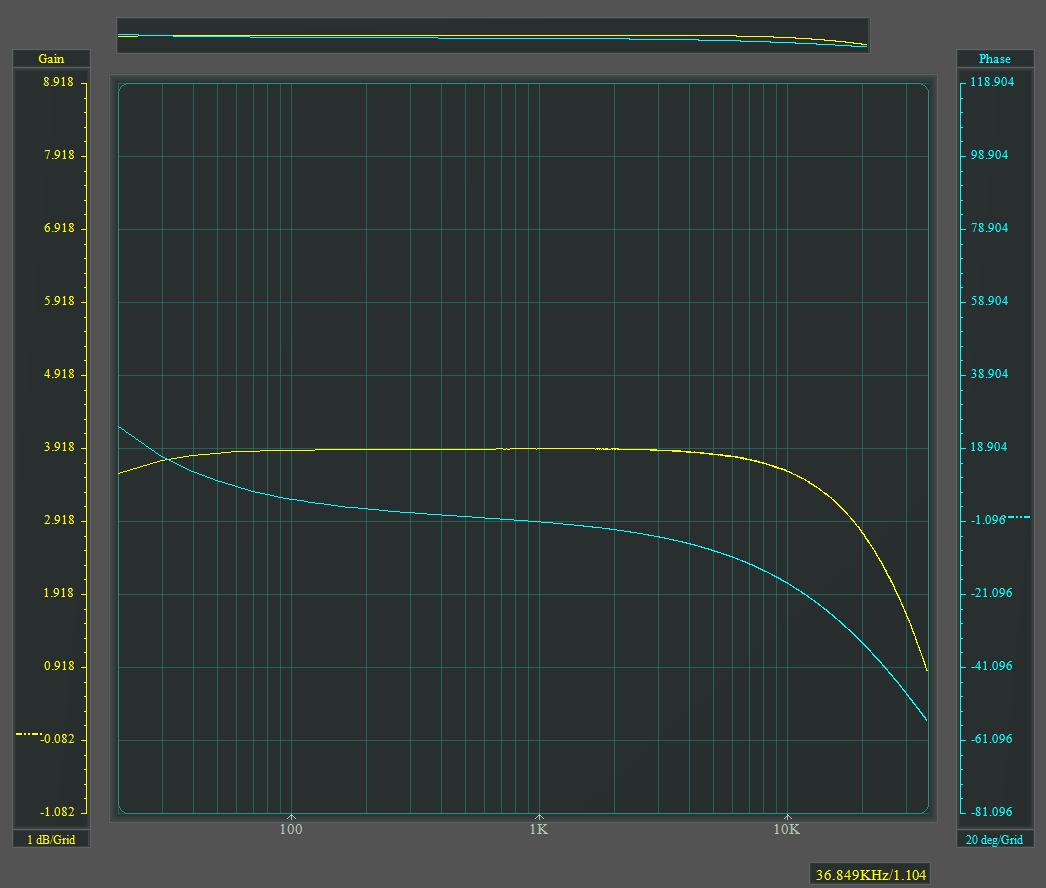
We can observe an attenuation of about -0.4 dB at 20 Hz and -1 dB just before 20 kHz, around 18 to 19 kHz. What matters most to us, however, is the phase behavior (blue line): from 20 Hz to 1 kHz there is a rotation of about 24°, while from 1 kHz to 10 kHz another 36° is added. To make this phenomenon more evident, I use a 10 kHz triangular wave, which makes the effect of phase rotation on the signal clearly visible.
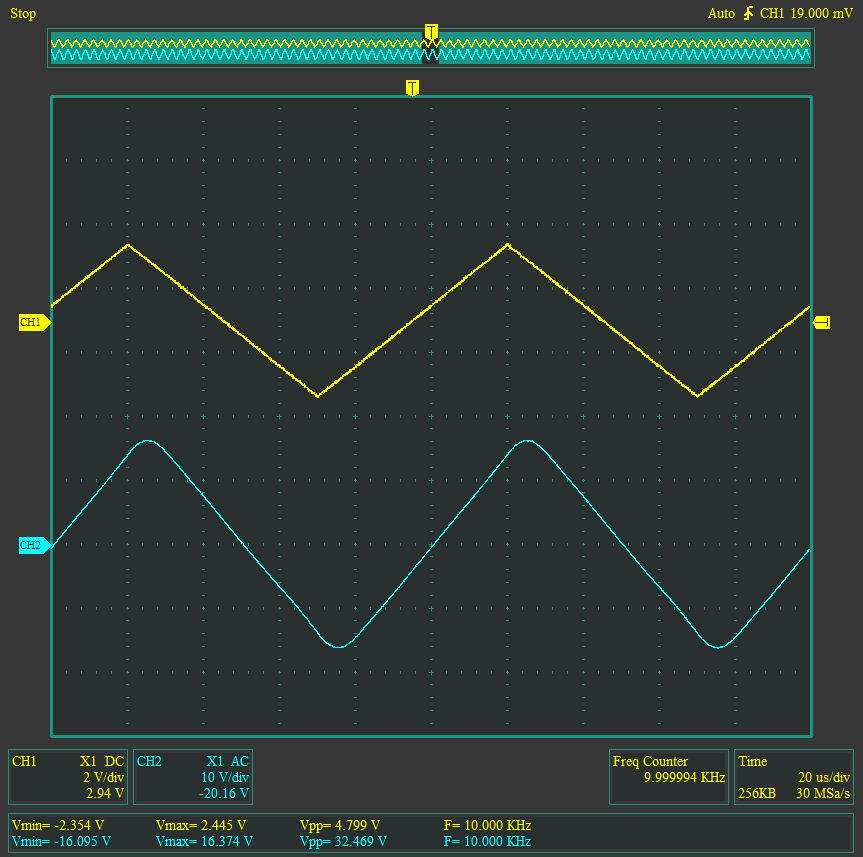
In yellow you can see the generator signal, while in blue you see the amplifier output. It is clear that the output signal is delayed compared to the input, with a noticeable rounding of the tips, a sign of low slew rate due to limited bandwidth. Using a 14 kHz sine wave, chosen because at that point the deformation is particularly obvious to the naked eye, you can see how the waveform is further distorted due to the action of negative feedback.
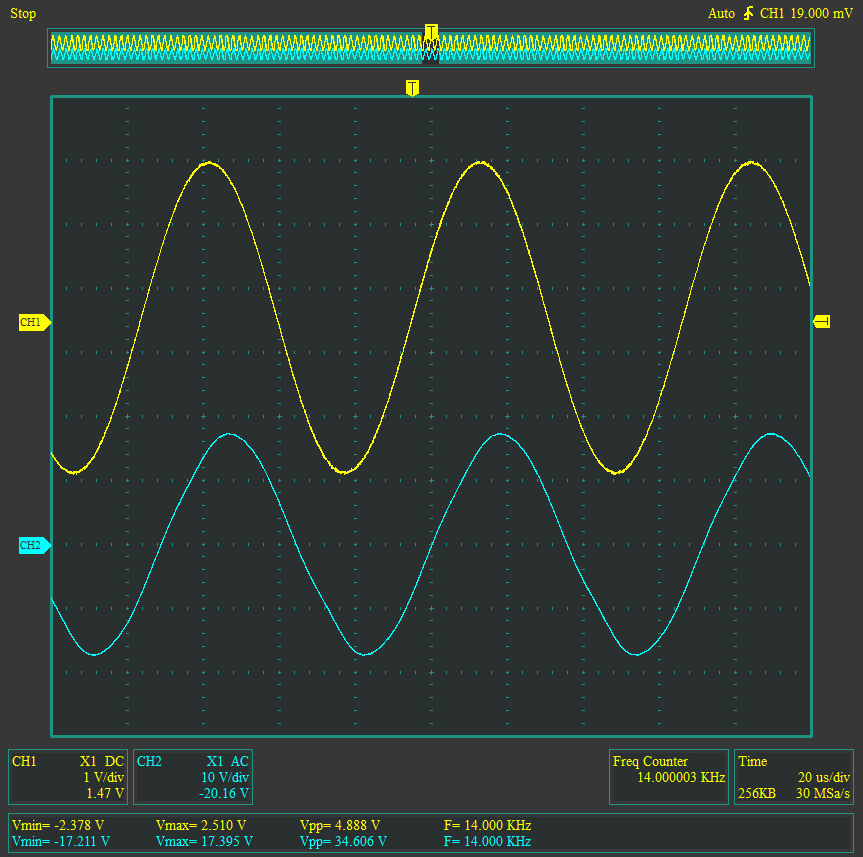
Here too, in yellow we see the generator signal, while in blue we see the amplifier output. Besides being shifted forward, the output signal appears clearly distorted. This distortion is caused by the combination of excessive phase rotation and an equally excessive level of negative feedback.
I want to underline once again, for anyone reading this article, that I am a firm supporter of negative feedback, but only if used correctly. On this topic, I invite you to follow this link to read the article I dedicated to it.
Negative feedback should be used, but under the right conditions. You cannot expect that simply applying it will make any circuit “sound good”, even the worst-designed one. On the contrary, a circuit must be studied to perform at its best already without feedback. Only then can you introduce the right amount of feedback to get the desired improvements, such as proper damping.
As I also wrote in the other article, the worst enemy of negative feedback is phase rotation (and, obviously, the ignorance of those who do not know how to use it or do not want to learn). In the sine-wave example above, you can clearly see how the combination phase rotation plus negative feedback can create disasters. Visually, the distortion is already noticeable at 14 kHz, but when listening the negative consequences are perceived much earlier. Now let’s look at the spectral analysis at 1 kHz, 1 watt:
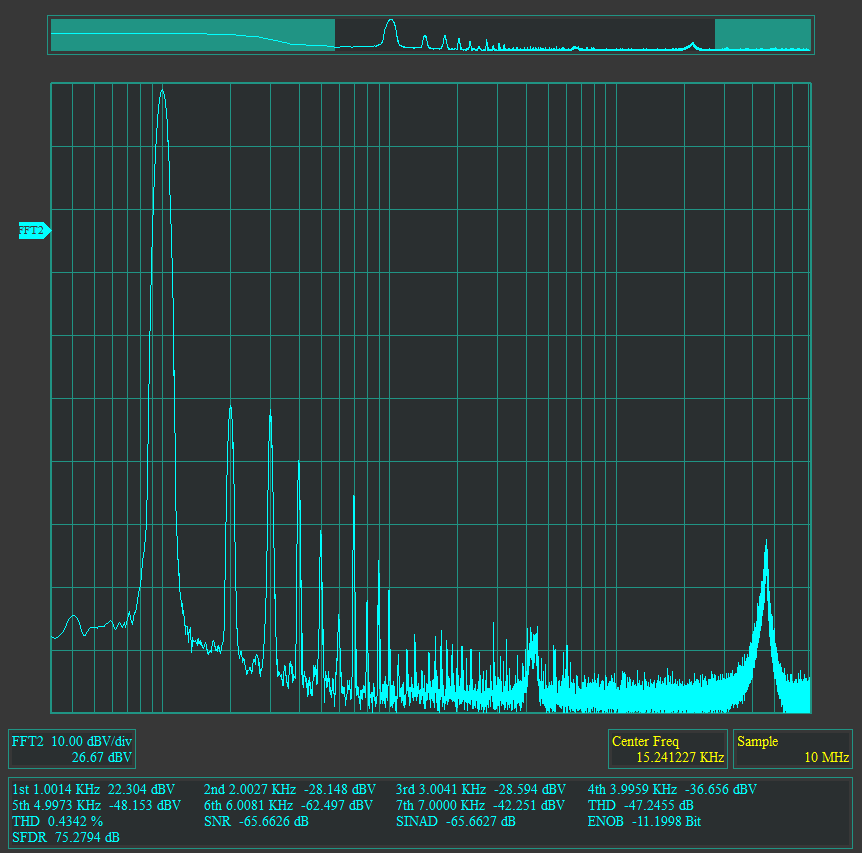
THD: 0.43%, with various “dirty” components at high frequencies, measured at 1 watt and 1 kHz. Continuing, the main problem with this amplifier is that they wanted to use a wide-bandwidth output transformer, but paired it with a circuit that is not able to exploit it correctly. Hashimoto itself, for example, advertises transformers with bandwidth up to 100 kHz on its website, but then suggests using them in archaic, non-updated schematics. At that point you might as well wind any transformer using the cheapest laminations available and with no care in the winding. And yet, fixing a schematic like this to adapt it to a more modern sound is not impossible at all. So why not do it?
The main problem with the Leak schematic, besides the snubber, is precisely the use of the EF86. First of all, the screen grid of this tube should be fed with a more stable voltage, not simply through a 1 Mohm resistor. Also, the EF86 has a high output impedance, and I am not convinced by the “slowdown” effect that can result from interaction with the parasitic capacitances of the wiring (even though, I must admit, I have done it myself in some situations in the past).
I also do not particularly like using negative feedback (NFB) on the cathode of a pentode. When you modulate the cathode of a pentode, you do not only subtract signal from the control grid (G1), you also introduce an influence linked to the screen grid (G2).
Remember that anode current depends not only on the voltage ratio between cathode and G1, but also on the cathode to G2 ratio. The idea behind NFB is to subtract the signal with respect to G1, but by modulating the cathode you also move the reference with respect to G2, something that, personally, I prefer to avoid (maybe it is my “fixation”, but that’s how it is).
Moreover, a stage with such a high gain was not necessary, because it would force heavy use of negative feedback to avoid having an overly sensitive input. My philosophy is to apply only the minimum NFB necessary to achieve the desired damping. In any case, it is interesting to see the bandwidth plot of the EF86 stage used in the original Hashimoto schematic, isolated from the rest of the circuit:
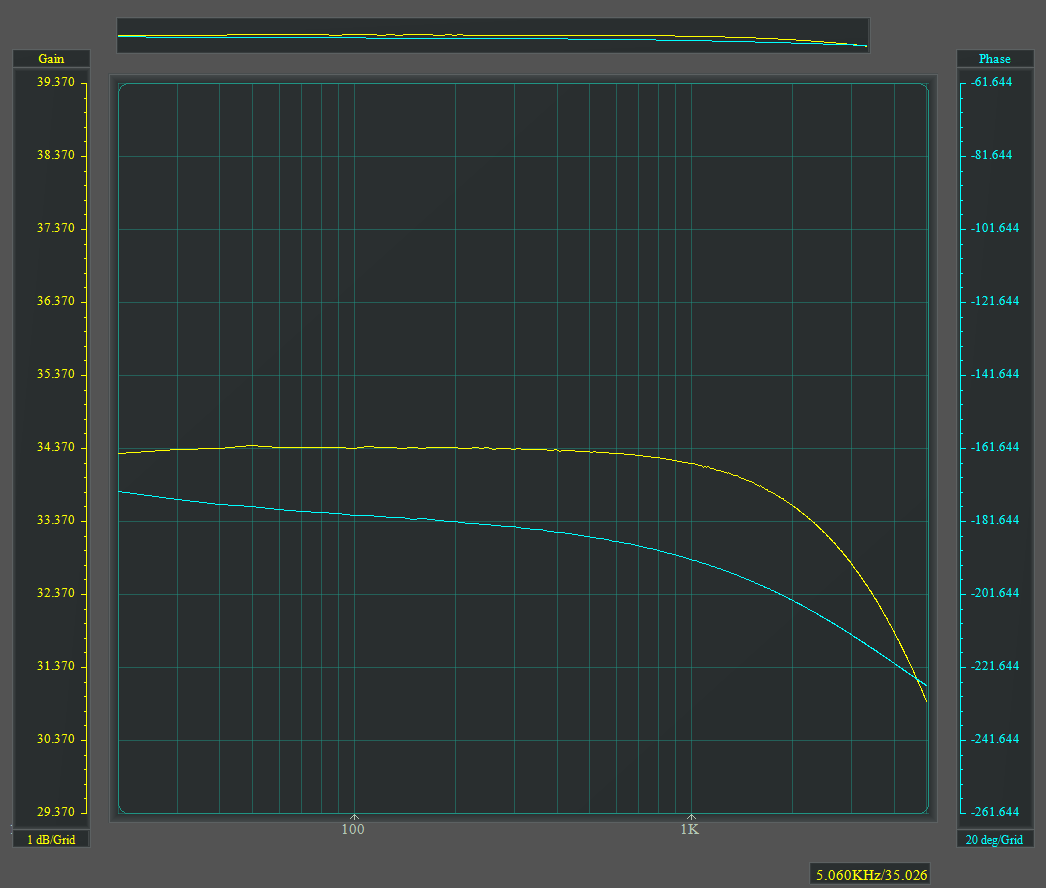
The natural bandwidth (without feedback) of the EF86 stage, complete with snubber, shows a -3 dB roll-off already at 4.5 kHz, with a phase rotation of 40° at 3 kHz. A result like this makes this stage completely inadequate. If it behaves like this on its own, it means that the whole bandwidth of the original Hashimoto amplifier (even though limited to 18 kHz) is achieved “by force” thanks to heavy use of negative feedback.
On the contrary, my philosophy is that a circuit should work well on its own, already without feedback. Negative feedback should be only a final aid to optimize damping and refine the response, not the main means to “correct” an unbalanced circuit.
The simplest and most effective modification is to intervene on the input stage. The EF86, connected as a triode, offers excellent characteristics. Below I report the curves for the triode configuration, where both the screen grid (G2) and the suppressor grid (G3) are connected to the anode.
Many people do not know it, but when G3 is not internally connected to the cathode and has a dedicated pin, it is preferable to connect it to the anode as well when using the tube as a triode. This measure reduces noise and lowers the internal resistance of the resulting triode. In fact, analyzing the curves with G3 connected to the cathode shows a slight reduction in slope, while connecting it to the anode yields better, more stable behavior.
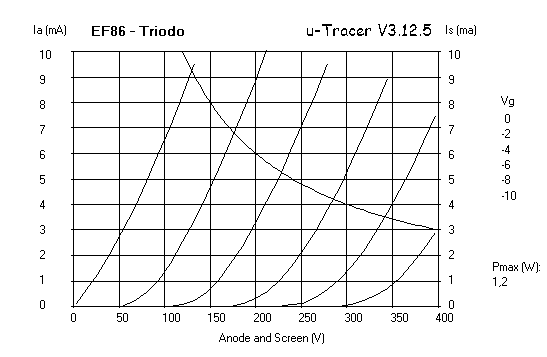
I therefore replaced all the resistors around the EF86, including the supply resistor, the negative feedback (NFB) resistor and the related compensation capacitor. I changed the value of one of the two ECC82 load resistors to correctly balance the phase splitter, which otherwise would have been slightly unbalanced if two identical resistors had been used. I also varied the values of the coupling capacitors between ECC82 and KT88, as well as the grid resistors of the output tubes.
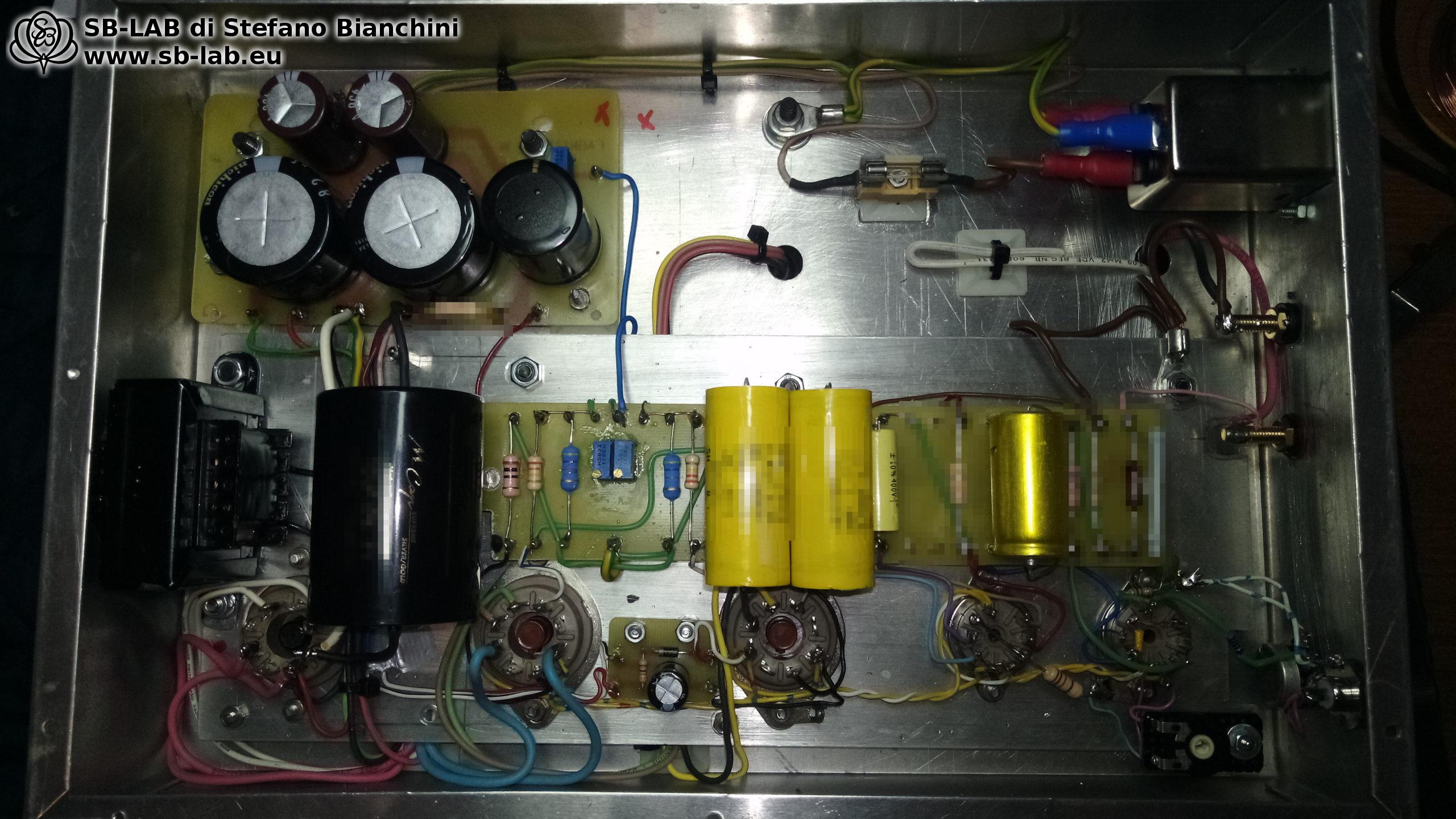
I suggest using a high-quality electrolytic with generous capacitance for bypassing the cathode of the EF86 connected as a triode, possibly paired in parallel with a small polypropylene capacitor to further improve the response (Fabrizio, instead, had used a cheap, low-performance capacitor).
For coupling between ECC82 and KT88, I recommend excellent polypropylene capacitors, such as Mundorf Supreme Classic. In the modified version built by Fabrizio, some excellent Arcotronics NOS were installed. Finally, it is important to bypass the second electrolytic of the CLC cell of the anode power supply with a good-quality polypropylene: this measure helps achieve a clearer, more defined sound. A simple cheap electrolytic, in fact, tends to penalize the high frequencies due to its high ESR and dissipation factor (D). In Fabrizio’s build you can see a Mundorf Supreme Classic used for exactly this purpose.
Here is the premium schematic below. Please note that to view it, you must purchase the set of SB-LAB transformers.
Fabrizio’s modified build:
Let’s now see how much the circuit has improved, at least from an instrumental point of view, compared to the original configuration. Let’s start with bandwidth analysis:
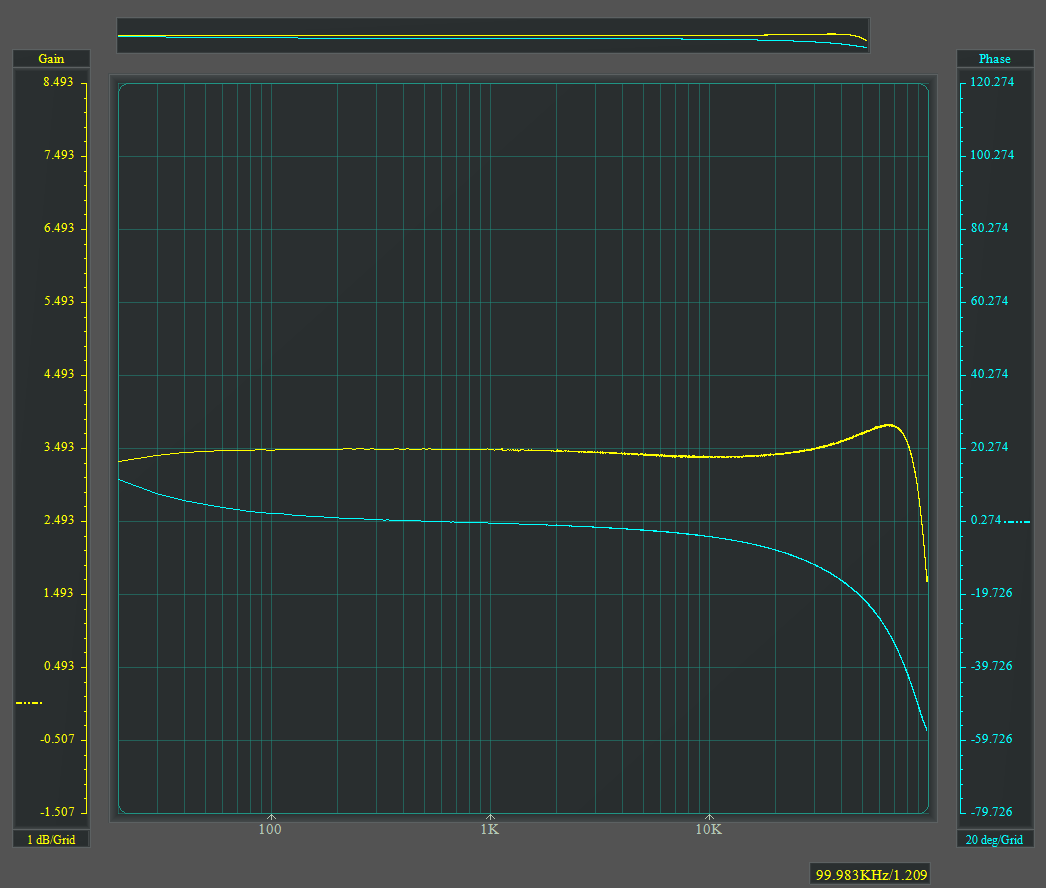
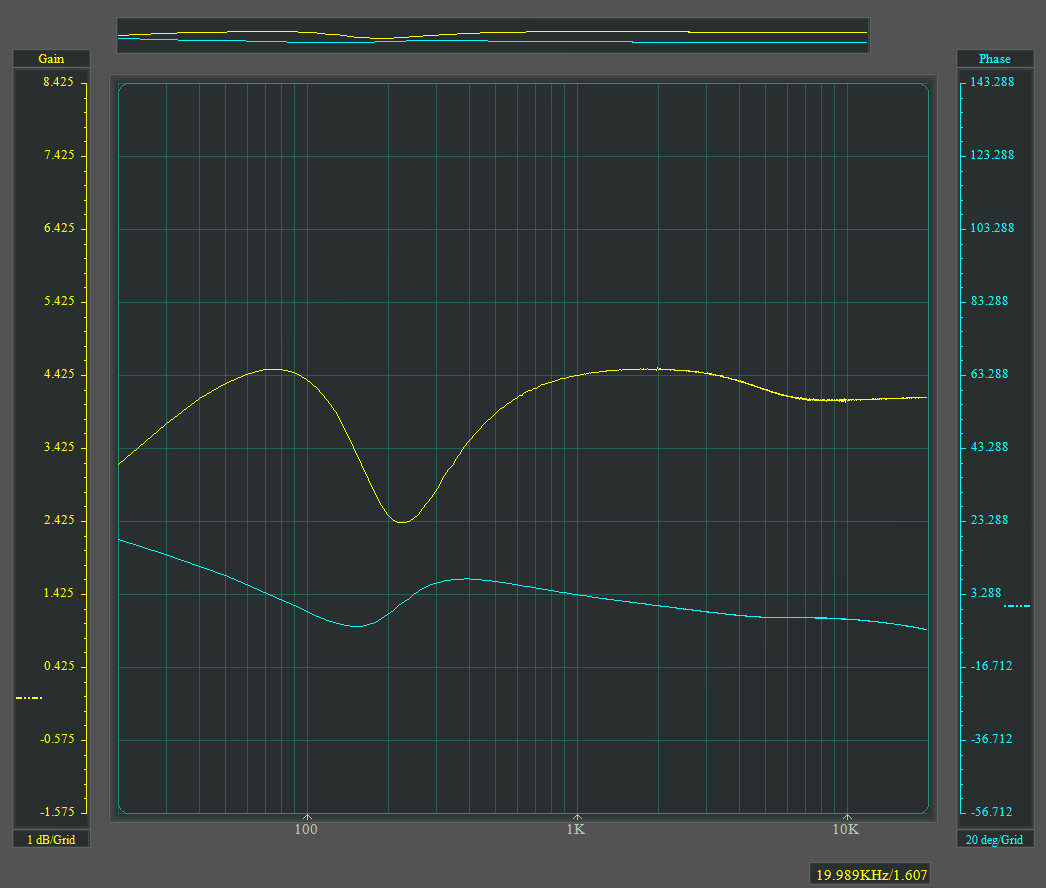
-0.2 dB at 20 Hz and -1 dB at 90 kHz. I did not want to suppress the slight “bump” at 65 kHz, since it is well outside the audible range: I preferred to preserve maximum circuit speed. Besides the frequency response, the phase response has also improved drastically: only 12° of rotation between 20 Hz and 1 kHz, and just 8° between 1 kHz and 20 kHz. Compared to the original configuration, the difference is enormous. Finally the SB-LAB transformer is fully exploited! Now let’s also look at the 10 kHz triangular waveform…
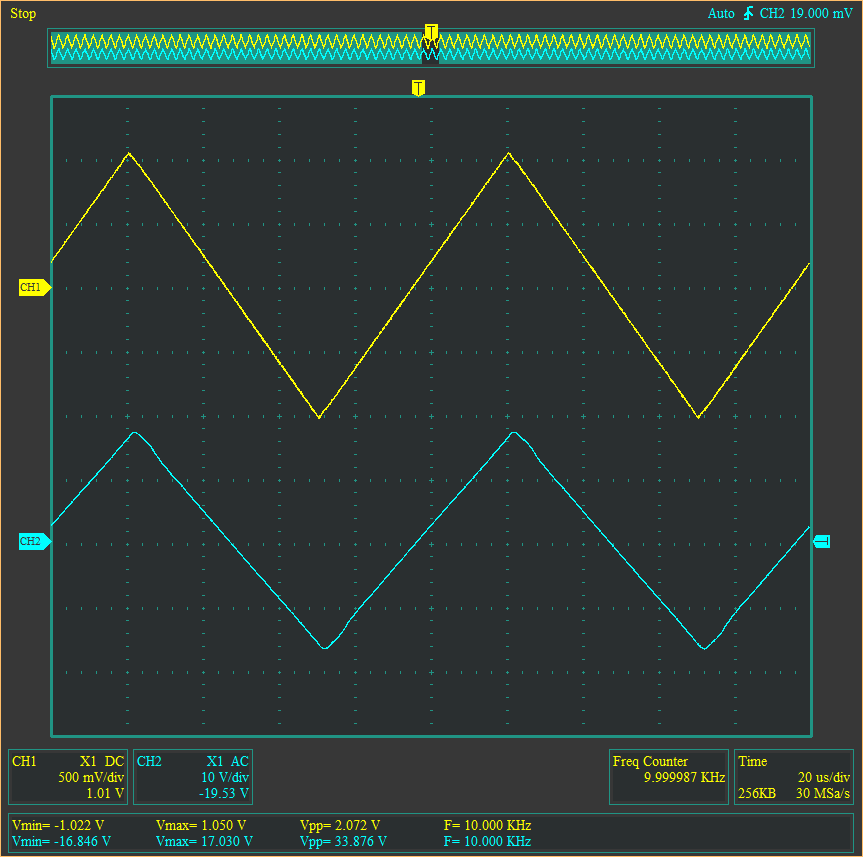
The phase shift is minimal, and the tips are much less rounded than in the original version. And the 14 kHz sine wave? Let’s see it right away!
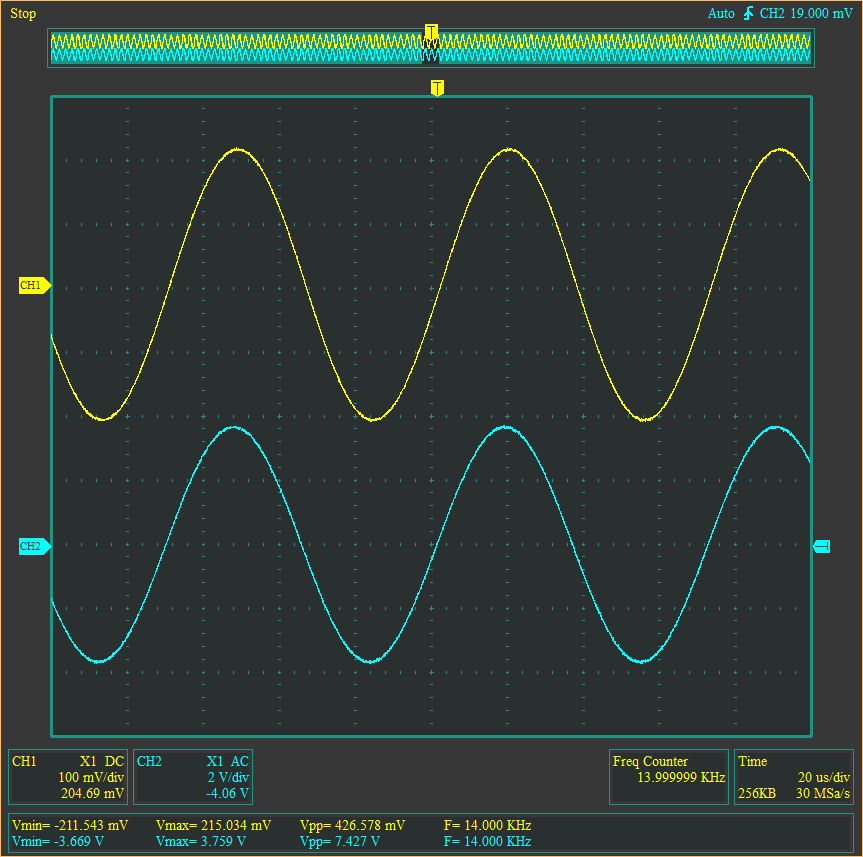
This one, at last, looks like a real sine wave, with no deformation or “dents”! And the spectral analysis at 1 watt? Let’s see how it behaves compared to the initial situation…
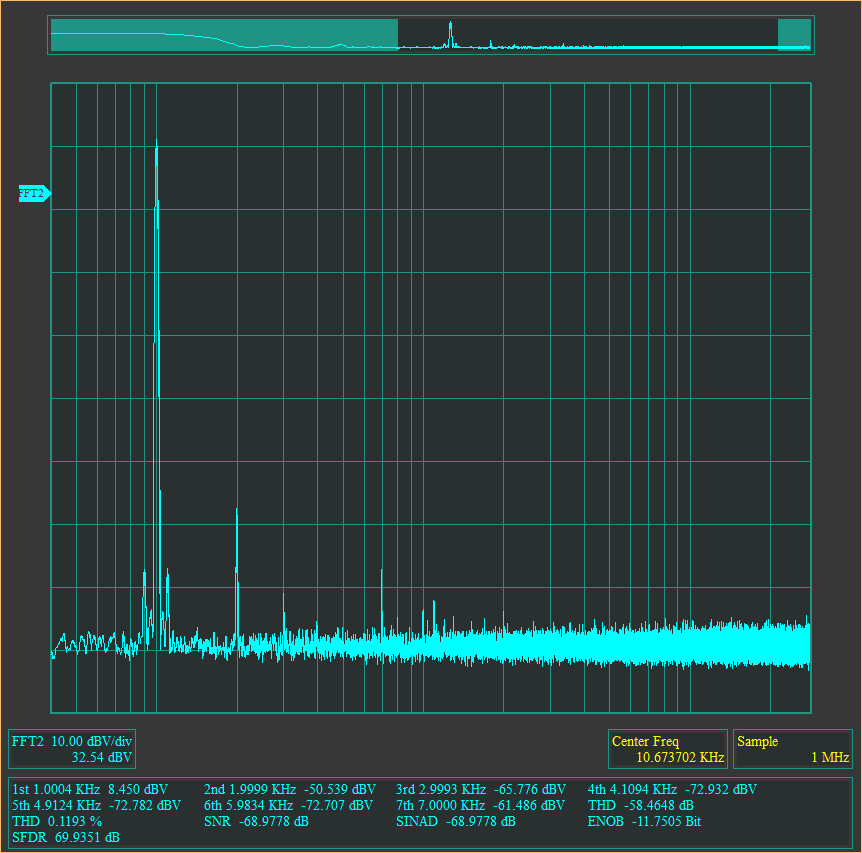
THD at 0.11%. Many people, passing through my pages, claim that it is impossible to achieve distortion figures this low with a tube amplifier. And yet yes, it is absolutely true (and with less negative feedback than the original schematic). I can do it because my transformers are not like the ones you commonly find on the market. These graphs are not faked, they are the result of real and verifiable measurements! Now let’s also look at the spectral analysis at 25 watt:
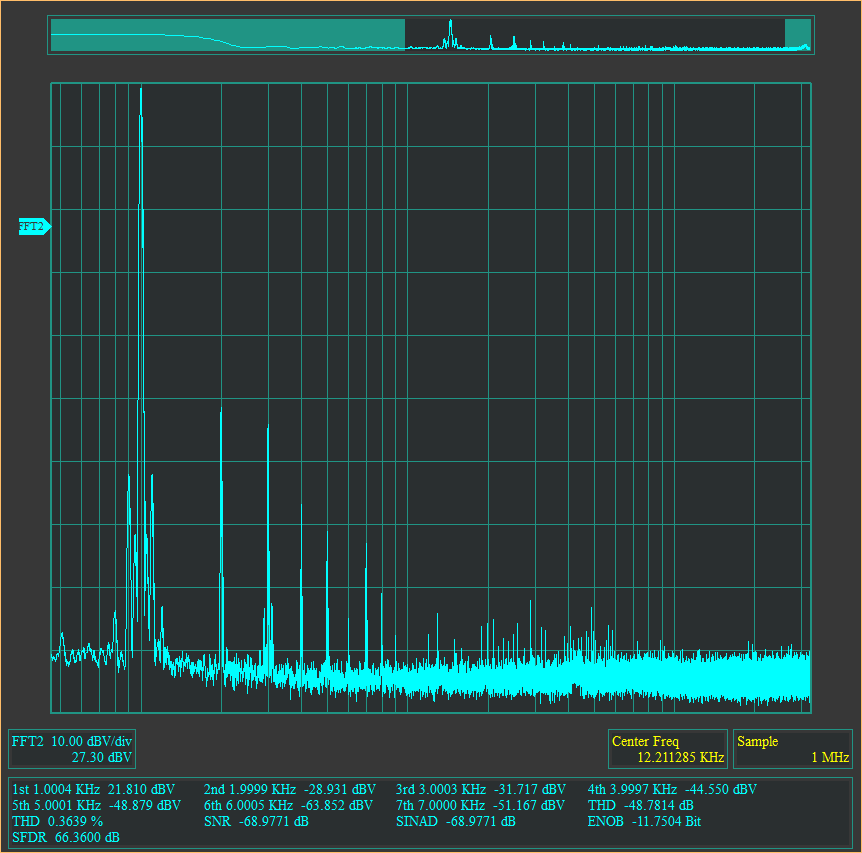
The revised schematic, at 25 watt, shows even lower distortion than the old version measured at 1 watt! Finally, let’s take a look at the bandwidth plot on a reactive load: the damping factor of the circuit is about 5.7, an absolutely excellent value. Power went from 50 watt to as much as 65 watt RMS before clipping.
The complete set to build two monoblocks with my optimized schematic includes: 2 output transformers, 2 power transformers, 2 filter chokes and the schematic in a readable, updated version. If you are interested, contact me through this form to receive an updated quote.
The conclusion of this article is clear: when you take a schematic found on the internet, whether it is from a vintage unit or designed by someone else, and you decide to build it, you must always focus on tuning. It is essential to modify these schematics to adapt them to the real situation and, above all, to the transformers you have chosen to use. This applies in particular to vintage schematics: if you do not do it, you risk getting results below expectations and, in some cases, not fully exploiting the potential of your transformers (especially if they are high quality), even ending up judging them unfairly.
I was fortunate that Fabrizio, in this case, was smart and contacted me to understand what was going on. I myself tend to speak openly about the performance of my transformers, but if they are installed in a non-optimized circuit, the results cannot live up to the declared specifications.
Unfortunately, other people, less careful, in the same situation could come to the wrong conclusion: thinking that my transformers, even though more expensive and heavier, do not perform better than some 50-euro stuff, when in reality the problem is the circuit.
This article shows that my transformers offer performance comparable to Japanese products of the very highest level. Much of the cheap “stuff” you find online succeeds only because, due to lack of knowledge, many people are not able to appreciate the real quality of better products.
If you have high-end transformers on your hands, you also need to be able to exploit them properly. For this reason, I remain always available to help my customers get the most out of their builds.
Fabrizio’s comment (originally at the end of the article in the comments area):
Finally the sound I like! Prolonging listening, lingering with a smile on my face enjoying the quality of the reproduced sound, and having the confirmation that I spent my money well by investing in a set of SB-LAB audio transformers is what has been happening to me these days. There is no need to bluff yourself to realize you are in front of a high-quality piece of audio equipment, because its circuit is high quality.
Thank you Stefano.
I had two quartets of selected KT88 Mullard and G.E.C. tubes in a drawer, and some EF86 Telefunken silver shield NOS, so I decided to replace the already excellent EF86 Teonex (Watford Valves) with the Telefunken, and the recently produced Russian Genalex Gold Lion with the G.E.C. quartet from 1960, first one set and then the other, while I kept the 12AU7 RCA clear top phase splitters (my favorite ecc82) and the Philips Miniwatt GZ34 (Mullard) rectifiers.
I had never tried these swaps before but yes, given how good the modified amplifiers are, I felt it was worth doing these tests, also driven by some curiosity.
Anyone reading might expect me to now write that an improvement was immediately noticeable by fitting these renowned and expensive tubes on the new circuit. Well, sorry to disappoint anyone, but it’s not like that.
The amplifiers sounded tremendously good before with the Russian tubes and they continue to sound amazingly good even with the KT88 G.E.C.
No audible change that can be considered an improvement, and this is clear confirmation that a premium tube cannot, by itself, improve an excellent circuit by much, just as it cannot, by itself, change the sonic fate of a poorly conceived circuit.
In the case of the amplifiers in question, instead, we can truly “only” (as if that were a small thing!) notice the changes in sound that are inevitably induced by the intrinsic characteristics (materials used, production process)
of two tubes from different production. In practice it becomes only a matter of preference, of pure taste. All of this, provided that at least good-quality parts are used, of course.
Then you might notice the tart timbre (“tarty” the English would say) of the Russian Genalex and perhaps prefer it to the suave timbre of the 1960 G.E.C.
These amplifiers, which I am proud to own, sound controlled, dry, very defined, dynamic and powerful, with an unusually balanced timbre, better than the best I have happened to own
and/or listen to (Accuphase, MacIntosh, Quad).
The upper midrange is beautifully rendered, very powerful, penetrating. The highs literally shake your soul (it’s a physical experience), without breaking it, without any emphasis of annoying sibilants. The bass is present and controlled, perfectly damped. The soundstage is rock-solid and three-dimensional, steady and sharply defined.
Take another look at the measurements of these units… gentlemen, this man deserves the respect and consideration of us true tube and hi-fi enthusiasts.
A tip: take advantage of it.